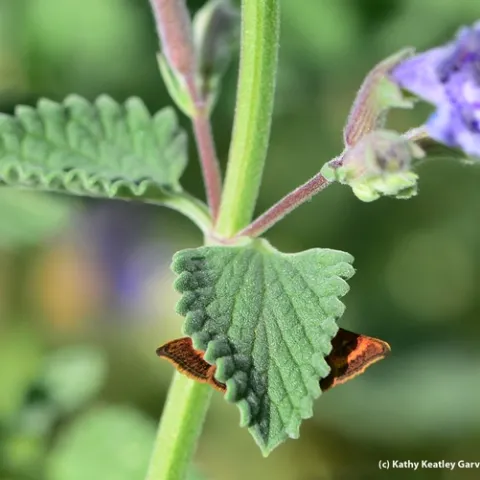
if you're growing plants in the mint family, Lamiaceae--you know, the plants with the square stalks and opposite leaves--you may see a very tiny reddish-orange visitor. It's so tiny that it's smaller than the leaf of a catmint (Nepeta). Its wing span is probably about 10 to 15 millimeters.
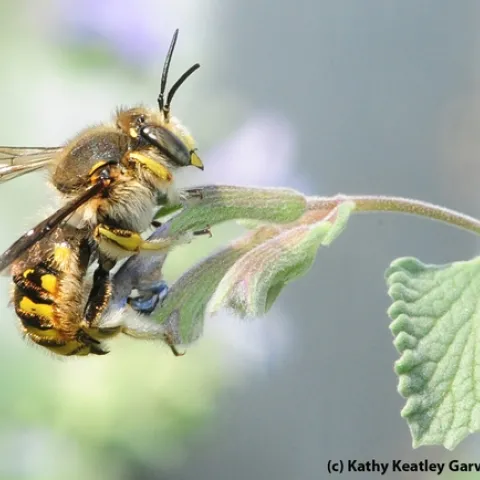
If you've ever glimpsed a European wool carder bee foraging in your yard, chances are that's all you saw--a glimpse. The wool carder bees (Anthidium manicatum), so named because the females collect or "card" plant fuzz for their nests, move quickly.
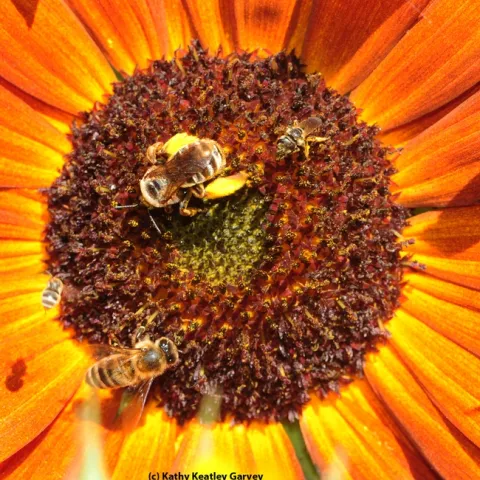
You often see a single solitary bee on a sunflower. Perhaps it's a sunflower bee (Svastra) or a honey bee (Apis mellifera). But four on one? Sharing a sunflower? Yes.
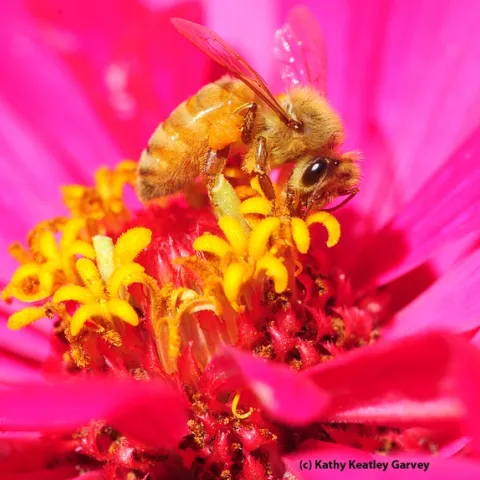
Now that's Italian! The Italian honey bee (below) nectaring on a zinnia at the University of California, Davis, is striking for two reasons: she's as gold as starthistle honey in the sunlight and she's a very young forager.
Seattle will be the place to "bee" on Oct. 4-7. That's where the Western Apicultural Society (WAS) will hold its annual meeting--and this year it's in conjunction with the Washington State Beekeepers' Association.