UC ANR is committed to providing an accessible and inclusive web experience for all users. If you encounter an accessibility barrier on this or need content in an alternative or remediated accessible format, please contact anraccessibility@ucanr.edu.
Hap-bee Thanksgiving! If you're having cranberries, squash, pumpkins, carrots, cucumbers (and pickles) onions, grapefruit, oranges, apples, pears, cherries, blueberries, sunflowers and almonds, you can thank the honey bee.
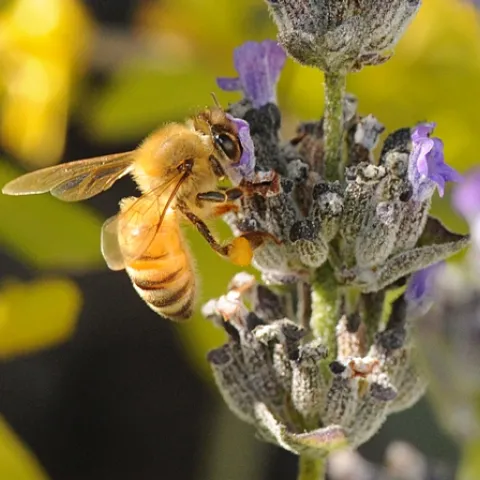
I slipped into the back yard today to see how many honey bees were nectaring the lavender, one of the few plants still blooming. A few here. A few there. That's when I saw her. A bee the color of pure gold. And she was carrying a load of pollen that was equally pure gold.
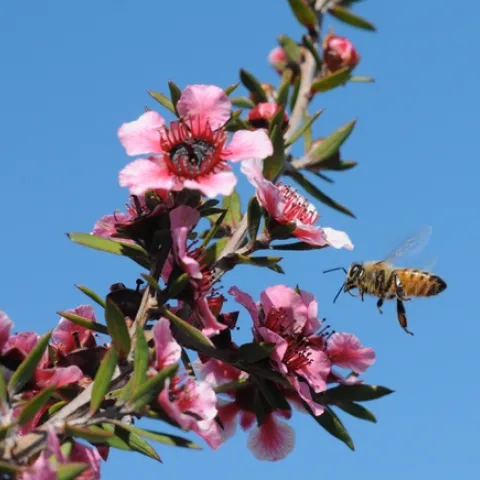
In a way, it's "tea for two." The New Zealand tea tree, Leptospermum scoparium, aka "manuka," "tea tree," and "Leptospermum," is a favorite of the light brown apple moth AND honey bees. We captured images of bees on Leptospermum scoparium keatleyi recently in Sausalito.
Picture this. A light rainstorm strikes the garden, pummeling and shredding some of the blossoms. As the rain lets up, a honey bee buzzes into a rock purslane blossom for a sweet shot of nectar. She is not alone. If you look closely, you'll see three green aphids on an unopened blossom next to her.
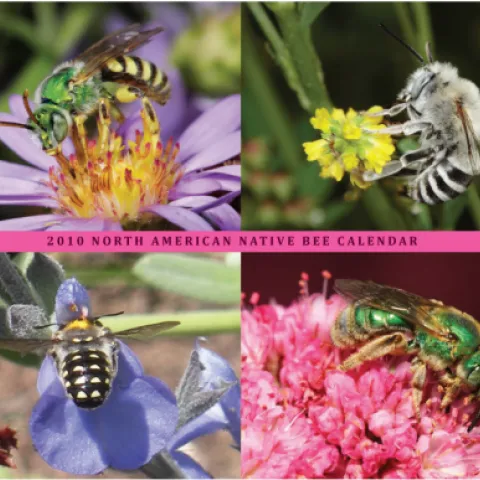
Humans aren't the only calendar pin-up models. Think native bees. Think the 2010 Native Bees Calendar. The Xerces Society and the Great Sunflower Project have joined forces to produce a calendar showcasing 12 commonly found native bees.