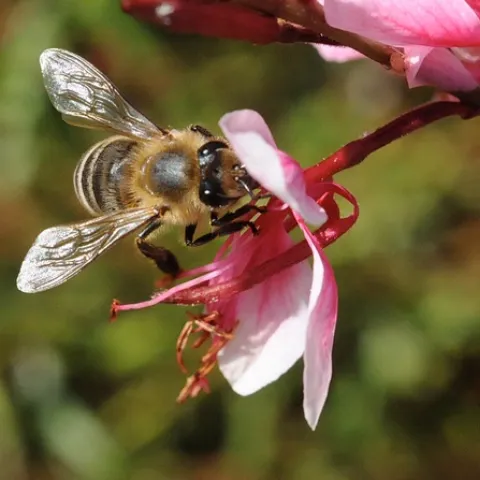
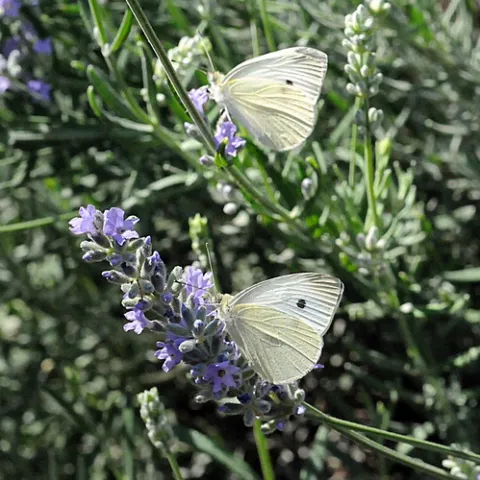
A bee on a ball. When it flowers, the button-willow (Cephalanthus occidentalis), also known as willow, buttonbush, honey ball, and button ball (oh, that's so close to butter ball!) attracts honey bees and butterflies like you wouldn't believe.
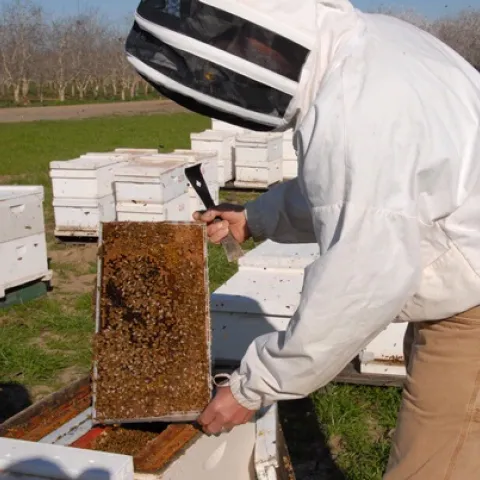
If you were a queen bee, you'd be laying about 1500 to 2000 eggs today. It's your busy season. "She's an egg-laying machine," said bee breeder-geneticist Susan Cobey of the Harry H. Laidlaw Jr. Honey Bee Research Facility at UC Davis. "And she's the mother of all the bees in the hive.
"Omigosh, what's that? A gray hairstreak?" If it's in your hair, you consult a mirror, your favorite salon, or just ignore it. If you're an entomologist or a lepidopterist, a gray hairstreak is delightful.
Build it and they will come. Baseball's Field of Dreams? No, a bee nesting block. Think "bee condo." It's an artificial nesting site made of wood and drilled with different-sized holes and depths to accommodate the diversity of native pollinators. Often the bee block is nailed to a fence post.
We've all heard of the cuckoo clock. And most of us have heard of the cuckoo bird (Cuculus canorus), which lays its eggs in the nest of birds of other species. But the cuckoo bee? Yes, there is a cuckoo bee. The female lays her eggs in the nests of other solitary nesting bees. They resemble wasps.