
Have you ever wondered how queen bumblebees survive winter? Many queen bumble bees living in temperate climates spend the winter in underground nests and remain buried in a hibernation-like state called diapause. During diapause, the quiescent queen’s metabolism slows; in common eastern bumblebee queens, it commonly slows by more than 95%.
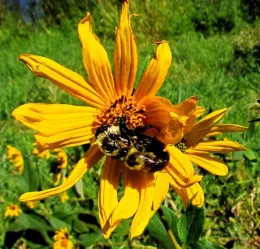
Most colony-living, eusocial bumble bee queens live for a year, with the colony’s founding queen dying and her daughter queens dispersing and mating in late summer or autumn. After mating, the newly fertile queens prepare to overwinter, seeking an appropriate nesting site, often in an underground burrow dug by another animal.
Most research on diapause among bumble bee queens is done by studying them in cold, dry environments, like a laboratory refrigerator. Until recently, no one had investigated what happens to queens when their nest sites flood.
It seems an obvious problem now that I’ve read about it, but even though we live in a temperate rainforest and I’m inordinately fond of bumble bees, I’d never considered it. Nor did it originally occur to the scientist, Sabrina Rondeau, who was studying bees in her lab in Ontario. She happened upon the problem when the queen bumble bees she was studying inadvertently got wet. In fact, the queens were submerged.
Rondeau was doing her PhD research on pesticides and bumble bees. To induce diapause, Rondeau put the queens in soil-filled test tubes in a laboratory fridge to mimic frigid winter conditions. She was exploring the interactions of diapause, cold stress and pesticide exposure. Some days later she found that some of the tubes were filled with water due to condensation in the fridge. To her surprise, the queens were alive.
.jpg)
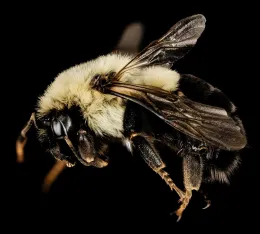
Rondeau followed up on this observation by conducting a study with 143 common eastern bumble bee queens (Bombus impatiens). In this first study, the queens were placed in soil-filled tubes, refrigerated for a week to induce diapause and then flooded with tap water. In the fridge, diapausing queen bees and their tubes were either held underwater or allowed to bob on the surface for different time periods (8 hours, 24 hours or 7 days). 89.5% of the queens survived and there was no difference in survival between treatments.
How did the queens do it? In their next study, Rondeau and her colleagues set up special chambers to measure respiration, gas exchange and metabolic rate and placed soil-filled tubes with submerged diapausing common eastern bumble bee queens into the chambers.
Rondeau and her colleagues found that the queen bees were able to breathe underwater, the instruments in the chambers showed that oxygen was being consumed and carbon dioxide produced. Even though the amount of oxygen consumed was small, the queens were able to survive because they lowered their metabolic rate by an astonishing 99%. They also shifted to anaerobic metabolism, a form of energy production and consumption that does not require oxygen.
The paper concludes that “this study demonstrates that diapausing bumble bee queens can survive week-long submersion by entering a state of profound metabolic depression, supported by aquatic respiration and anaerobic metabolism, which together make them resilient to flooding.”
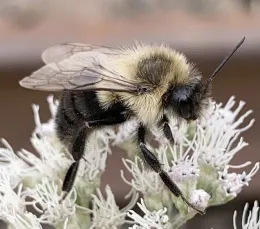

I’m relieved to know that bumble bees can survive underwater, but how do these queens breathe? Snorkels? Diving bells? Let’s hope Dr. Rondeau and her colleagues will be searching for answers to that question next.
Resources:
Darveau C, Rondeau S, and S Rojas 2026 Diapausing bumble bee queens avoid drowning by using underwater respiration, anaerobic metabolism and profound metabolic depression
Rondeau, S and NE Raine 2024 Unveiling the submerged secrets: bumblebee queens' resilience to flooding
Stokstad, E. 2026 How bumble bees survive days underwater without drowning
Visscher PK, Vetter RS, Orth R. 1994 Benthic bees? Emergence phenology of Calliopsis pugionis (Hymenoptera: Andrenidae) at a seasonally flooded site.
Koch J, Strange J, and P Williams 2012 Bumble Bees of the Western United States US Forest Service & Pollinator Partnership
Xerces Society: Bumble Bees: Nesting and Overwintering
USDA Natural Resources Conservation Service: Bumble Bee Conservation