
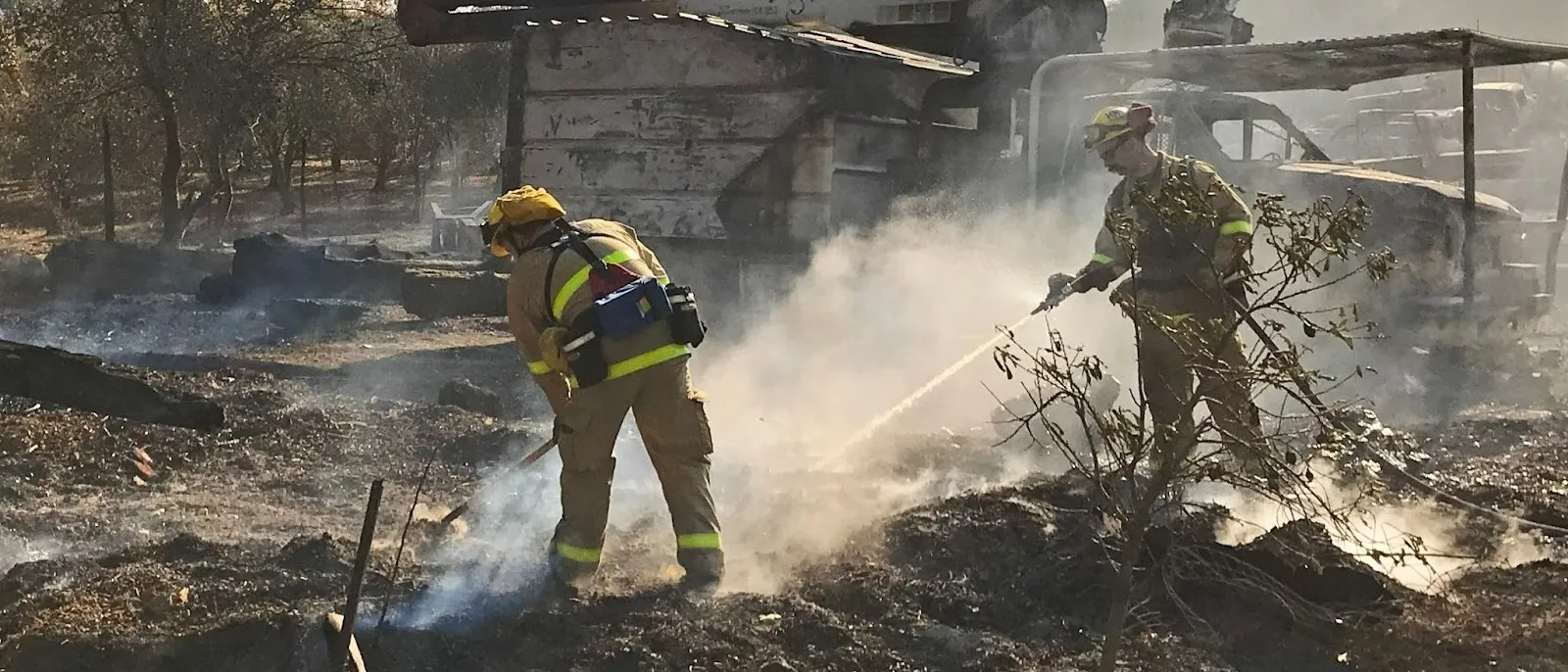
Firefighters on the 2019 Kincade Fire in northern California. Photo by Faith Kearns
By Faith Kearns
The 2017 Tubbs Fire in Santa Rosa, California is memorable for many reasons, including the almost unbelievable way this wildland fire pushed into neighborhoods and leapt across Highway 101. It is also the moment when many of us first saw how wildfire can directly damage community water infrastructure and supplies.
The day the fire started, I was at a workshop nearby. As I left in the evening, the winds picked up in that way that feels deeply familiar to almost everyone in California. I wrote about the limits of our control shortly afterward, trying to make sense of what we were watching unfold.
It wasn’t until several weeks later that news about water system impacts began to circulate. I remember feeling genuinely shocked. I had been working on wildfire and water issues for years, yet this was a first for me. I wrote again, still trying to make sense of the issues. The concern stayed with me long enough that I sought funding to study the problem while with the California Institute for Water Resources, leading to a 2021 report with Greg Pierce and Peter Roquemore that captured our early understanding of this emerging threat.
Then came the January 2025 Los Angeles fires, which once again transformed how we think about the wildfire–water connection. Issues that once seemed separate—fire response on one hand, water management on the other—were now colliding in ways that tested the limits of both systems simultaneously. From Los Angeles to the Grand Canyon, the fires of the past several years have made one thing unmistakably clear: we must re-examine what is realistically possible for fire departments and water systems to do.
Colleagues and I are undertaking some of that work through a series of workshops and the Water + Fire Research and Policy Coordination Network, supported by UCLA’s Sustainable LA Grand Challenge in collaboration with UCLA's Luskin Center for Innovation and UC Ag and Natural Resources. The initiative brings together researchers, policymakers, and on-the-ground practitioners to share solutions that can strengthen preparedness and recovery at the water–fire intersection.
One question we hear repeatedly is: what can actually be done?
The example that follows, stemming from a recent workshop, offers a tangible example of what collaboration on wildfire and water issues looks like in practice. In Lake County, a rural community north of the Bay Area, Fire Chief Willie Sapeta and local water leaders are designing an innovative action model for fire departments, water systems, and emergency managers.
A fire chief’s long view
Lake County, located north of the Bay Area, has experienced some of the state’s most destructive wildfires over the past decade. Sapeta, a 45-year veteran of the region’s emergency services, has led an effort that redefines how largely rural jurisdictions, with many lessons for more urban areas, can ensure adequate water supplies for fire suppression.
Sapeta’s approach combines pragmatic planning and equipment sharing, as well as strong personal relationships, to create a flexible, deployable alternate water supply system. The initiative provides a blueprint for other areas confronting the dual challenges of extreme fire behavior and vulnerable water infrastructure.
Chief Sapeta began his career in 1980 as a high-school volunteer in Middletown and rose through every rank – EMT, paramedic, engineer, captain, battalion chief – to become fire chief in 2012. His deep local roots helped him build enduring partnerships with water purveyors.
Historically, Lake County Fire purchased and maintained its own hydrants while private water companies installed them; it was an unusual arrangement that forged early technical collaboration.
“We ordered the hydrants, they installed them,” Sapeta says. “That meant we understood their systems, and they trusted us.”
Escalating fire risk in Lake County
Lake County has endured repeated, large wildfires over the past few decades, with activity ramping up since 2012. In fact, between 2012 and 2024, over 65% of the county land mass and roughly 3,200 structures were lost to major incidents such as the Valley, Clayton, and Sulfur fires, the Mendocino and LNU complexes, and the more recent Boyles Fire.
Increasing north-wind events, localized microclimates, and inadequate forecasting have compounded operational strain. The county’s demographic and socio-economic profile adds further context and urgency to fire-water planning.
The population of Lake County was around 68,000 residents in 2023 and the median household income hovers around $58,700. About 70% of housing units are owner-occupied, and the median home-value is near $317,000. Over 20% of the population reports having a disability, a factor that requires extra care related to evacuation and sheltering.
The combination of frequent high-intensity wildfires and a community with moderate economic means makes ensuring robust water supply for fire suppression, evacuation readiness, and recovery particularly important.
How firefighting realities sparked water collaboration
By 2010, larger and faster fires were overwhelming local resources. When potable water systems failed or reservoirs ran low, firefighters improvised by hauling water by tender, using portable tanks, and drawing directly from lakes or raw-water intakes. These experiences highlighted the need for a systematic alternate water supply plan that could activate quickly when traditional systems were compromised.
Sapeta’s department began informal coordination meetings with nearby water companies to discuss fire flows and infrastructure vulnerabilities. In 2021, these conversations formalized into a working group, eventually evolving into the Lake County Water Association (LCWA), a coalition of 40 member agencies and utilities representing most of the county’s systems.
“For us, collaboration wasn’t theoretical, it came out of necessity,” Sapeta says. “We had fires where systems hemorrhaged water resulting in complete loss of a water system. We realized we had to plan together.”
LCWA now meets monthly with the Lake County Fire Chiefs Association to review vulnerabilities and plan joint projects. The group also created an emergency guidebook, standardized communication channels, and designated three regional liaisons to coordinate water logistics during major incidents.
Building a playbook for an alternate water supply
A formal framework Sapeta developed translates the formal and informal relationships that have been vital to Lake County becoming a leader in water and wildfire into clear, actionable procedures for every incident.
For example, activation of the alternate water supply plan occurs when:
- A fire exceeds local water purveyor capacity within the first operational hour.
- Hydrant flow tests show system failure or diminished pressure.
- Multiple-structure or large commercial/industrial fires occur.
- Drought, mechanical, or electrical issues reduce supply.
In practice, the Chief or Incident Commander triggers activation once evidence suggests that existing infrastructure cannot sustain projected flow rates.
Under the plan, the fire district and LCWA are seeking grant funds or alternate funding to purchase portable fire pumps (1,500–3,000 gallons per minute), to be positioned across the county near major water bodies or intake lines. Each pump package would include up to 1,000 feet of large-diameter hose and manifolds capable of filling several engines or tenders simultaneously. LCWA personnel would deploy and operate these pumps in coordination with Incident Command.
Alternate water sources include raw-water hydrants, pre-plumbed intake lines, and drought-stage staging sites. The goal is to shorten fill times, reduce tender turnaround, and minimize draw from potable systems.
When domestic water systems partially fail, portable pumps can be connected directly to treatment plant intakes to maintain continuous service, a crucial measure for community recovery once firefighting operations subside.
The framework also makes roles and responsibilities clear. For example, a water supply officer is a liaison between the fire department and LCWA. They have access to hydrant testing, flow analysis, and deployment coordination. An LCWA liaison maintains contact with Incident Command, coordinates alternate pump deployment, identifies raw-water sources, and helps isolate damaged infrastructure to preserve system integrity.
In addition, the incident commander determines plan activation, appoints a water supply group supervisor, and ensures water operations use a dedicated radio channel separate from tactical fireground traffic, while a fill site manager manages logistics and tender movement.
Finally, traffic control, continuity of flow, and safety perimeters are explicitly addressed. Continuous water movement and early resource ordering are emphasized; pumps and personnel should be requested within the first operational hour to maintain suppression momentum. A structured termination and transition procedure ensures portable units are demobilized and serviced once municipal systems regain stability.
Current status and needs
By late 2025, the Lake County Fire District and LCWA had operationalized key elements of the plan. Inter-ties among four primary water systems now allow movement of millions of gallons throughout the Lake County Fire Protection District. Each company has the ability for 24/7 contact with Chief Sapeta and is incorporated into the county’s unified command framework.
The county continues to seek funding for portable pumps. A fully certified fire-rated unit costs close to $300K; agricultural pumps in the $50-100K range may meet most operational needs. Sapeta advocates a cost-sharing model where cities and the county each own a unit, maintained collectively and charged on a “unit-hour” basis for use.
Another priority is integrating backup generators or the ability to connect with a portable generator. During major events, LCWA liaisons coordinate rapid shutoff of destroyed structures to prevent hemorrhaging and protect system pressure.
Sapeta’s long-term vision includes quarterly training exercises using these portable pumps and further integration of agricultural and industrial water sources, as well as broader support for “the soft infrastructure of relationships.”
What other communities can learn
Chief Sapeta emphasizes that technical infrastructure alone is insufficient; relationships and protocols matter equally. For other communities looking to strengthen their water and fire agency relationships, Sapeta has advice.
Sapeta says that when it comes to fire departments, there are a number of key steps to take:
- Know your water systems. Map tank capacities, generator coverage, and flow limits.
- Create regular communication loops. Quarterly coordination meetings or informal luncheons build trust and familiarity.
- Designate water liaisons within command structure and practice activation early.
- Invest in deployable equipment. Even one portable pump can sustain operations when hydrants fail.
- Plan for post-fire recovery. Early restoration of potable service speeds community repopulation.
For water agencies, Sapeta recommends:
- Take the first step. Invite your local fire leadership to meet-and-greet sessions; show facilities and discuss vulnerabilities.
- Clarify operational expectations. Define when and how systems can be used for firefighting.
- Share cost and maintenance responsibilities. Collective ownership of pumps or dry hydrants reduces expenses.
- Participate in exercises. Field training aligns safety protocols and builds mutual confidence.
Looking forward
Lake County’s alternate water supply plan shows how a largely rural jurisdiction with limited resources can create resilience through collaboration and clear procedures. The system does not eliminate risk, Sapeta notes that extreme wind-driven fires will still overwhelm capacity, but it can reduce losses and speed recovery.
Sapeta notes, however, that the model scales: “Large metropolitan areas can do this, too. It just takes someone to start the conversation.”
By embedding operational clarity into a culture of personal trust and relationship, Lake County has turned lessons from catastrophe into a reproducible framework.
“You don’t know your firefighting capabilities until you know your water company’s capabilities,” Sapeta says. “The rest is about working together before the next big one.”
Related resources:
- Fire and water issues are intimately linked in California (2017, Faith Kearns)
- Wildfire and water supply in California report (2021, Greg Pierce, Peter Roquemore, Faith Kearns)
- Wildfire and water podcast episode (2025, Faith Kearns, Greg Pierce)
- Redefining expectations for urban water supply systems to fight wildfires (2025, Greg Pierce, Edith de Guzman, Megan Mullin)
- FAQs: Do urban water supply systems put out wildfires? (2025, Greg Pierce, Faith Kearns, Silvia R. González, Lauren Dunlap, also in Spanish)
- Wildfire is a growing threat to the West’s water systems (2025, Faith Kearns)
- Adapting urban water supply infrastructure and policies for wildfire in the 21st century (2025, Erik Porse, Greg Pierce, Faith Kearns, Edith de Guzman, Camilo Salcedo, and Hope Hauptman)
- Water systems and wildfire: Understanding capacities and limitations (2025, Erik Porse, Greg Pierce, Faith Kearns, Edith de Guzman, Camilo Salcedo, Jason Islas, Ariana Hernandez)
Faith Kearns is a scientist and research communication practitioner, the Director of Research Communication with ASU’s Arizona Water Innovation Initiative, and an Affiliate Scholar with the UCLA Luskin Center for Innovation.