
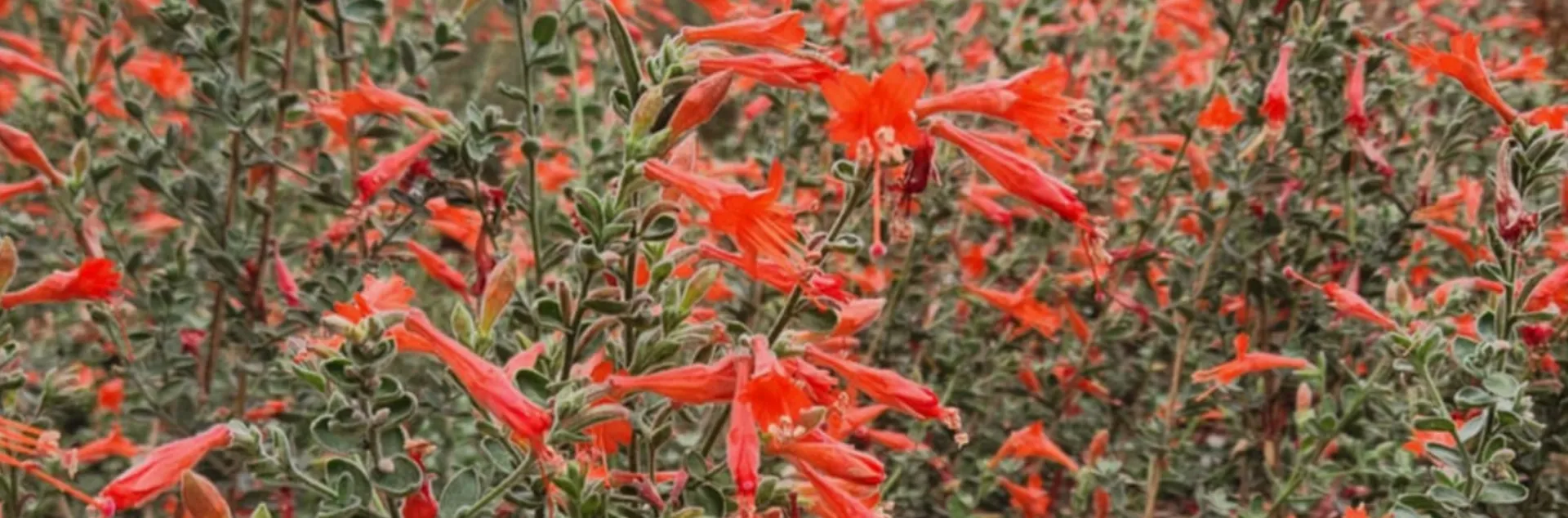
If you’ve been considering adding some California natives to your garden, late fall is the best time to plant. The soil is still warm, and the fall and winter rains will help the plants become well established, ready to handle the stress of our hot, dry summers. By planting natives, you will be saving water, supporting wildlife, and making your garden more resilient to climate change.
Right Plant, Right Place
Of course, putting the right plant in the right place is the first guideline. Considerations include your general climate and microclimates, soil type, sun exposure, and water needs.
Planting locally adapted natives not only means your plants will thrive, but also that they will support the pollinators and other wildlife in your community that have coevolved with them. A plant community is a group of plants that grow together in nature; planning for plant communities can also help your plants succeed. Calscape is a wonderful resource for searching for plants that grow in your area. You can filter for the type of plant, sun needs, water requirements, and even nurseries that sell the plant. Additional considerations are the microclimates within your garden. Where is the sun at various times throughout the seasons and the day? What plants or structures shade the site or channel wind? What are the water requirements and root structures of existing plants? Carefully observing specific areas in your site as you plan your garden can help ensure success.
Although native plants typically require less water than exotics, riparian species—those that grow along streams and lakes—do require regular water. The practice of hydrozoning, or grouping plants with similar water needs together, will make irrigation easier and more successful. Plants with the highest water needs should be close to the house as you will need to monitor those most closely. Even drought-tolerant natives will require watering for the first 1 to 2 years until they become established, which is usually when they double in size.
Sun exposure needs also vary among native plants. When observing your site, note how many hours of sun it gets throughout the day and in different seasons. You may wish to take photos of your site at various times to better understand and document sun exposure.
Your soil may vary in different parts of your site and can be:
- Clay—Fine-textured and high in clay particles, this soil retains water but becomes compacted and sticky when wet, and hard when dry.
- Loamy—With a balanced mixture of sand, silt, and clay particles, this soil retains moisture while allowing for good drainage. It is nutrient-rich and easy to work with.
- Sandy—Course-textured and quick draining, this is best for drought-tolerant, deep-rooted species.
Learn more about soil types here.

Fortunately, there are native plant species adapted for even clay or sandy soils; Calscape gives examples of plants suitable for each type of soil. It’s best to work with the type of soil on your site rather than try to significantly alter it, although most soils can be improved with the addition of some compost.
Keep the mature size of the plant in mind as you plan sites for planting, which can be challenging! It is hard to visualize the ultimate size of a small plant. There is no need to pay for larger plants; 4-inch or 1-gallon pots are ideal for transplanting and will grow quickly.
Planting Procedure
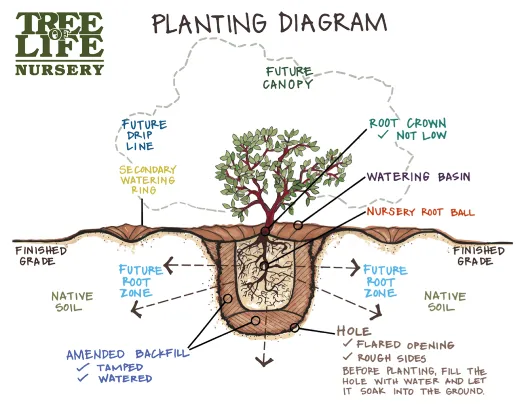
- Dig a square hole that is twice as wide and not quite as deep as the plant in the pot so it will rest about ½” to 1” above the grade. Rough up the sides of the hole. These techniques will encourage the roots to spread out rather than wrapping around themselves.
- Fill the hole with water and let it drain.
- Carefully remove the plant from its pot and place it in the prepared hole, backfilling with native soil and tamping in loose soil around the plant but not directly on the root ball, ensuring that it sits about ½” above grade.
- Create a berm to hold water about twice the diameter as the planting hole.
- Apply a 2- to 3-inch layer of organic mulch such as arborist wood chips or bark chips. Keep the mulch a few inches away from the trunks and stems to prevent them from rotting. Decomposed granite or stones can also be used as mulch, or a few rocks can be added to the organic mulch but keep them away from the root ball as they will hold heat and may stress the plants if they are too close. Over time, your plant creates its own mulch with dropped leaves, which is why it is best to “leave the leaves.” Consider the native habitat of your plant—chaparral, woodland, desert, or seashore—when choosing mulch. What would natural mulch look like in each of those areas? If necessary, mulch can be reapplied in the spring and fall.
For more detailed information, Calscape has a helpful planting guide.
Watering
Be sure to give your native plants the right amount of water, especially in the first year after planting. As a general guide, if the soil is dry 1to 2 inches below the surface, water deeply. Remember that deep watering encourages the roots to grow deeper, resulting in a healthier plant. Your plants will likely require a deep soak once a week for the first month. The best time to water is early in the morning before the sun hits the plants; watering at night can contribute to mildew growth. Calscape has a detailed watering guide on their website.
Too much water can lead to a root fungal infection and the death of the plant. This can be confusing, since the signs of overwatering and underwatering, such as wilting leaves and stunted growth, are similar. Checking the moisture level of the soil to a depth of at least 2 inches with a moisture meter or your finger is good way to decide. Native plants adapted to summer dry conditions, for example, oaks and bulbs, are especially prone to fungal infections, so knowing your plants’ characteristics and needs is important, as are your frequent observations. The saying, “the best thing you can put on your garden is your shadow” is apropos. Regularly observing your plants is one of the most rewarding aspects of gardening! It can be so enjoyable to spend time in your garden each morning, observing the ways your plants grow and change with the seasons.
Other Times to Plant
What if you miss the fall planting window? All is not lost. Riparian plants need regular water all year, so they can be planted any time. Most others can be successfully planted in winter or early spring. Summer is the worst time to plant natives, because keeping the new plants moist will increase the risk of fungal infections and the summer heat will stress the plants, but some gardeners have had success even then with careful monitoring.
A native plant garden has so many benefits. Even by planting a few natives this fall you will be supporting wildlife, saving water, making your garden more resistant to climate change, and growing your knowledge of California’s natural habitats and plant communities. You will be able to observe your plants grow and change throughout the seasons and the years, as well as enjoying the birds, butterflies, and other wildlife they bring.
Author: Constance Starner, UC Master Gardener