


Once the winter chores of pruning, cleaning up debris, mulching, and the like have been completed, it’s the perfect time to reevaluate your flower garden. Perennials have been pruned back or gone dormant, fewer plants are blooming, and there are empty spaces that were previously occupied by luxurious growth, whether perennials, annuals, or bulbs. It’s the perfect time to take a hard look at what’s working and what isn’t. By evaluating the existing plants and locations, we can decide what needs to be removed, moved, added or re-designed to make the flower garden look more pleasing.
Reevaluating Existing Plants
Take a look at all the existing plants. I’m responsible for the Flower Garden out at the Master Gardener Demonstration Garden (sometimes called the Learning Landscape) at the San Joaquin County Agricultural Center just off Arch Road near the Stockton Airport. I like to take photos throughout the year, so I remember when and how well things have bloomed, and where they are located when they’ve gone dormant. I recommend a smartphone for this, as you’ll have a date stamp, can put it in an album for easy retrieval, and the phone will probably be with you.
“Right plant, right place” is a truism of gardening—we want to put together plants that have the same requirements for soil, water, and sun. Are all the plants happy where they are in the garden? Do they have the requirements they need? Is a plant underperforming, such as poor bloom or weak growth? Is it overperforming, growing too tall for its place, or spreading and reseeding? Can we remedy the problem?
For example, in the Demonstration Flower Garden, we transplanted bearded iris (Iris x germanica) in 2022. They are in full sun (at least 10-12 hours per day), and while they bloom and look lovely in the spring, in the hot Central Valley summer their leaves become pale and brown quickly. Iris like sun, but not that much sun and heat! In another part of the garden, the same plant gets some shade from a rosebush and remains robust and green. The iris on the right in the photo below will suffer as summer continues, while the ones on the left, with protection from the rose, will be happier.

The iris have been in for four years and it’s time to divide them. Summer after they have bloomed will be the perfect time to divide them and move them to a better place. It may also be time to consider some companion plantings that will provide more shade and hide the less than lovely summer growth.
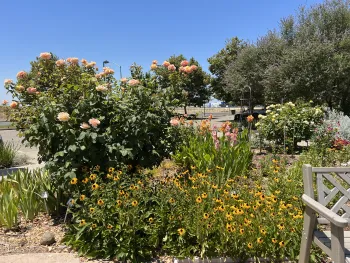
Another consideration is spacing. Sometimes plants are planted too close together, and when they grow into their mature size, they crowd each other. In the photo above, the yellow black-eyed Susan (Rudbeckia hirta) and purple coneflower (Echinacea purpurea) are crowding each other and need to be transplanted to provide more room. Some plants can also spread or reseed, taking over areas that weren’t intended for them. In the Demonstration Flower Garden, a different cultivar of black-eyed Susan has spread under the rose bush and into the Shasta daisies and needs to be pulled back. The photo below shows some black-eyed Susan that has spread too much and gotten out of hand. It will be divided come spring.
Then there’s the subjective element—do the plants give us joy? Do they look good, bloom reliably and long, complement other flowers with their shape, color, and size, and add to the coherence of the landscape design? Have the plants become too high maintenance? This is subjective, but it’s your garden—do you love it? If not, what do and don’t you like?
Reevaluate the Design
While some gardens are carefully designed to begin with, so much can change over time! Plants fail to thrive and are replaced, new plants get added in a spare spot, plants grow bigger or smaller than expected. Things can start to look a bit hodge-podge. Gardens are ever-changing, so this is to be expected, but we still aim for a pleasing design. We need to evaluate the design and see if it still works.
In general, taller plants go to the rear of a border or the center of a circular plot, while shorter ones go toward the front, with some variation in the middle so the garden doesn’t look too stair-step. It can be formal, with straight lines, or more casual and curved. Sometimes plants may grow taller than expected and block the view of shorter plants. A few years ago, we planted Shasta daisy (Lecantheum x superbum) and daylily (Hemerocallis ‘Stella D'Oro’) together in the Demo Flower Garden. The daisy turned out to be an exceptionally tall variety and the daylily had to be moved to another location.
Sometimes a garden develops a lack of coherence over time, with too many single plants scattered about. A single tall plant may be a dramatic focal point in the garden—a rose bush, a lion’s tail (Leonotis Leonurus)—but with too many single plants the garden may lack a unified look. Planting groups of the same kind of plants in clumps or drifts provides more visual impact than a single plant. I have seen borders that use the same selection of plants, but mix them up, with each few feet repeating the plants of the previous section. This has a more casual look than drifts but still has a repetition.
Another thing to consider is bloom color, time, and length. Ideally, we want something in bloom throughout the garden most of the year. Are the colors and bloom times of the existing garden pleasing? Are there times when nothing is blooming, and if so, what might be added?
Don’t be afraid to remove what doesn’t work or move it to be better spot. Sometimes we need to be ruthless to create a better look!
Make a Plan
Once we have evaluated all the plants and their location, the design, maintenance needs, and whether it is pleasing to us, it’s time to make a plan. Decide what has no place in the garden, what needs to be moved, what needs to be divided or trimmed back, what is fine where it is and what needs to be added.
If a plant is blooming less or looks stressed, determine why. Make sure it has the right amount of nutrients, sun, and water. Perhaps the problem is pests that have defied control. Determine if it is something that can be fixed.
If the design isn’t working, explore ways to improve it. Perhaps plants have grown too tall and need to be moved back. Perhaps there isn’t enough coherence, and there need to be fewer single plants and more drifts of the same variety. While flower gardens often rely mostly on perennials, annuals can be a good addition for a time of low bloom or to fill in an empty spot.
Finally, consider the practicalities. We’re looking at an existing garden, and unless we want to tear it out and start anew, we’ll have to go in steps. In the Demonstration Flower Garden, there are two mature rose bushes (Rosa ‘Julia Child’ and Rosa ‘Tahitian Sunset’) that are not where I would put them. But they bloom beautifully and are healthy, so we must design around them. The Flower Garden was originally conceived as a cutting garden adjacent to the vegetable garden. It has expanded into a flower garden, so it has changed purpose, and therefore the design needs some changes.
Our plan for the Demonstration Flower Garden this year is to divide bulbs, transplant some plants, and develop a more coherent design. The canna lily will be divided in the spring and we’ll move the Shasta daisy next to it in a central location. We’ll divide iris in late summer after bloom, move them to a different location, and choose companion plants to intermix with them. We’ll transplant crowded plants, pull back spreading ones, and research flowers to fill in the garden. Then we’ll see what’s next.
Any garden plan needs to have specifics, or it’s likely not to get done. Deciding what changes to make. Planning for them is part of the fun of gardening in the winter. What is your plan? Whatever it is, enjoy!
Further Reading:
Two excellent resources for selecting plants come from Sunset magazine:
Annuals and Perennials. Menlo Park, CA: Sunset Pub. Co., 2002.
Sunset Western Garden Book. Kathleen Norris Brenzel ed. 9th ed. Menlo Park, CA: Sunset Pub. Corp., 2012.
For information about garden design, visit Flower Garden Design Basics at Cornell University .
Sara Milnes, UC Master Gardener