
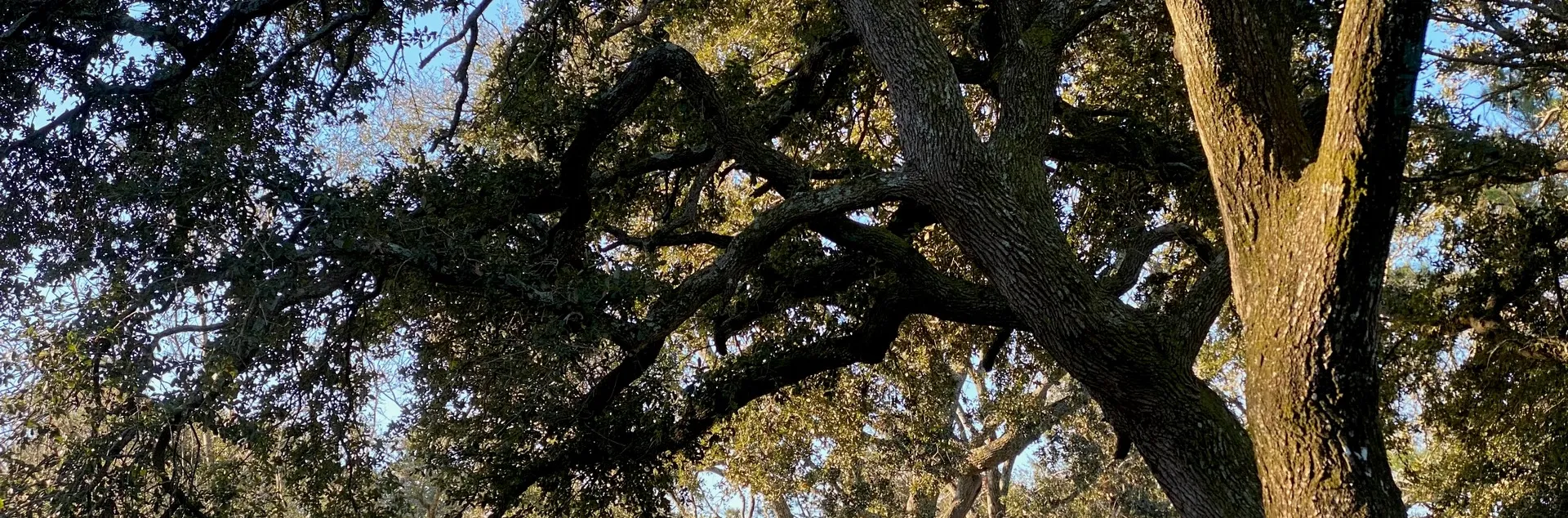
Winter storms with high winds or heavy rains take a toll on our trees and may cause a tree to fail. Most susceptible are the trees that keep their leaves all year, including broadleaf evergreens like eucalyptus and conifers. The greenery acts like a sail in a heavy wind and can cause the tree to bend. Another cause of failure is crown rot, where the root system near the base of the tree has deteriorated. When combined with saturated soil and wind, the tree may fail.
Heavy branches or entire trees can fall, causing property damage, power outages or significant injuries. This failure is not always predictable or preventable, but it is possible to minimize the risks. Inspecting your trees regularly for structural defects, especially before and after storms, should be part of your regular gardening routine. Then you can make corrections before there’s a problem.
Common structural defects
It’s important to keep in mind that otherwise healthy trees may have structural defects that can make them hazardous. When we inspect, we are looking for indicators that a tree may be structurally unsound and a possible hazard.
• Lean—has the vertical axis of the tree changed recently, or is there any sign of uplifted or exposed roots? If the tree was vertical but has shifted, it is in the process of falling and requires immediate attention. Some trees don’t grow vertically, so you’re looking for a recent change in the vertical position of the trunk.
• Multiple trunks—trees that have more than one trunk can be prone to splitting, especially those with narrow angles of attachment. Make sure to inspect the point where the trunks meet. The narrower the angle the greater the risk.
• Weakly attached branches—check large branches (greater than 3 inches) at the point where they attach to the trunk. This check is especially important where there are multiple branches arising from the same point. If one fails, the others are more likely to fail as well.
• Cavities and decay—look for cavities or large areas of decay in the trunk and large branches. If you find cavities or decay at key load bearing areas of the tree — the base of the trunk, or where branches meet the trunk—the likelihood of a failure is higher. If you find cavities or decay it is very important to consult an arborist, especially if the tree is large. Don’t try to clean out the cavity or seal it.
• Cracks in trunks and branches—your goal is to assess whether a crack is in the bark or extends into the wood of the tree. You may find cracks along the grain of the wood, or across it. If possible, insert a pencil or ruler into the crack and measure its depth. If it is more than 2”–3” deep it could extend into the wood, depending on the thickness of the bark. Deep cracks indicate structural weakening, and you should have the tree inspected by an arborist.
• Hanging or broken branches—branches that have broken off but haven’t fallen must be removed as soon as possible.
• Dead branches—these branches will eventually fall and should be removed.
How to inspect
Remember to regularly inspect your trees and keep an eye on the larger trees more frequently than smaller ones. When you’re ready to inspect your larger trees, grab a pair of binoculars. Stay on the ground! Notice if there are overhead telephone or power lines, making sure the top of the tree is below the powerlines and meets power and telephone company regulations for vertical distance. Look for other critical infrastructure the tree might damage should it fail. Call an arborist if you think a closer inspection is needed. They will have the equipment and training to make the inspection safely and take action when needed.
If you see something that makes you think a tree might be a hazard, keep people, pets and vehicles away from the tree until the hazard has been removed.
Resources
UC ANR has a free publication on how to inspect your trees at https://anrcatalog.ucanr.edu/pdf/8365.pdf.
When looking for an arborist, look for either ISA or ASCA certification:
• https://www.treesaregood.org/findanarborist
• https://www.asca-consultants.org/search/custom.asp?id=3818
The latter certification, ASCA, is usually held by consulting arborists who specialize in providing diagnosis and possibly treatment, whereas the ISA certification is held by both consulting arborists and arborists who work for tree care companies.
Help Desk of UC Master Gardeners of Contra Costa County (RDH)