
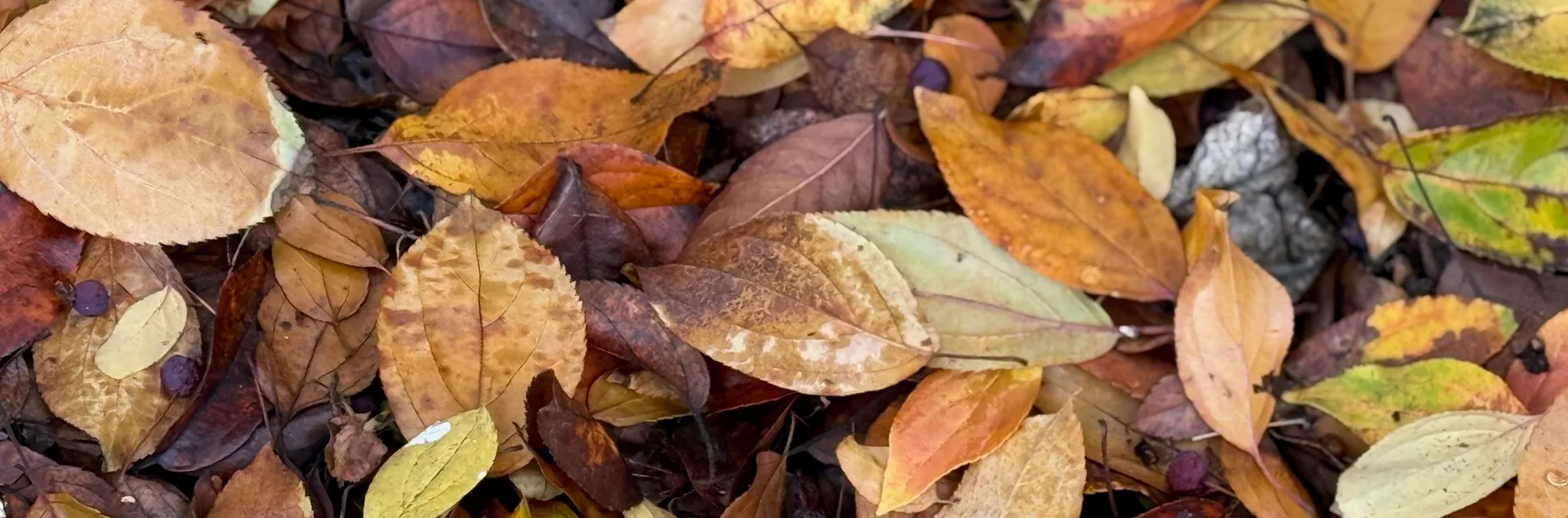
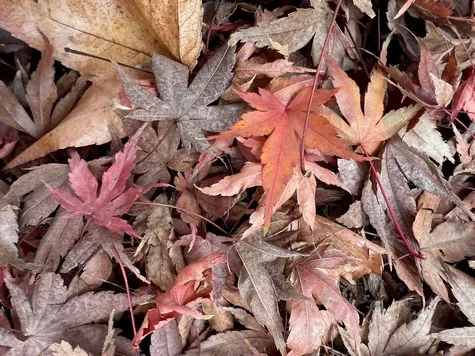
Leaving the leaves has become the hot, fall garden topic. An appropriate topic for this time of year as leaves are falling steadily. The U.S. Forest Service, the National Park Service and the National Wildlife Federation are all huge advocates for leaving the leaves. State and local fire departments are cautious regarding the practice, citing potential fire hazard concerns, while HOA’s are rigidly against leaving “unsightly” leaves in place. Let’s take a closer look at this “hot” topic.
Why would we want to leave leaves? New research is advocating the practice of leaving fallen leaves in place from fall through late spring. This practice helps thousands of insects complete their life cycle. These include most of our beneficial pollinators (especially ground nesting bees) along with a wide host of insects including moths and butterflies, and toads. This insect population supports mammals, birds, reptiles, and amphibians that rely on these creatures for food, completing the natural cycle of life.
What kind of impact can leaf litter have? To envision what kind of an impact leaving the leaves can have, let's look at a study done by Max Ferlauto with the Maryland Natural Heritage Program. Max conducted a suburban study to see if leaving leaves in place over the winter would have any significant effect on the insect population. His study set up 3 x 3-meter plots in an urban setting, some with leaf litter and others with no leaf litter. Emergence traps were set up over each plot so a count could be taken in the spring as species emerged. The “catch” was 18,000 insects for the leaf litter plots. Even Max was surprised and impressed. There were “pest” insects present but most insects provided significant benefits with regards to pollination, pest control, beneficial soil insects plus thousands of insects which are a food source for other species
Where leaf litter was removed insect populations decreased substantially. Butterflies’ and moths' emergence was reduced by 45%. The spider population was reduced by as much as 67%, while the beetle population suffered a 25% reduction. These numbers make a strong case for the impact leaf litter has in protecting the overwintering habitat for all manner of insects.
With the concern that leaf litter could be a fire hazard is there an alternative or compromise? Here in California, we are ever mindful of the potential for fires. Cal Fire has established Defensible Space Zone guidelines for homeowners; by staying within these guidelines and moving leaf litter to the outer periphery of the landscape we can have a win-win situation. The leaf litter is on the ground only from fall through spring during a low fire season and a season when we get rain, which provides a natural level of safety.
Defensible Zones Defined & Illustrated:
https://bof.fire.ca.gov/projects-and-programs/defensible-space-zones-0-1-and-2
While fire hazard is on the minds of Cal Fire, HOA’s are sometimes opposed to leaf litter for the unsightly aesthetic value leaves create. Homeowners may be concerned with leaves being a potential slipping hazard on walkways and fear that a heavy matt of leaves will smother and kill their lawns. These are all legitimate concerns.
Is there any good compromise? The compromise here is moderation. To be beneficial for overwintering insects’ habitat does not require having mounds of leaves everywhere. Even a small patch of leaf litter left over the winter can be of great value. A depth of 2-4” of leaves will allow for good insulation yet provide air circulation, light penetration and enough moisture for insects to thrive. Leaves can be placed in back yards, out of public view and used as a natural, protective ground cover for bedding plants.
The following points will help strike a balance for creating a neighbor friendly, fire wise habitat using leaf litter:
• Leaves which make a walkway slippery, clog storm drains, or fill household gutters are not habitat worthy. Be “clean and safe” and dispose of these leaves.
• A thick, matted layer of leaves can harm your lawn. Leaves block essential sunlight, water, and airflow, which can suffocate and eventually kill the grass and other groundcover plants. Don’t leave leaves on lawns!
• Leaves should be raked and left whole. Whole leaves make a better habitat and food source.
• For safety’s sake, leaf litter should be only 2–4” deep.
• Place the leaves in an area which will remain undisturbed.
• For the sake of aesthetics, hide the leaves behind a hedge, shed or fence.
• Mix your fall garden cuttings, hollow stems, and flower heads in with the leaves; these are all valuable insect nesting resources.
• Don’t be too eager to clean up the leaf litter in the spring. Wait until daytime temperatures are consistently 50°F or higher when the pollinators and insects will have gotten what they need from the habitat and your good works are complete. Then, grab that rake!
These links will shed further light on the benefits of leaving the leaves to provide overwintering habitat for a variety of pollinators and beneficial insects.
• Xerces Society: Nesting & Overwintering Habitat for Pollinators & Other Insects: https://xerces.org/sites/default/files/publications/18-014_02_Natural-Nesting-Overwintering-FS_web.pdf
• Arboretum All Stars: Leave the Leaves: https://arboretum.ucdavis.edu/blog/leave-leaves-help-pollinators
• UC ANR: Permission to Leave the Leaves / Promoting Native Bee Habitat: https://ucanr.edu/blog/real-dirt/article/permission-leave-leaves-promote-native-bee-habitat-leaving-some-leaves-and
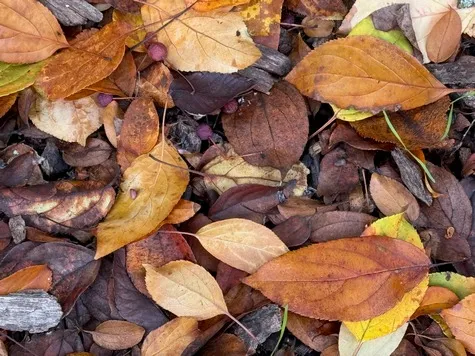
Photos courtesy of Susan Heckly, UC Master Gardener volunteer
Help Desk of the UC Master Gardeners of Contra Costa County (BHD)