
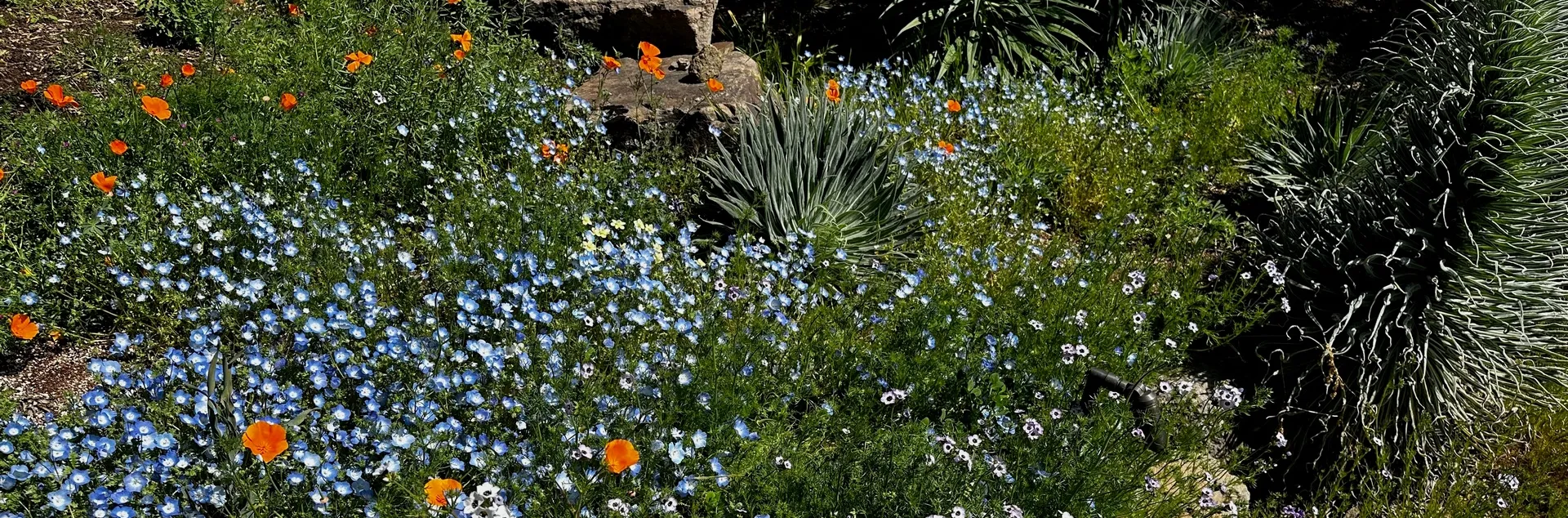
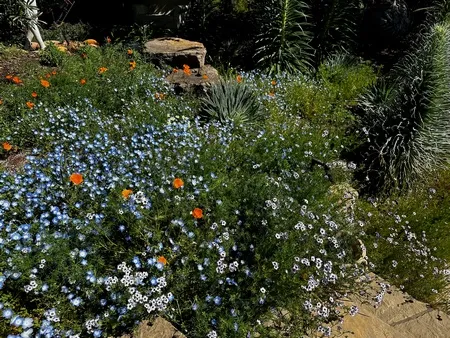
As I write this, the first signs of fall are all around us — a hint of leaves turning color, cooler temperatures, and rain on the horizon. In California this means we are approaching the season for native plants to begin their annual cycle. Because they live their complete lifecycle in one year, beginning in fall to winter, blooming in spring and then setting seed in the summer, California native annual wildflowers are usually not sown in late spring or summer. Instead, we start sowing them in November as the rains begin. We can sow them through March, although November to January is optimal and allows for less water.
Choosing your seeds
As you consider different flowers for your garden, in addition to looking at color, check to see when they bloom. You can decide if you want to mix early and later-blooming annuals into your sowing choices for longer-lasting color. For example, if you sow early season wildflowers (poppy and tidy tips), then add a late blooming flower into the mix (such as clarkia or globe gilia). Other considerations include the amount of sun where you’re planting, if you’re mixing your annuals in with perennials and want a specific color palette, and attracting a variety of pollinators.
For native wildflower seeds in Contra Costa County, check out the Contra Costa County Library Seed Libraries (https://ccclib.org/seed-library/) for free seeds, and search for local events by the California Native Plant Society (CNPS), the UC Davis Arboretum (https://arboretum.ucdavis.edu/seeds), and Tilden Botanic Garden (https://www.ebparks.org/parks/tilden/botanic-garden). You can also purchase wildflower seeds online through the Theodore Payne Foundation (https://theodorepayne.org/) and nurseries that specialize in California native plants, being careful to check that the plants’ growing conditions are consistent with your garden environment.
Soil preparation: remove the weed competition
Before you sow your wildflower seeds you want to get rid of as many weed seeds as you can. The weeds are lying in wait for winter rain and will compete with your wildflowers. You can trick weeds into germinating by watering the soil now, and as they appear hoe them down. You may need to do this more than once. When you are no longer watering the area and you are ready to put your seed in the ground, do not turn the soil deeply in preparation because this will unearth any remaining buried weed seeds. A rule of thumb is to never hoe or till more than four inches down into the soil. Whatever is deeper than that, you want it to stay down there in a dormant state rather than giving it the opportunity to come up toward the surface to germinate.
When to sow
You can sow all your seeds at once or stagger the times when you sow them for an extended bloom season. To stagger, start in mid-November and re-sow through February and even into March. Those plants you sow late in the season will most likely need supplemental water to maintain a bloom once the rains have ended.
Think about staggered sowing when…
• you want a staged bloom for individual plants of the same species
• your initial sowing doesn’t have the germination rate you’d like
• you can drop native seeds into newly created open spaces to compete with weeds before they germinate again
• your first flush of seedlings is eaten by birds.
How to sow
To ensure adequate germination, you need seed-to-soil contact, air flow, and water permeability. You can use a light mulch, which will help to protect from bird predation and keeps the soil moist. However, the mulch needs to be kept to a single thin layer, protecting but not smothering the seeds or keeping the water from them. If you already have deep mulch or large wood chips, it’s best to clear a space and sow there. If you are concerned about birds, an alternative to mulch is bird netting or a row cover.
Wildflowers are surface sown, meaning they only need to be about 1/8” below the surface of the soil. There are three ways to sow your seeds.
• Horticultural Sand: Mix one part seed to 3 parts horticultural sand. Scatter the seed/sand mixture evenly. The sand helps to protect the seed from birds and also covers the seed.
• Scatter and Cover: Scatter the seeds over lightly raked soil and then cover them with a bit of garden soil (not heavy clay) or light potting soil. It’s important not to bury the seed deeply; it should be about 1/8” beneath the surface.
• Scatter and Rake: Scatter the seed and then rake it gently so the seed doesn’t get displaced or pushed too deeply under the soil, keeping it 1/8” beneath the surface.
You might find it helpful to use flags to indicate where the seeds are located until they germinate.
Some seeds, for example lupine, need special handling such as scarification or soaking before sowing. These methods help to improve germination rates by softening or breaking through hard seed coats.
Watering
Don’t let your seeds sit dry after sowing. Water the soil surface first, sow your seeds, then water the soil again. Dry seeds are more likely to be eaten by birds or animals. When watering, use the shower nozzle setting to mimic rainfall. You want to water the entire area gently but thoroughly, allowing the seed to stay in place and avoiding run-off or pooling. Seeds must stay moist for germination, so if there’s a dry spell this winter, you’ll need to hand water to keep the soil consistently moist. Once your seedlings are ½” to 1” tall you can water less often and more deeply, to avoid water dependence.
And enjoy!
Sowing native wildflower seeds is a wonderful and easy way to add beautiful native plants to your garden while you also support native pollinators. Enjoy!
Help Desk of the UC Master Gardeners of Contra Costa County (RDH)