
By Penny Pawl, UC Master Gardener of Napa County.
Many of us have the variegated spider plant as a houseplant. It is fascinating how this plant produces new plants and small white flowers at the end of a long stem. Many years ago, a close friend planted her spider plant outdoors and let it naturalize in a corner of her garden. It did well there.
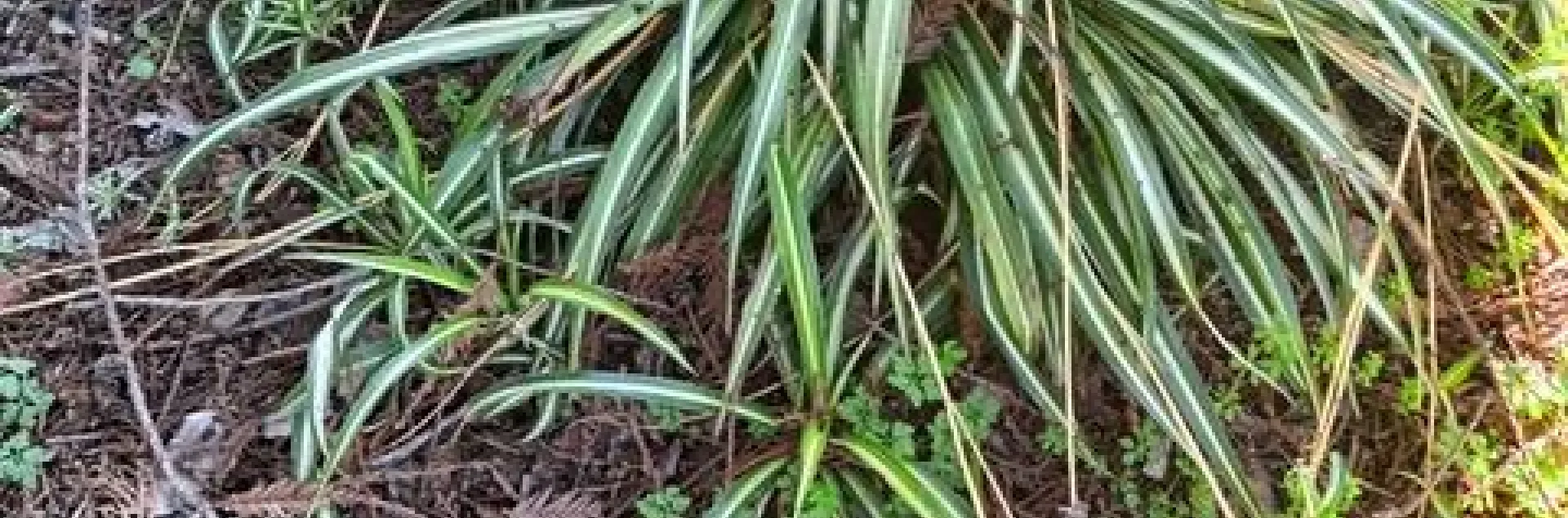
Several years ago, when I was feeling overwhelmed with houseplants, I moved my spider plant outdoors. It was in a large pot that I placed in the shade of a redwood tree. And those long stems started to root in the soil under the redwood. I moved the pot to another area but the rooted stems continued to grow and fill in a large open area. They are making a beautiful ground cover.
Another spider plant, not variegated, has taken up residence in another part of the garden. I don’t know if it grew from seed or how it came to be there. I don’t irrigate or feed any of these plants, yet they are thriving in semi-shady areas.
Now a little history about the spider plant (Chlorophytum comosum), which is native to Africa.Spider plants have traveled to other countries besides the U.S., including Western Australia and Bangladesh.
Spider plant originates in a part of the world that is dry for several months every year. That’s why it survives here on winter rain alone. I never water my outdoor spider plants in summer as I am stingy with water. They compete with the redwoods for water, but that does not seem to stop their growth at all.
Spider plants have a dense root system that stores water. If you are growing the plant in a container and decide to repot it, leave room for root expansion. These plants do not need repotting often; I have left them in the same container for several years. If grown in containers, however, they will need water.
Spider plant is in the asparagus family, which also includes hostas. That fact surprises me as hostas have different needs.
Spider plant is also known as airplane plant, ribbon plant and spider ivy. It can be grown outside in USDA Plant Hardiness Zones 9 through 11, but in areas with winter frost it is an annual. My garden has frost occasionally, but the spider plant does not suffer. Perhaps it is protected by the redwood, which is close to 100 feet tall.
I recently decided that the spider plant in the original pot was taking up too much room in my garden house. It was sending out lots of “pups,” as the new growth is called. I wanted to move the plant to another area and give the pot itself a rest. I transplanted the mother plant and all the pups to a 15-to 20-foot area. They will fill in this area eventually. They seemed to experience no transplant shock. They just settled in and started to grow.
If you want to grow spider plant as a houseplant, be sure your container is at least an inch wider in diameter than the root ball. The roots need room. Use a good houseplant soil and expect to water once a week. Water enough that some water drains out the bottom to help eliminate any accumulated salts.
Where to keep your indoor spider plant? Avoid direct sunlight as it may burn the leaf tips .Outdoors, they tend to prefer dappled light or shade. Hanging the pot near a window or on a porch can work well.
Now that your plant is growing beautifully, what to do with all those pups? Look at them closely and you’ll see their baby roots. Transplanting them into another container will yield a new generation. If you get too many spider plants, give them to friends. For many people, they are a favorite houseplant.
Library Talk: Join UC Master Gardeners of Napa County and Napa County Library for a free talk on “Healthy Soil = Healthy Plants” on Thursday, March 5, from 7 pm to 8 pm via Zoom. Are your plant problems due to the health of your soil? Learn about potential problems and possible solutions for improving your soil. Register here to get the Zoom link .
Help Desk: The Master Gardener Help Desk is available to answer your garden questions. Use our online Plant Problem Help Form or email us at mastergardeners@countyofnapa.org. Include your name, address, phone number and a brief description of the problem. You can also visit us in person on Mondays and Fridays from 10 am until 1 pm at the University of California. Cooperative Extension Office, 1710 Soscol Avenue, Suite 4, Napa.
Photo courtesy of Penny Pawl