
By Cindy Watter, UC Master Gardener of Napa County.
One of the advantages of living in Napa Valley is that we can garden year-round, not counting floods and fires. That is also a disadvantage for the indolent gardener, who, unlike his or her East Coast counterpart, does not have down time in which to dream over seed catalogs or wonder if the roses will survive the freeze. No excuses for Californians. There is always something to do.
In my case, the ever-present task is digging up stumps of privet that appear in my yard. Their presence is courtesy of a neighborhood privet as tall as the Archer hotel.
In the past, I was lazy and just clipped them close to the ground. But they would always grow back and become trip-and-fall hazards.
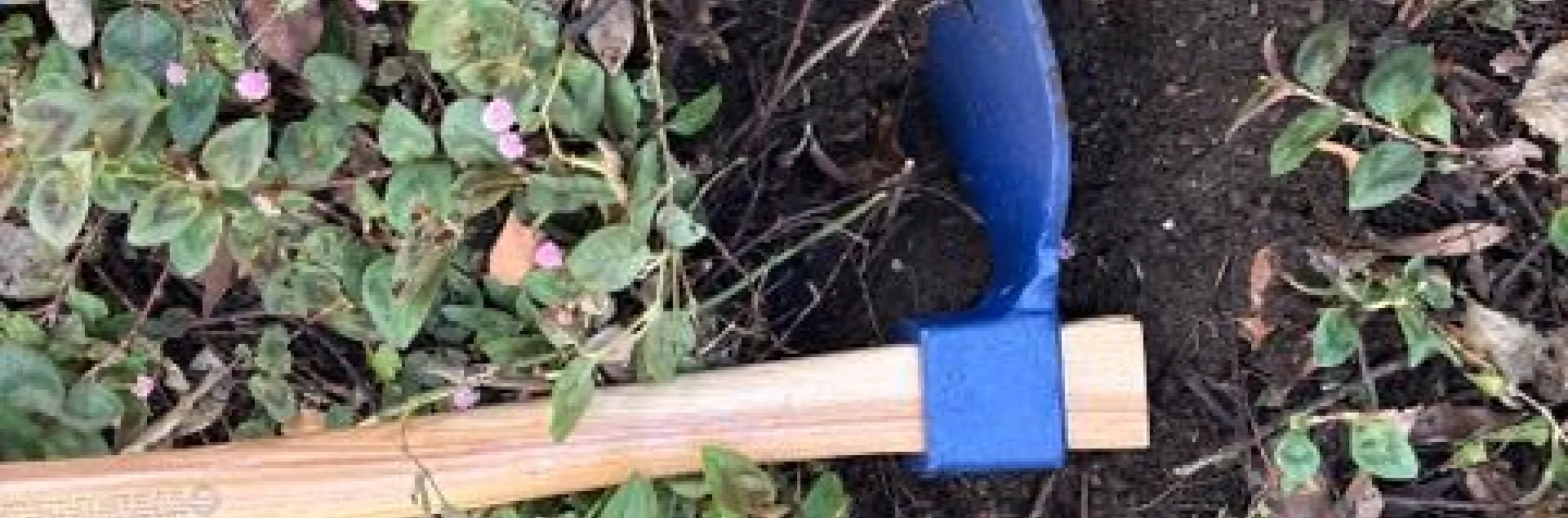
Last year I dug out quite a few with my trusty Japanese sawtooth weeding knife. It was hard work. I laid them out in a row, like a proud terrier with a collection of dead rats, and for Christmas my husband bought me a more efficient digging tool, a forest adze. This is what firefighters use to cut out flammable material, whether it is in a house or the woods.
The forest adze may not be the most romantic of gifts, but it is a life-enhancing joy for me. First, it does the job. Second, it is so well balanced that even an arthritic oldie can wield it successfully.
Finally, it looks like the main character in a splatter film. If I am going to attack the most
pernicious plant in creation, maybe I can frighten it a little bit first.
I used my forest adze to dig out an infuriatingly persistent sprig of privet. The rain and my compost had softened up the soil, but still, the adze delivered an impressive performance, dislodging the privet in 45 seconds. This example had been in residence for five years and had firmly resisted removal.
Privet (Ligustrum) is considered an invasive plant in most states. We imported it from Europe, but it originated in Asia. Privets grow quickly, and their original function was for borders, hedges, and topiary. However, they can spread and crowd out native species. There are many varieties; most are evergreen.
The privet has small dark green oval leaves and produces tiny white flowers in the spring. Birds spread the seeds. The flowers are a source of nectar for bees. Their abundant pollen can cause allergic reactions, and the plants themselves are toxic. If children or animals ingest any part of the plant, expect gastric problems.
All the garden books I have consulted say the privet grows to about eight feet tall. The giant I can see from my house must be a superior example, as it is at least as tall as the tallest Victorian in the neighborhood.
If, after all this disparagement, you insist upon growing privet, be aware that it likes sun and well-drained soil. I know one person who grew a privet hedge for privacy, and she keeps it pruned so it doesn’t flower or spread seeds. She is a responsible gardener.
Today you can buy privets that are sterile and don’t colonize your neighbors’ yards, but I can tell from my walks around town that we have plenty of the old-fashioned variety.
The lesson here is that the right tools can make even the most laborious gardening tasks more pleasant. And here’s another lesson: if you have good tools, take care of them. They are expensive and deserve care.
I always thought I was doing a good job, oiling the joints and sharpening the blades, but my Felco clipper blades had a deposit on them that kept them from working smoothly. No surprise as they are 25 years old.
What to do? I didn’t want to use a possibly toxic rust remover that would cause disposal problems. Or kill me. One of my friends told me to try vinegar and baking soda and let them soak overnight. Well, it couldn’t hurt.
I felt like I was in grade school doing a science experiment. The soda foamed furiously. No, I didn’t measure anything. I put the clippers in a non-reactive glass bowl and poured the vinegar/soda solution over them, enough to cover. The next day I rinsed them off and lightly rubbed them with steel wool. Now the clippers are rust free, smooth to the touch, and a pleasure to use. When I think that my hands endure thousands of repetitive motions using those clippers, rust removal makes sense.
With my smoothly functioning tools, I shall remove the butterfly bush (Buddleia) that has been attacked by a different pest every year. This activity is known as “shovel pruning” in UC Master Gardener argot. Translation: if the plant refuses to cooperate, get rid of it. I will substitute an ‘Amistad’ salvia which requires lots of sun but little water or pruning. Yes, there is always something to do in the garden, but the right tools make it enjoyable.
Library Talk: Join UC Master Gardeners of Napa County and Napa County Library for a free talk on “Favorite Greens to Grow in Spring” on Thursday, February 5, from 7 pm to 8 pm via Zoom. Using the principle of “Right Plant, Right Place,” we’ll address water needs, microclimate, sun exposure and soil quality to help you grow a variety of tasty cool-weather greens. Register here to get the Zoom link.
Help Desk: The Master Gardener Help Desk is available to answer your garden questions. Use our online Plant Problem Help Form or email us at mastergardeners@countyofnapa.org. Include your name, address, phone number and a brief description of the problem. You can also visit us in person on Mondays and Fridays from 10 am until 1 pm at the University of California Cooperative Extension Office, 1710 Soscol Avenue, Suite 4, Napa.
Reference: The New Sunset Garden Book, pp. 411-412.