
This blog contains archived digital materials published or created by the Tulare County Cooperative Extension prior to April 24, 2026 that are not digitally accessible.
Tulare County is the home to production of four different nut crops—almonds, pistachios, walnuts and pecans. Over the past 20 years, however, pistachios have dominated new plantings. In just 15 years, from 2009 to 2024, pistachio acreage in Tulare County grew five times. Pistachios currently occupy over 95,000 acres in the county and are listed in the top 10 million-dollar agricultural products.
Although California produces over 98% of the pistachios grown in the United States, the tree is native to western Asia and Asia minor. Pistachio trees can be found in the wild in hot, dry areas of Lebanon, Palestine, Syria, Iran, and Iraq, as well as desert areas of northern Africa and southern Europe. Their introduction to North America is credited to the United States Department of Agriculture. Since the trees were first planted in Chico, California in 1904, plant breeders with the University of California have released new cultivars that are valued for their early harvest dates and excellent nut qualities.
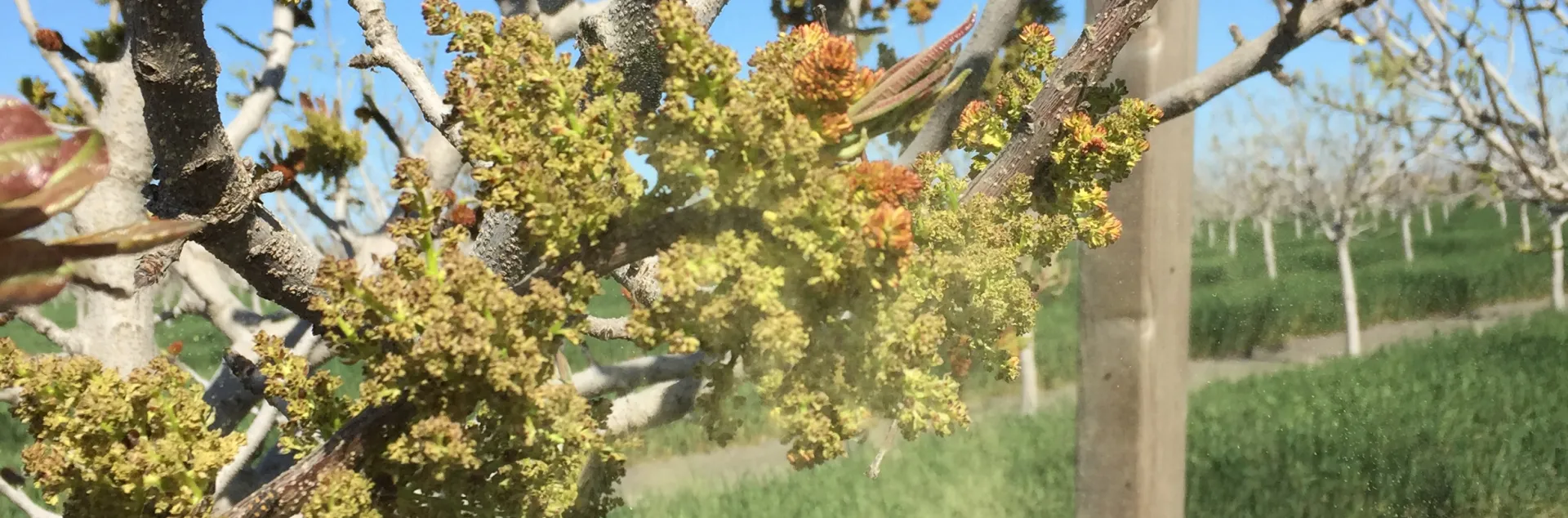
Pistachio orchards can easily be differentiated from the other nut crops because they have distinct male and female trees. The male trees are generally larger than the female trees and they comprise only about 5% of the orchard. The nuts are only produced on the female trees, so the male trees are only valued for the pollen produced at bloom. Bloom generally occurs in early April, but it is not a picturesque event that we associate with other fruit and nut crops like almonds or cherries. Because pistachios are wind pollinated, the flowers do not have petals or nectar to attract insect pollinators. The male trees generate a large amount of airborne pollen that may trigger an allergic response in humans. The allergy to windborne pollen is generally limited to hay fever, sneezing, or asthma, and is not associated with food allergies resulting from consumption of the nut.
The pollination processes that occur in April are the precursors to a successful harvest from late August through September. Growers may wait six years after planting to harvest their first crop. The crop is mechanically harvested with trunk shakers and then brought to local processors to prepare for sale. The nuts are then primarily sold in-shell and the natural crack in the shell is appreciated by consumers for ease access to the nut kernel. This widely grown crop of Tulare County has become a prized American household snack!