
Article by Peg Smith -
January and February are the prime time for adding fruit trees to the garden. Many gardeners are dealing with smaller gardens where space is a premium. Often, the consideration of adding fruit trees meets the thought, ‘I don’t have enough room.’
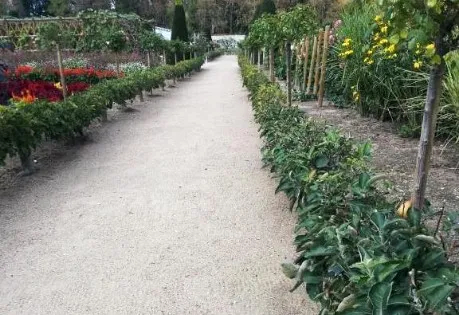
Always Wanted Fruit Trees But Don’t Think You Have Space?
Here’s an idea that does not require canopy space or a large amount of garden space. A method of fruit tree training called ‘stepover pruning’, which is a modified espalier approach to fruit trees.
There are advantages to this technique for small and large gardens.
- Trees do not produce a tall or wide fruiting canopy to shade other growing areas.
- Ease of care – no ladder climbing for pruning.
- Ease of harvest – no ladder or long-handled picker needed.
- Ease of pest control – growth is within reach, allowing for ease of observation to detect any disease or infestation. Mechanical control (hand picking of pests) is within easy reach. If any treatment is required, local control of application is easy.
What Is A Stepover?
A stepover consists of a shortened trunk with a T-shaped form from side shoots, similar to a normal espalier, but at a height of around eighteen inches to two feet. A stepover can also be formed from a single trunk that is, over time, bent and encouraged to grow horizontally.
A dwarfing rootstock is essential, and care must be taken in the initial establishment of the trunk to observe where the graft union (scion) between rootstock and desired cultivar occurs. The initial pruning cut to establish the shortened trunk should be above the scion and above two healthy cultivar buds on opposite sides of the trunk.
Once established, the care of a stepover follows the usual seasonal care for that fruit. The easiest fruits to adapt to the stepover form are spur-bearing cultivars such as apple and pear, which carry fruit on short side shoots called spurs. Quince also fruits on short spurs and on the tips of year-old growth.
Ways To Include Stepover Fruit In The Garden
- As a border for an ornamental bed.
- As a border around a raised vegetable bed. The limited height will still allow a gardener to reach into the bed to tend the seasonal vegetables.
- As a single crop in a raised bed or garden area. A ten-foot by four-foot bed would allow three ten-foot lengths of stepover fruits, which would provide thirty feet of fruit production.
Perhaps you can squeeze some fruit into your garden? This Royal Horticultural Society publication, Apples and pears: stepover training and pruning, gives a detailed step-by-step guide for stepover training.