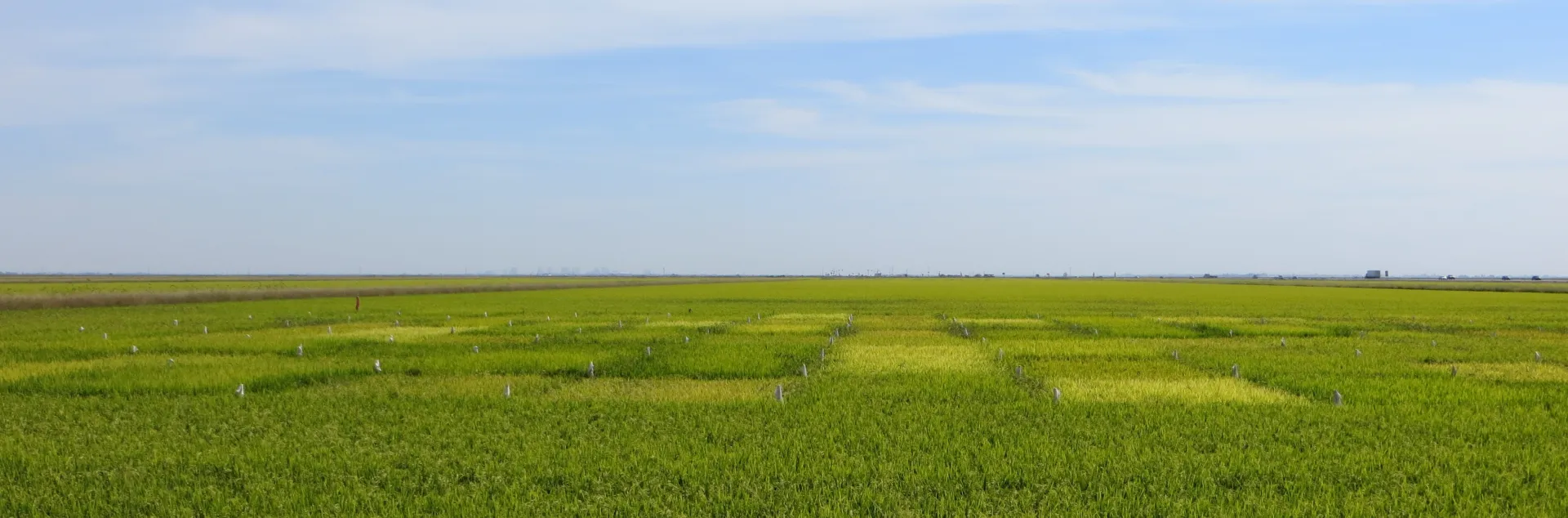
UC Cooperative Extension collaborates with the California Rice Experiment Station to evaluate commercial varieties and advanced breeding lines. The San Joaquin County Delta location was one of eight locations in the 2025 statewide trial. The Delta is the only drill-seeded site and is a testing location for very-early and early maturing varieties because it has cooler growing conditions than other rice growing regions of the state. The trial was drill-seeded on April 18th at a rate of 150 lb/acre in a field planted with M-206. Only medium grain varieties were evaluated, which were replicated three times as 150 ft2 plots. Fertility and pests were managed by the grower in the same manner as the field. We harvested the trial on October 9th, and yield was determined by hand-harvesting a 15 ft2 area from each plot.
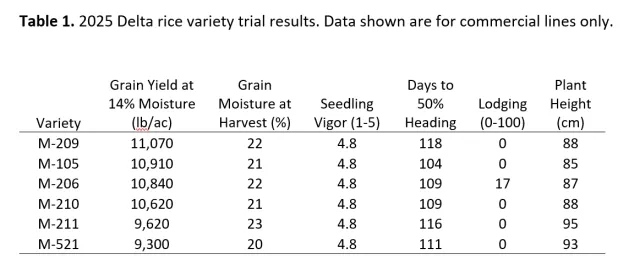
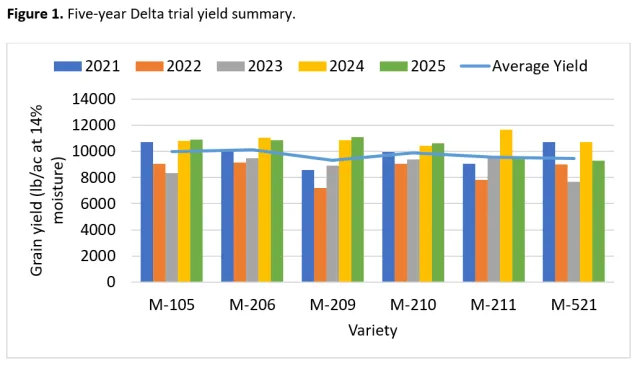
Results from the Delta location are shown in Table 1 and Figure 1 (advanced and preliminary breeding lines omitted). Among the entries, M-206 is the most commonly planted variety in the Delta and across the state. It has good agronomic characteristics, consistent quality across different harvest moistures, and the highest average yield among the commercial varieties over the last five years. Please note, however, that M-206 will be phased out in a couple of years, so growers should be trialing other varieties now to help them determine which varieties to grow when M-206 is no longer available. Some Delta growers plant M-105, which is a very-early variety and has the second highest average yield over the last five years of the Delta variety trial. It tends to be more susceptible to blast in years when blast is a problem, which may have contributed to the 5-year yield variability. Growers should consider trialing M-210, which has the third highest average yield in the Delta, closely behind M-206 and M-105. M-210 is early maturing, has blast resistance, and would be a good option in the Delta, particularly on farms where blast has been observed. Next to M-206, M-210 has the best yield stability over the last five years. M-209 is a longer duration variety and has widely variable results in the Delta. It has a high yield potential, but low temperatures will cause blanking. Over the years, the yield of M-211 and M-521 have been variable. M-211 is not well adapted to cooler environments, and its quality tends to decrease below 18 percent harvest moisture. M-521 is also known as ROXY® rice and is oxyfluorfen resistant. While the variety is released, the herbicide technology has not yet been approved by the EPA and CA DPR. Statewide results of all eight testing locations will be available soon from the UC Rice Research and Information Center website (https://agronomy-rice.ucdavis.edu/).
Special thanks go to the cooperating grower and the CA Rice Research Board for financially supporting statewide variety testing. If you have questions about the trial or about Delta rice production, please don’t hesitate to contact me.