
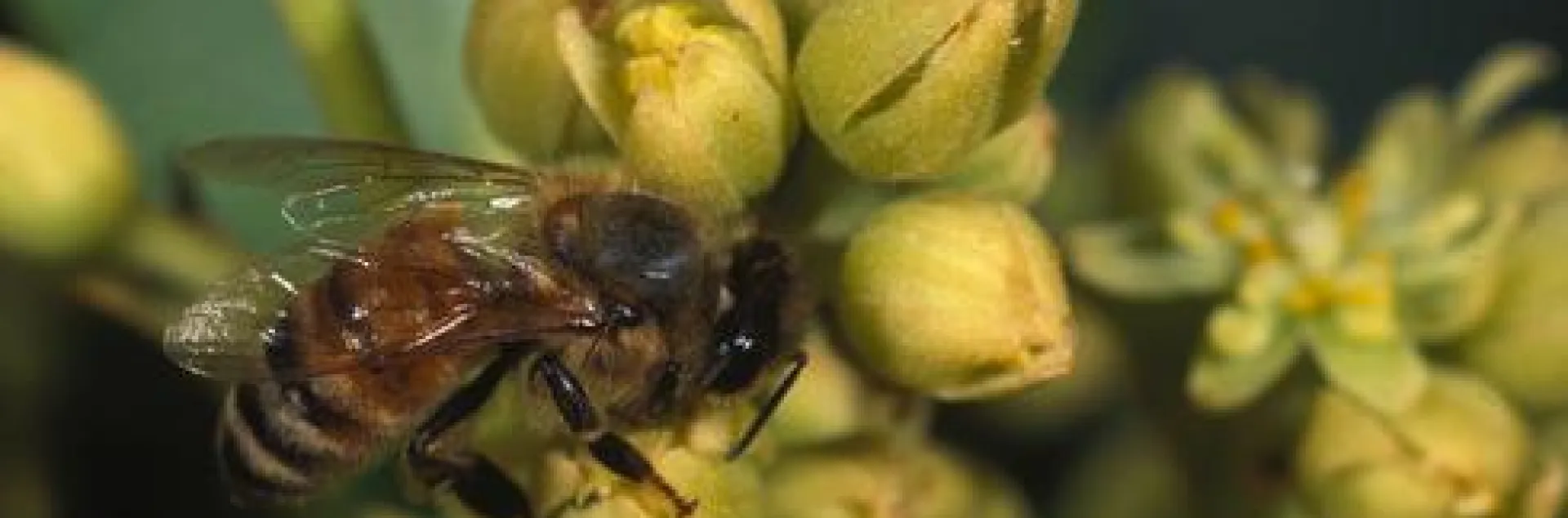
2025 has been a rough year for the honey bees and their keepers. Reports of extreme colony mortality began in January, just before the almond bloom which requires the pollination services of an estimated 1.5 million colonies (Fenton, et al., 2025). As of July, honey bee colonies have reportedly dwindled by over 60% (https://www.projectapism.org/colony-loss-information), which is a significant increase from the average annual winter losses over the last few years (Aurell, et al., 2024). From rising costs per colony to no colony availability for their own pollination services, growers across California have no doubt felt the effects of these losses.
In response to the reports, the USDA Bee Research Laboratory in Beltsville, MD launched speedy research to investigate this year’s extreme colony deaths (Lamas, et al., 2025). The research team examined Varroa destructor mites and pathogen prevalence in colonies from 6 different commercial apiaries prior to almond pollination services. Most notably, the research team reported that all Varroa mites they examined from collapsed and surviving colonies showed genetic markers for resistance to the acaricide (mite-specific pesticide) amitraz, the current primary control method for Varroa mite. They also found high prevalence of Varroa mite-vectored viruses, which are known to cause mortality in honey bees. These results suggest that the difficulty of controlling Varroa mite is likely the driver of the massive colony losses observed this year.
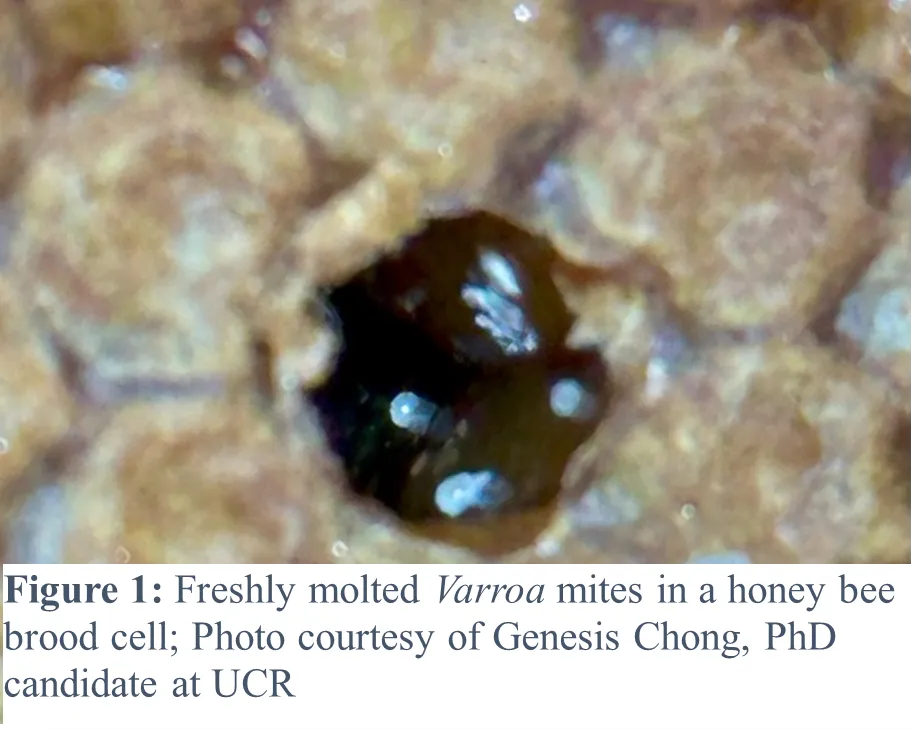
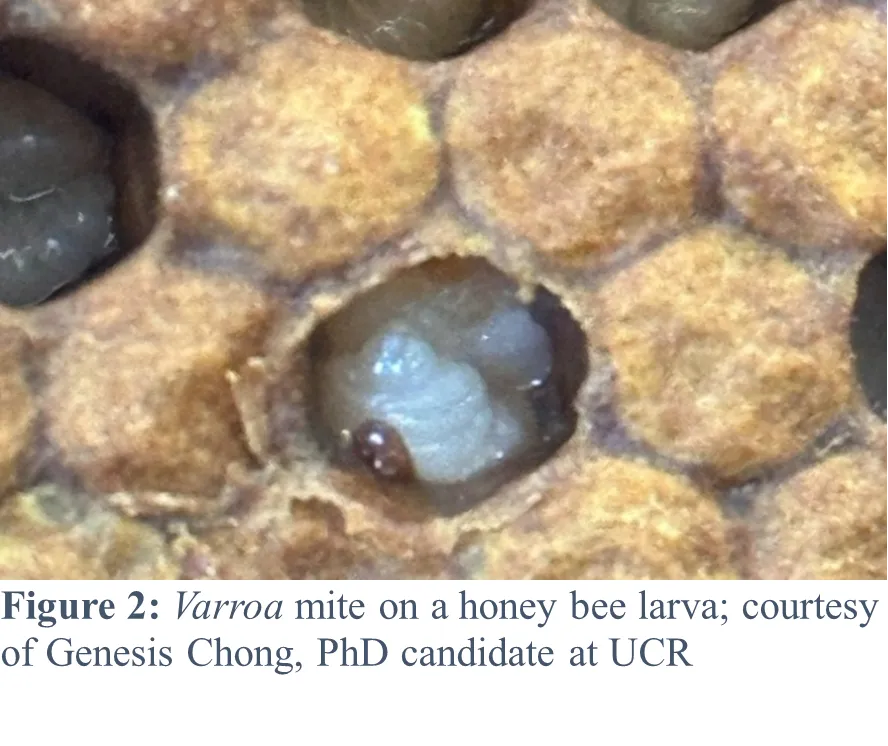
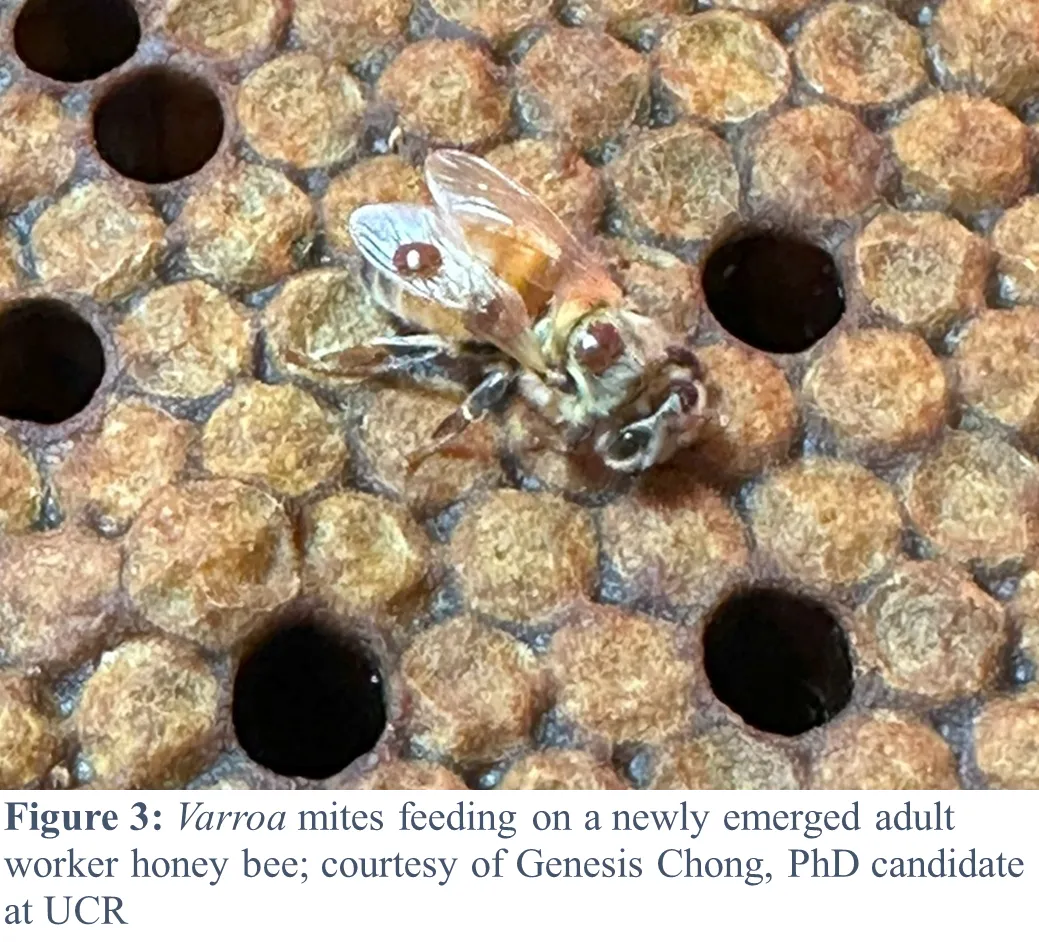
For those unfamiliar, Varroa destructor is a parasitic mite that feeds on honey bees and reproduces within brood cells (Figures 1 and 2), preferably drone brood cells, in honey bee hives. Varroa is known to transmit several viruses to bees, including Deformed Wing Virus (DWV), which can be devastating to colonies. In 2007, when “Colony Collapse Disorder” was first identified, it was linked to high prevalence of Varroa mite-vectored viruses. Varroa can be particularly troublesome during winter when colonies experience a period of dormancy known as overwintering. Colonies can be stored in temperature-controlled sheds or can be winter-proofed for the season before being assessed for their health prior to the almond bloom in February. During overwintering, honey bee queens halt reproduction. If a colony has Varroa mite, these isolating conditions create the perfect environment for disease to spread within the hive. Though they require brood to reproduce, mites can persist and feed on adult workers for months (Figure 3). With the halt in reproduction from the queen, there are no new workers to replace those that die from disease, which can rapidly deplete the population of an affected hive. These devastating effects are what give Varroa its species name “destructor.”
Like all integrated pest management programming, using a variety of control methods and rotating chemical controls with different modes of action are key to preventing devastating colony losses caused by Varroa. Beekeepers typically employ an IPM program for Varroa mite that includes monitoring for Varroa, methods to improve colony hygiene, preventing overcrowding, removing drone brood, and chemical control. However, with so few options for chemical control, pesticide resistance can overtake even the most diligent IPM practices in honey bee colonies.
Beekeepers now face a huge challenge in controlling mites in their colonies. In the past, coumaphos and tau-fluvalinate were used for control before Varroa mites developed resistance to them. Now, with the additional loss of amitraz for mite control, things are looking dismal for commercial beekeepers. Other chemical controls for mites, like DIDS (4,4'-diisothiocyanostilbene-2,2'-disulfonic acid), are currently being researched and appear to be a promising novel solution. DIDS is a substance that acts as a voltage-gated chloride channel blocker and has been shown to be an effective acaricide. However, research on this chemical is ongoing and it is not yet commercially available. Another alternative mite control method may include using exposure to carbon dioxide. Bees have a higher tolerance to carbon dioxide than Varroa, and some new research proposes using this as a potential way to reduce mite loads in colonies (Onayemi, et al., 2022). The downside of this method is that carbon dioxide concentrations and exposure times need to be precise and well-controlled, as it can have detrimental effects on the bees themselves if used improperly. Additionally, few beekeepers will have access to the materials needed to effectively use carbon dioxide to reduce mites in their colonies.
Until there is another reliable and commercially available control method, beekeepers will be working overtime and increasing their spending to recover their annual losses and ensure that there are enough colonies to meet pollination service demands. While honey bee colony losses can be financially damaging, it is fortunate that honey bees are well-domesticated and have a strong breeding program. Colonies lost can be replenished, but in the meantime, beekeepers will suffer the costs of lost pollination service, colony start up, and continued pest and disease treatment in the face of such extreme losses. Alternative pollination services, like purchasing commercial bumble bee colonies may seem like a solution. However, commercial bumble bee providers face production challenges and colonies available for pollination services are often limited. Altogether, this may mean continued difficulty in renting honey bee colonies and/or increased costs for pollination services for growers.
While the outlook might seem grim at this point, hope is not completely lost. It’s important to note that despite acaricide-resistant mite infestations and a lack of mite control options, many colonies continue to survive. Honey bees have natural defenses like hygienic behaviors and innate immune systems that help them cope with external stressors, and the surviving colonies may show their own resistance to disease and mite infestations. Being able to investigate surviving colonies will provide excellent opportunities for researchers who study resistant traits and what causes some bees to have them while others don’t. This research on the surviving bees may lead to new, more disease-resistant breeding stock for future colonies. Lastly, researchers and organizations dedicated to promoting honey bee health will continue to study the stressors that affect bees and how to mitigate them. Pressure from the colony losses this year may spark novel research that can lead to the development or accelerated market release of new control methods against Varroa.
Making a healthier environment for these important pollinators can help mitigate the stressors that honey bees face. For now, supplementary floral resources like hedgerows or cover crops can provide a diverse source of nutrients necessary for bee health (https://www.almonds.com/almond-industry/orchard-management/cover-crops-and-forage). Additionally, following common sense pesticide application protocols and having a diverse IPM program can help reduce honey bee exposure to harmful substances that may be further detrimental to weak colonies. While this year was certainly a challenging year for beekeepers and growers, ongoing research and product testing should offer new solutions to safeguard honey bee colonies for future growing seasons.
Sources cited:
https://www.almonds.com/almond-industry/orchard-management/cover-crops-and-forage
Aurell, Dan, et al. "A national survey of managed honey bee colony losses in the USA: results from the Bee Informed Partnership for 2020–21 and 2021–22." Journal of Apicultural Research 63.1 (2024): 1-14.
Fenton, Marieke, Brittney K. Goodrich, and Jerrod Penn. "Measuring beekeepers' economic value of contract enhancements in almond pollination agreements." Ecological Economics 227 (2025): 108351.
Lamas, Zachary S., et al. "Viruses and vectors tied to honey bee colony losses." bioRxiv (2025): 2025-05.
Onayemi, Stephen O., Brandon K. Hopkins, and Walter S. Sheppard. "Elevated CO2 Increases Overwintering Mortality of Varroa destructor (Mesostigmata: Varroidae) in Honey Bee (Hymenoptera: Apidae) Colonies." Journal of Economic Entomology 115.4 (2022): 1054-1058.
https://www.projectapism.org/colony-loss-information