

The local chapter of the California Native Plant Society (Ventura and Santa Barbara counties) is offering scholarships this year that are coming due and should be less competitive this year.
The CNPS Channel Islands Chapter is launching its 2026 student scholarship offering!
This year they will be offering two scholarships:
- A graduate student award totaling $1,500 and a CNPSCI membership
- An undergraduate student award totaling $1,500 and a CNPSCI membership
Students working on a project relating to SB and Ventura counties are welcome to submit an application.
To apply, students must fill out this form: https://docs.google.com/forms/d/e/1FAIpQLSd0pNaWjr9TM9YNbOP8r8Fld-UQJNyOrnbfVvWdDwTSYnPL3g/viewform?usp=sharing&ouid=113531439562241344368 including a cover letter, brief project proposal, and a letter of support from a faculty member or advisor.
Think edible native plants that could be explored for this area. Some potential plants are highlighted in a recent post: From Steve Thomas-Patel, My So Cal Garden, https://mysocalgarden.com/posts/edible-california-native-plants
There are some native plants that we do consume, or some variation of them. Most people won't try to subsist entirely on native plants, but there are many that could be added to anyone's diet.
For example, California has a native grape, Vitis californicus. It's a true grape and you can eat its berries, but we don't. We do, however, graft with it. Many plantings in wine country are European grapes grafted on Vitis californicus rootstock. Using the wild grape as a rootstock makes for a strong plant that is well adapted to the climate, that still produces that desired pinot noir or zinfandel grape.
Pacific Blackberries, Rubus ursinus, are a significant native fruit. Raspberries are also native to parts of California.
California also has native strawberries. Fregaria vescas, known as "Alpine Strawberries" or "Woodland Strawberries". These produce tiny, very delicious strawberries. There is also the Beach Strawberry, Fragaria chiloensis. Alpine Strawberries were once found in markets, but we displaced when the common hybrid strawberry caught on. They pack gread flavor, most likely they were just too small to be profitable once the larger ones came around. Our common, store bought strawberry is a hybrid that is part Fragaria chiloensis. So still kind of there. These are two of my favorite groundcovers.
Walnut trees are also very edible. Calfornia has two species, the "Southern California Black Walnut" and the "Northern California Black Walnut". They are just as edible as the European Black Walnut, but are said to have a stronger flavor. You probably won't find them in your local grocery store, but you can find them for sale online.
Elderberries have been catching on lately as a health food, believed to fight disease such as flu and cold. Just don't eat the berries raw, they are poisonous unless cooked.
Sage plants are sometimes eaten for their seeds, such as the chia or the black sage. Black sage can be used in place of culinary sage and has a stronger flavor (so you may want to reduce the quantity you use).
Miner's lettuce is a riparian plant that I have seen and eaten in the wild. It's just a mild, green leafy lettuce-like plant that could easily be used anywhere lettuce in place of lettuce on a salad or sandwich.
Golden current (Ribes aureum) makes a sweet, edible fruit.
Huckleberry (Vaccinium ovatum is a close relative to the blueberry, grows better in our climate and produces similar fruit. It isn't found native in many parts of Southern California though.
Coast Prickly Pear Opuntia littoralis cacti produce edible fruits and are commonly found throughout even the non-desert parts of Southern California. This is one you may actually find in some produce sections of stores, especially if you go to a mexican grocery store.
The California "evergreen cherry," [P. ilicifolia] or " islay," early attracted attention for the beauty of its shining dark green foliage, which somewhat resembles holly. The fruit was shown at the first horticultural fair in San Francisco, in 1853, and was described as of delicate flavor, with a kernel "almost equal in flavor to the almond." The plant is now grown as an ornamental shrub and as a hedge plant.
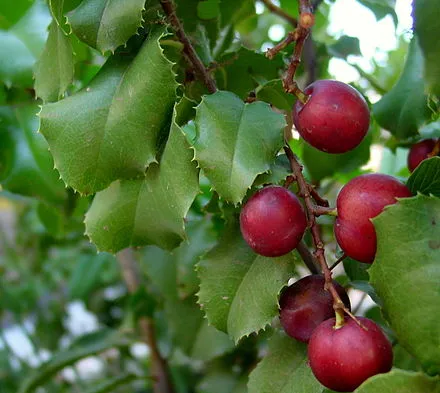
Prunus ilicifolia ssp. lyonii (https://calscape.org/Prunus-ilicifolia-ssp.-lyonii-(Catalina-Cherry)
There is on the islands of Catalina and Santa Cruz, off the coast of Southern California, an evergreen cherry which is much superior to the related species on the mainland. It is described as a tree fifteen to twenty-five feet high, with compact and well-rounded head, bearing a fruit three-quarters of an inch in diameter, dark red-purple, the thin pulp sweet, with a bitter almond flavor, but no acidity or astringency. This fruit has been mentioned as worthy of cultivation.
The problem with so much of our native fruit is that they are small and expensive to pick. But hey, that's what makes them worth more...................if they taste good.