
Research might seem like it happens primarily in labs or hospitals, under microscopes or with the latest in high-tech equipment. But in California, where farming has grown into a $60B industry, science is happening down on the farm — and research has literally become an essential part of putting food on the table.
Look no further than the Rosy Red Valencia orange. Patented in 2018 by citrus grower Nancy Lange, this juicy new citrus variety might never have made it to the market without help from University of California researchers.
The Rosy Red Valencia. Courtesy Nancy Lange/rosyredvalencia.com
UC Cooperative Extension, part of UC Agriculture and Natural Resources, works directly with farmers, ranchers and growers around the state, running experiments and collecting data to help farmers optimize their practices. UC Cooperative Extension advisors are in every corner of California, bringing scientific insight to farmers about drought and soil challenges, new varietals and technologies, and emerging pests and disease.
As a land-grant university, UC has been helping farmers feed America since the very beginning. But don’t take our word for it — the farmers themselves can tell you.
Nancy Lange wasn’t intending to develop her own variety of orange. But nature is the ultimate startup, and a tree on her farm in Tulare County had another idea.
“I had the remarkable luck to find a ‘sport,’ or mutated limb, on one of my Valencia trees,” Lange says. She marked this strange limb and registered it to be tested with the California Department of Food and Agriculture. Its leaves were pointy and lighter than those of others on the tree; and eventually, it produced oranges with a rosy blush rind and pinkish juicy flesh. She took buds from the limb to see if new trees with the characteristics of this branch would successfully grow, and much to her astonishment, they did.
A unique-looking branch could deliver new fruit with surprising deliciousness. But it could also be the warning sign of disease or genetic disaster. That’s why, with the help of UC Cooperative Extension advisors at nearby UC Lindcove Research and Extension Center, Lange reached out to UC Riverside’s Citrus Clonal Protection Program, a state-supported initiative dedicated to rigorously testing the safety and viability of new types of citrus. The stock CCPP creates from the original tree, or mutated limb, in Lange’s case, known as “Mother” trees, become the source for each nursery that will grow the variety in the future. The process took three years, but it was time well-spent, Lange says.
“Terrible diseases like HLB [Huanglongbing, or citrus greening disease], if allowed to infect citrus nursery trees, could wipe out California citrus. The job CCPP does is critical,” Lange says.
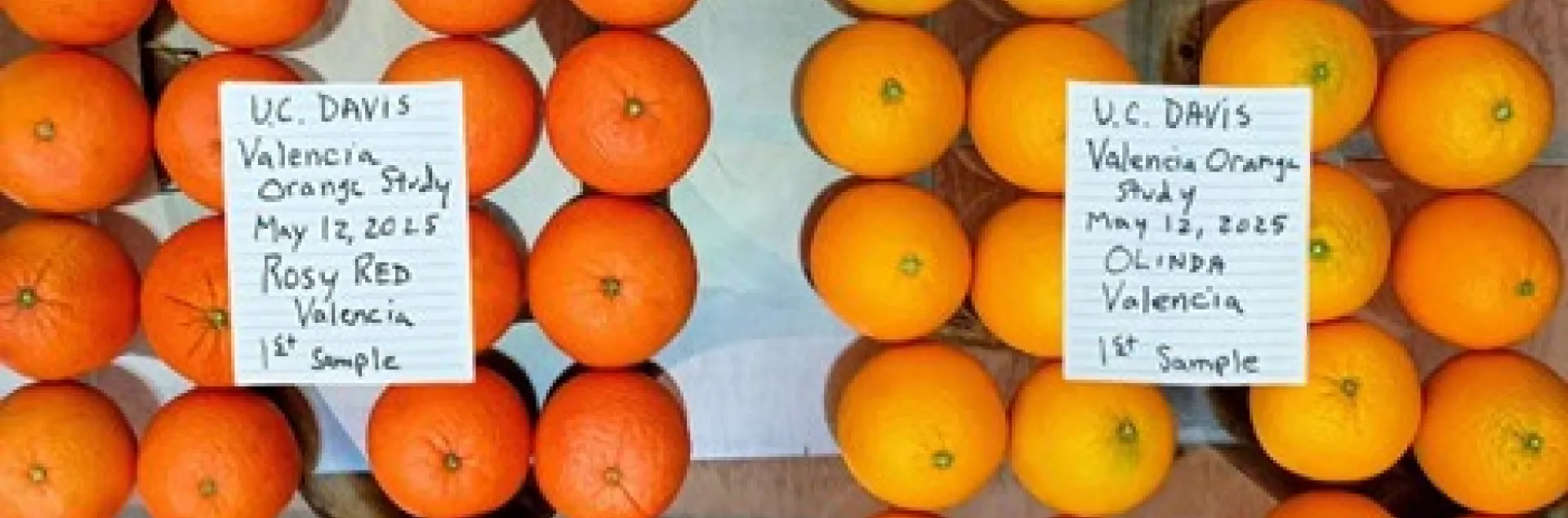
UC science continues exploring Lange’s exciting new orange — the Rosy Red participated in a study with the UC Davis Department of Nutrition this year, evaluating the antioxidant and anti-inflammatory capacities of the Rosy Red Valencia and Olinda Valencia types. Results of the study are expected in late fall. Stay tuned!
“There would be no Rosy Red Valencia without CCPP,” Lange says. With their help, from one mutated limb, thousands upon thousands of trees have now been planted, and the Rosy Red Valencia has begun to be harvested. Lange received her patent in 2018, and now she, and consumers around the country, can quite literally taste the fruits of her labor.
“I am grateful that this vital service is funded to allow for the growth of new varieties in California and continues to promote the innovation of the California citrus industry,” Lange says.
For more information:
University of California
Tel: +1 510 883 8232
Email: media@ucop.edu
www.universityofcalifornia.edu
