

Blog by Michelle Davis
I have long associated different flowers, flowering shrubs, and flowering trees with different seasons of the year and holidays, i.e., marigolds with Halloween, chrysanthemums with Thanksgiving, Bermuda lilies with Easter. As I was making my yearly pilgrimage to the CPA in Sacramento, I realized that I didn’t have one for tax prep and Tax Day. Looking around, it immediately occurred to me that the perfect flower would be Camellia japonica. They are blooming right now.
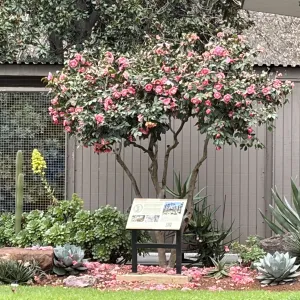
Japanese camellias are long-living, slow-growing, evergreen shrubs that can last more than 100 years with favorable growing conditions. They bloom from fall through spring, producing pink, red, purple, or white flowers. Originally from southeastern Asia, camellias can be found there in warm temperate and subtropical regions. Camellias belong to the plant family Theaceae, and if you look closely at that word, you would recognize the word “tea”. There are many species of the genus Camellia, and the tea branch of the line belongs to Camellia sinensis and its varieties. Most of the genus Camellia belongs to the tea lines. The horticultural or garden Camellia species includes Camellia japonica, Camellia reticulata, Camellia saluenensis, and Camellia sasanqua (this last group blooms mainly in fall).
Camellia japonica appreciates slightly acidic soil with consistent moisture (not soaking), planted where it is sheltered from wind and can have partial shade. Japanese camellias often do not survive when blasted with hot afternoon sun. The USDA hardiness zones are 7-9. Some gardeners without these ideal conditions will plant them in containers and move the container as needed during the year, repotting every 3 years as the plant gets bigger into a larger container. Given how slowly japonicas grow (decades to reach 6 feet), if a faster-growing camellia is needed, it would be better to plant a Camellia sasanqua.
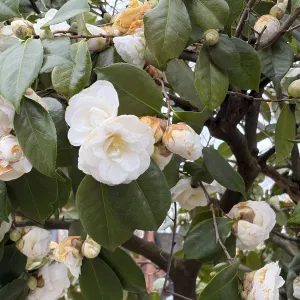
Camellias do not need to be deadheaded, as the bloom will eventually fall on its own, and deadheading doesn’t encourage reblooming. They also don’t need routine pruning except for any dead or broken branches. Some bud drop is to be expected, but if it seems like too much, it can be due to not enough soil moisture during the summer. And if the leaves are turning yellow with green veins, check the soil pH for alkalinity and fertilize with slow-release nitrogen fertilizer or, better yet, a specific camellia fertilizer, but only when temperatures are below 90 degrees F. Pick up the fallen buds and flowers to prevent pests and diseases. Roots grow close to the surface, so consider mulching to keep the soil moisture in, but not soaking. The blooms attract songbirds and pollinators, and if you have the right growing environment, can be a beautiful addition to your home landscape.