Blog by Lisa Rico
This last summer, I befriended a praying mantis. Confession, they were not my favorite. Besides being a bit freaky looking, they eat things I don’t want them to eat. For example, I had one that lived in my artichoke plant and would literally “hang out” near the flower, just waiting for a bee. I let the choke go to flower just FOR THE BEES? Doesn’t it understand that?
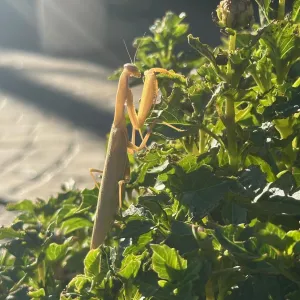
Some of you may remember I wrote recently about trying to become more “bug-friendly.” In that effort, I’m trying to let Mother Nature be more in charge and make friends with the mantids (mantises).
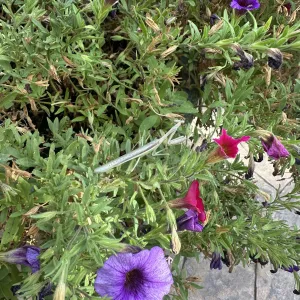
This summer, they must have received the memo because I had plenty of them. My yard and garden areas are spread out quite a bit, and at least one mantid was living and thriving in each bed. One was living among some potted plants outside my studio door. Every day when I watered, she would appear – a bit frantic as she climbed to the top of the plant to avoid the water spray. I named her Matilda. I watched as she got bigger. Eventually, she began to turn colors and became the exact same color as the browning leaves. I had no problems with budworms on my Calibrachoa this year, where, in the past, I’ve had to use the Bt spray regularly. Good job, Matilda.
One day, I noticed a new mantid nearby. Smaller and greener with long antennae.
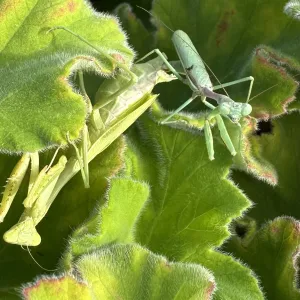
Thanks to easy research at https://ipm.ucanr.edu, I was able to easily identify the male and female mantid and learn about their mating cycle. They had a long and interesting courting session. Over the course of a week, the distance between them grew shorter until one late afternoon, I noticed they were “together.” The male, now known as Matthew, was on Matilda’s back.
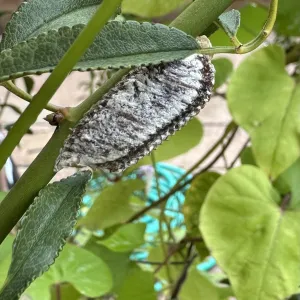
They remained “together” for days. I understand sometimes the male hangs on to avoid becoming a post-mating snack. But Matilda allowed Matthew to survive the ordeal and went on to lay her eggs nearby, where they remain today waiting to hatch.
The egg casing, called an ootheca, can hold dozens of eggs. This spring, I look forward to getting to know their offspring and watching them snack on budworms only, no bees, Matilda promised.