
Blog by Jenni Dodini
I spent hours trying to figure out how to take care of these olive trees that I have become responsible for on our property. I came to the conclusion that I might be overthinking the whole thing after poring through multiple sites, but I kept on and found that there are enough sites to make anybody doubt their intelligence. However, the ones that gave the most consistent information were UC Agriculture and Natural Resources, Planet Natural, American Olive Farmer, UCD Olive Center, and The Sunset Western Garden Book.
I know that one can drive all over the valley and see olive trees pretty much everywhere. People have them in their personal gardens. We have them on our property. Because of that, one would think that I might know a little something about them, and the words "little something" pretty much describe my knowledge, since for years they were maintained by the person leasing our land. I knew that they were the kind that olive oil is made from. I knew that the cicadas happen and do not harm the trees. I knew that even on an organic farm, the trees needed to be sprayed for olive flies, or whole groves would not have a good yield, even the nearby groves that had been sprayed. I knew that every Christmas, a jug of olive oil would show up after "they" did the harvest and took the fruit away. Then things changed...
Image
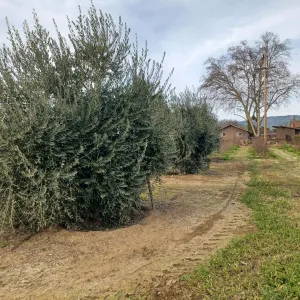
We now have 5 trees that we are responsible for, except for the spraying, because the current leaseholder has the permit and does the spraying.
They survived being transplanted and the ensuing heavy winds and rains of the following winter. Last year, 2024, I thought that I would harvest the fruit and take it to our local milling business on the community milling days. Life circumstances and early rains got in my way, and all of that lovely fruit went to waste. I also realized that I knew absolutely nothing about those trees except that they do fine even with the cicadas showing up and benign neglect. This is what sent me down the rabbit holes on the internet. Then I gave up and worked on other things.
Fast forward to this year. I have a friend on the other road whose family ranch has many acres of olive trees that produce tons of fruit and, therefore, gallons of oil. She encouraged me to get interested again and harvest the fruit this past year, 2025. Well, I did more research and a review of the research I did last year. I did pay attention to the trees and gave them a couple of good DEEP waterings during the summer's heat waves. What else did I learn? Olive trees, Olea europaea, are evergreen trees that are fairly drought-tolerant once they mature. They don't do well in clay soils as they like sandy, rocky, slightly alkaline, fast-draining soils. They are not very happy when we have terribly wet winters; however, they do quite well in the hot, dry summers of our Mediterranean climate. They do best in USDA zones 8 to 11, where they receive 6 to 8 hours of full sun daily and can tolerate temperatures down to 15 degrees F.
I'll go by season to fill you in on what else I learned because this is what makes more sense to me:
- SPRING -- This time of year is when they bloom. They may need to be pruned if the bloom is particularly heavy. Fruit is only produced on the new wood. They recover well from pruning. One should prune their trees to human height for ease of harvesting, and also prune to promote good air circulation and a balanced canopy. If left to their own devices, olive trees would grow to be 30-foot-tall bushes! After pruning, avoid getting those areas wet. Fertilize mature trees with a balanced, slow-release fertilizer or compost, but be careful not to over-fertilize. Irrigate slowly after fertilizing.
- SUMMER -- This is the time for my least favorite chore, weed control. The young trees will need another round of fertilizing. Use drip irrigation as needed, but decrease watering during ripening to give the oil a better flavor.
- FALL -- If your olives are the variety for table fruit, you should harvest the fruit when it is green. If your trees are for olive oil, harvest when the fruit is black, but the fruit inside is still yellow-green. Green to purple fruit produces a peppery oil, while fully ripened fruit gives a more buttery-flavored oil. Harvested fruit needs to be kept cool and milled within 24 hours of picking. The trees start producing fruit around the 3rd year and reach full production around the 5th year. They can live and produce for a really long time.
- WINTER -- After the harvest, you will need to spray to prevent peacock spot. You might need to do some light pruning, so long as the weather is dry. And of course, continue orchard maintenance. Common diseases of olive trees are olive knot and verticillium wilt. Common pests are the olive fruit fly, scale insects, and olive moths.
So, not knowing the variety of trees that we have, I asked my good friend Google, and he said they are 'Arbequina'. Arbequina is the most common variety; however, there are newer breeds called 'Favulosa' and 'Lecciana'. So, you might ask, how did things go this past fall? Well.....Life got in the way again, and I missed both of the community milling dates. I looked at a video of pressing one's own fruit and found that to be a tedious process that I really had no interest in learning. Now, I have to rake up the fallen fruit and plan to do some pruning after the rains (I am optimistic that we will get rains this year), and hopefully get around to harvesting next fall.
banner image by Gary Barnes: https://www.pexels.com/photo/crop-faceless-gardener-touching-olives-on-tree-in-garden-6231906/