
Blog by Michelle Krespi
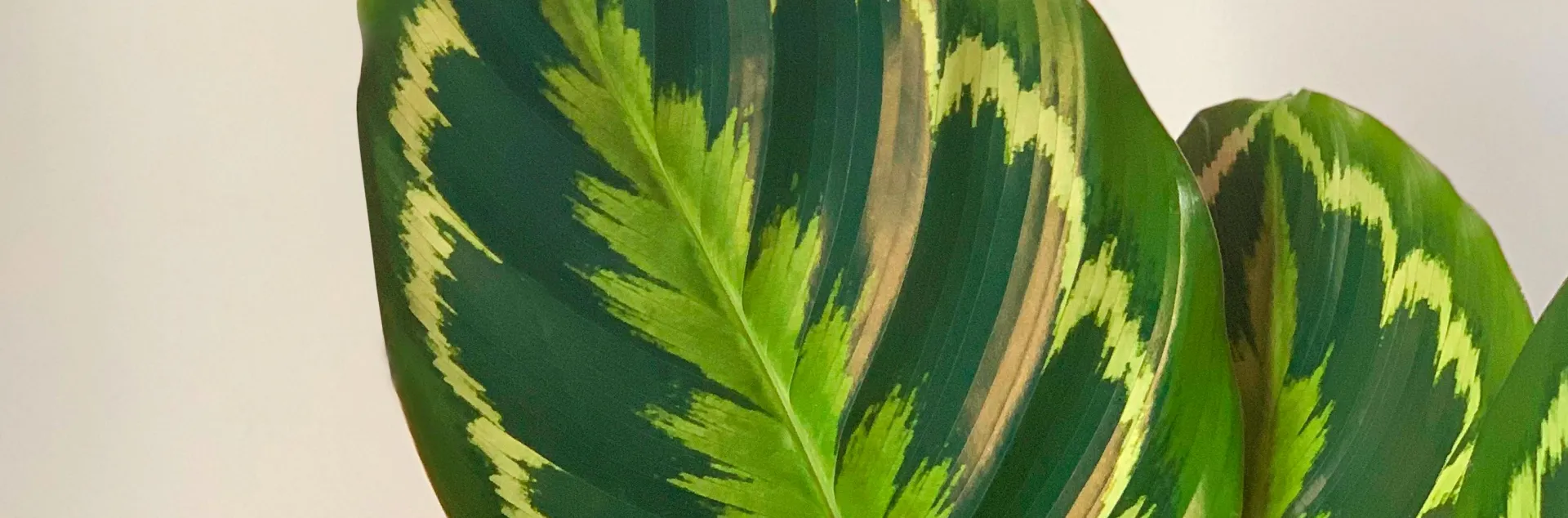
I have grown plants from the Calathea genus before, so I was used to the variety of leaf patterns this group exhibits. What drew me to this particular plant was how painterly the leaves are. The common name sums it up, Rose-Painted Calathea. Each leaf is a work of art, as you can see from the image of my new plant. It has a unique palette of dark green with accents of pink and white, which resemble brush strokes. In fact, the name roseoptica means “zebra-striped” in response to the pattern of the leaves. Like many in this genus, this plant has its own rhythmic movement. The leaves open during the day and close in the evening, which is a common response in the prayer plant family to air temperature and light. Its native habitat is the tropical rainforests of Brazil. It is found under canopies in warm, moist, and most notably shaded environments. As you’ll see, the right amount of light, humidity, and water are essential factors in how this plant thrives.
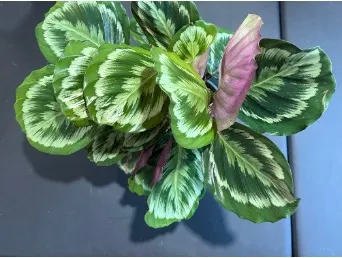
This plant, also referred to as Jungle Rose, is an evergreen perennial that grows as an understory plant.[1] Commonly, it is used as a houseplant and grows in a clump-forming, bushy habit, reaching a height and width of 1’ to 2’.[2] These qualities make this an ideal houseplant. Like many of the plants I write about, this plant has received the prestigious Award of Merit of the Royal Horticultural Society. Along with these qualities, Calathea plants are non-toxic to humans, cats, and dogs, but the sap may irritate people with sensitive skin. Although the plant is hardy in USDA zones 11-12, it is NOT frost-tolerant and only does well in temperatures ranging between 65˚F and above. Not only is this ornamental easy on the eyes, but it also improves indoor air quality by filtering out air pollutants as well!.
In order to keep your plant vibrant, it is important that it receives adequate humidity. A humidifier in the room would be perfect, but if that’s not an option, just fill the saucer the plant sits on with pebbles and fill with enough water so the roots don’t touch the water. Calatheas like moist conditions as long as they’re not waterlogged, which could lead to root rot. Lighting is another important aspect of its care.
Goeppertia roseoptica thrives with indirect light. Direct light will not only fade its beautiful striped leaves but can actually cause burn marks. Its placement by a light source that is muted by sheer curtains is essential to its growth. Feeding your plant is also important. As a rule, avoid fertilizing your plants during the winter months when many plants are in their dormancy. During the spring and summer, their growing season, feed this plant with a balanced, diluted fertilizer[3] once a month. I recently started using a pH meter when potting my plants. The optimum pH is between 6.0-6.5. Optimum means that the plant will uptake the maximum nutrients to support plant growth and health. I keep my plant clean by wiping down both the tops and bottoms (plants have breathing pores called stomata), which also need cleaning to allow incoming oxygen and to expel carbon dioxide, every month.
Finally, when you see roots coming from the holes in the bottom of your container, it’s a message that your plant needs repotting.
The best time to do this is during the plant's active growing phase. In the Calathea genus, most plants are propagated through division. In order to do this, remove your plant from its pot. The best way to do this is to lay the pot (if it’s plastic) on its side and push down all the way around, loosening the soil inside. Ease your plant out and look for natural clumps as a place to divide it up, making sure each section has one or two leaves and a good amount of roots. Fill the bottom with new potting mix, which should be made of one part peat moss or coco coir, one part compost, and one part perlite, making sure there are drainage holes at the bottom of your pot. [4]
With the correct care, this plant can live between 5 and 10 years, providing striking beauty and air purification for its entire life!
Thumbnail Photo by Kulbir: https://www.pexels.com/photo/calathea-roseopicta-leaves-9641446/
[1] An understory plant is a type of vegetation that grows underneath the forest canopy, which is comprised of smaller trees, shrubs, and herbs that are all shade-tolerant, thriving in low light conditions.
[2] Website- “Gardenia Creating Gardens”- Calathea roseoptica (Rose-Painted Calathea): An In-depth Look
[3] A fertilizer is considered “balanced” when the three macro nutrients Nitrogen (N), Phosphorus (P), and Potassium (K) are in equal proportion.
[4] Website: Everything You need to Know to Grow Goeppertia rosdeoptica by the Gregg Editorial Team