If you've ever glimpsed a European wool carder bee foraging in your yard, chances are that's all you saw--a glimpse. The wool carder bees (Anthidium manicatum), so named because the females collect or "card" plant fuzz for their nests, move quickly.
A quick post today to share a few links and reposts that I found interesting recently. The first is a link to a video on the television program, CBS Sunday Morning. In this program from a week ago, weeds were the focus. Click here for a link to the video.
You often see a single solitary bee on a sunflower. Perhaps it's a sunflower bee (Svastra) or a honey bee (Apis mellifera). But four on one? Sharing a sunflower? Yes.
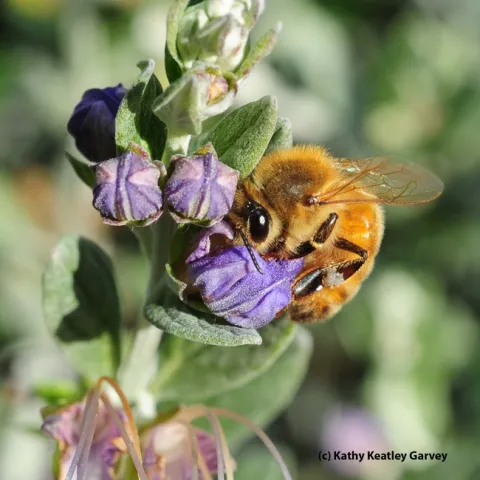
Now that's Italian! The Italian honey bee (below) nectaring on a zinnia at the University of California, Davis, is striking for two reasons: she's as gold as starthistle honey in the sunlight and she's a very young forager.
Seattle will be the place to "bee" on Oct. 4-7. That's where the Western Apicultural Society (WAS) will hold its annual meeting--and this year it's in conjunction with the Washington State Beekeepers' Association.
The photo just begs for a caption. The praying mantis, with a female sweat bee grasped in its spiked forelegs, suddenly turns its head to look at the photographer. Actually, three photographers: Davis insect photographers/bee enthusiasts Allan Jones and Gary Zamzow and I.
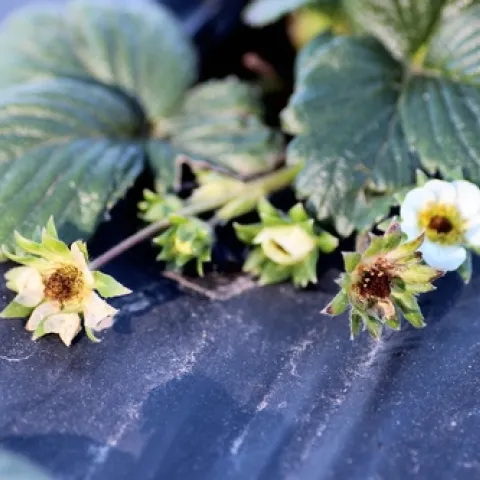
Spotted wing drosophila (SWD), Drosophila suzukii has become a potential concern for strawberries following its damage to cherries, blackberries, raspberries, and blueberries in coastal California. Other species of Drosophila are morphologically not equipped to attack ripening strawberries.
Dairy feed production is particularly amenable to conservation agricultural practices, according to four dairy operators featured in Part 4 of the Conservation Agriculture documentary series, released today on the Conservation Agriculture Systems Innovation website. (The video is also posted below.