The next step is to contact the club leaders and find out what projects are offered within that club that your youth may be interested in. Examples of projects include but are not limited to:
- Agriculture & Livestock
- STEM & Robotics
- Healthy Living
- Shooting Sports
- Photography & Arts
- Leadership & Civic Engagement
Note: Members may belong to one primary club while also enrolling in projects offered by other clubs if their primary club does not offer a project they are interested in.
Once project plans are complete, the county office staff will update ZSuites to reflect available projects per club. Members can then enroll in projects and start attending project meetings as the project leaders will be reaching out to all enrolled members on meetings and events. 4-H projects should be chosen based on interests, time available, family situation, residence, and availability of necessary tools and equipment. The project leader will develop and implement a project plan where members may design individual projects or work together on approved projects while also gaining the knowledge and skills of the topic.
Project meetings have a minimum requirement of 6 hours annually; however, some projects utilize more time throughout the year than the minimum requirement. The project leader will inform members and families of when meetings will occur.
In 4-H programs, youth take on leadership roles where they set goals, develop plans, complete projects, and reflect on their experiences. Youth are encouraged to discover their passions, adopt a growth mindset, practice self-reflection and set goals. 4-H projects and programs are focused around civic engagement, healthy living, and STEAM.
4-H Pledge
As a true 4-H member, I pledge:
My Head to clearer thinking,
My Heart to greater loyalty,
My Hands to larger service,
My Health to better living,
for my club, my community, my country, and my world.
Spanish:
Prometo usar mi mente para pensar con más claridad,
mi corazón para ser más leal,
mis manos para ser más servicial,
mi salud para cuidarme más,
por mi club, mi comunidad, mi país y mi mundo.
Translated by Dr. Lisa Lauxman, National 4-H Foundation
4-H Name and Emblem
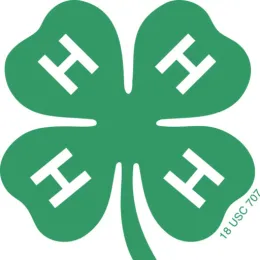
The 4-H Emblem is the national symbol of Cooperative Extension’s 4-H program supported by the United States Department of Agriculture (USDA).
The 4-H Emblem is a four leaf clover that has an "H" on each leaf, representing Head, Heart, Hands, and Health.
The clover is green to symbolize growth and youth, and the white color of the H's represents sincerity and honesty.
The clover was adopted in 1909. National 4-H has a policy about the proper use of the clover to help preserve its special character.
4-H Motto
"To Make the Best Better"
The Future of 4-H
California 4-H Strategic Plan 2023-28
The CA 4-H Strategic Plan 2023-2028 focuses on three interconnected themes to advance California 4-H towards high quality, equitable youth development programming and applied research over the next five years.
The three themes are:
- Strengthen access, equity and belonging in 4-H programs.
- Increase opportunities for meaningful youth engagement in high quality 4-H programs aligned with the 4-H Thriving Model of Positive Youth Development.
- Advance youth development research and extension.
The following areas were identified to support advancing the three themes:
- Grow financial stability.
- Improve communication and brand awareness.
- Reimagine volunteer management.
- Streamline administrative procedures.
Call to Action
Questions? Contact the Tulare County 4-H Office at 559-684-3300, Monday–Friday from 8 AM–5 PM. We hope you’ll join us!