
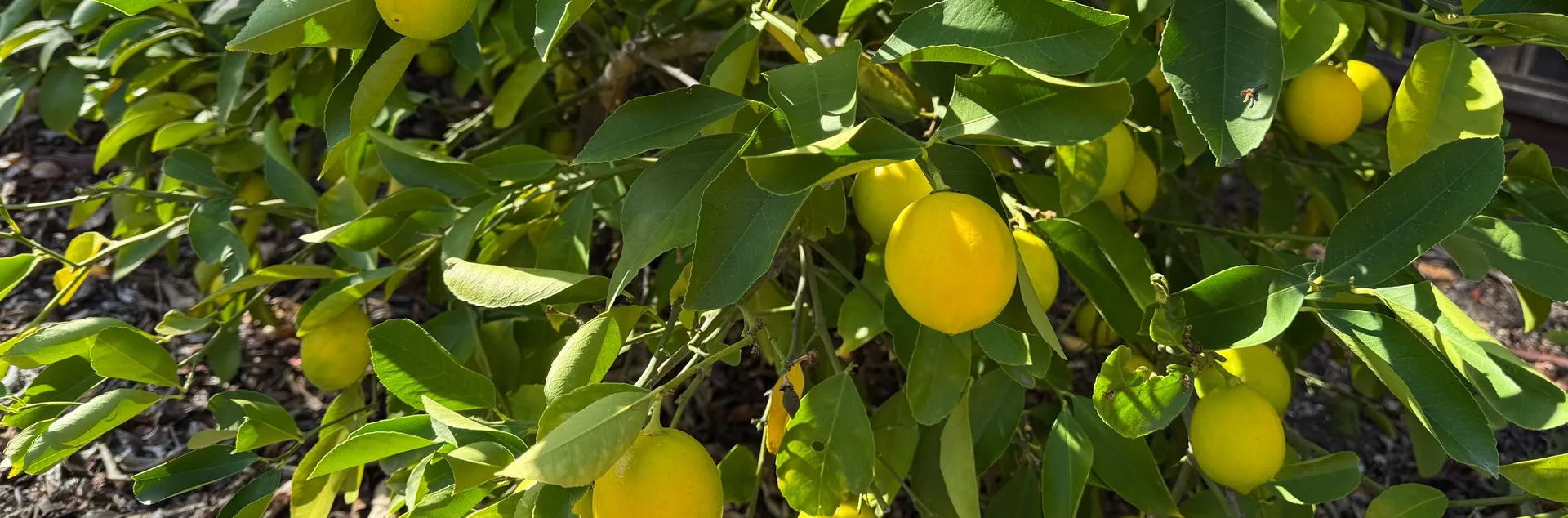
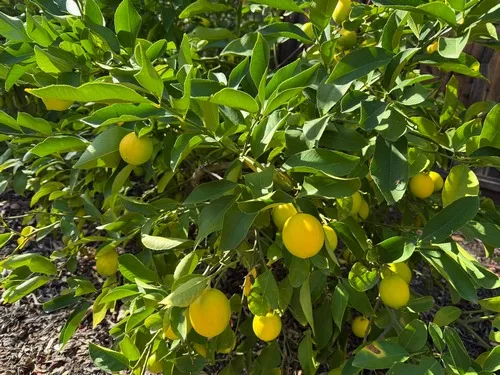
This time of year, we often hear from concerned growers of Meyer lemon trees and other citrus. The leaves are turning yellow, just as the fruit is nearing maturity. These symptoms are frequently due to nutrient deficiencies and/or too much or too little water. It could also be the cooling weather. Let’s talk about what you can do to help your trees stay healthy and happy.
Watering
Many trees take several years to become established, as their roots need to grow before they can support robust growth on top. Under-watering is a common problem for young trees. Citrus trees have shallow roots and need consistently moist but not soggy soil. The only way to be sure the water is getting deep enough is to check the soil in the root area by either taking a sample with a soil sampling device, digging a hole with a small trowel (without disturbing the roots), or using a water meter. Irrigate only when the top few inches of soil are dry.
Apply water to the entire root area which extends out past the edge of the tree’s canopy. Don’t apply water right at the trunk because there are no feeder roots in that immediate area and it can cause problems with fungal diseases.
During the heat of summer, a young citrus tree that is about 4 feet across will need 12 gallons of water each week if growing in a sunny location in the warmer areas of Contra Costa. The quantity required drops as we get into the cooler months. Until your tree is better established, plan to give it water once a week. Mature citrus trees need deep watering only once a month.
Having a 3- to 4-inch layer of mulch around the tree is extremely helpful to retain soil moisture and keep roots cool. The bottom of the trunk needs access to the air, so keep the mulch about 6 inches away from the trunk.
Fertilizing
The nutrients most commonly associated with various patterns of yellowing on leaves in citrus are nitrogen, iron, and to a lesser extent, manganese, magnesium, and zinc. Most mature citrus require regular fertilization with high-nitrogen fertilizer. Unless the tree is in a container, most other nutrients are available in sufficient amounts in the soil. We recommend organic fertilizers for citrus, following the package recommendations to feed. Nitrogen should be applied in January or February just prior to bloom. The second application then can be applied in May and perhaps a third in June. Typically, nitrogen is applied to the soil surface then watered in. Too much fertilizer or fertilizer applied too late in the summer or in the fall produces excessive growth that can invite problems with pests and disorders.
It’s also very common to see yellow leaves on citrus trees in winter. Cold soil causes the plant to be unable to take up sufficient nutrients even if they are available in the soil.
Air Circulation, Winter Protection, and Sunlight
For now, prune only to remove suckers that appear below the graft line and any highly vigorous, vertical shoots (water sprouts) that are too close to other branches (this is common on lemons).
With winter approaching, make sure you protect the tree from frost. Use a frost cloth cover that doesn’t touch the leaves (hold it above the tree with stakes) and goes all the way to the ground. If temperatures much below freezing are expected, use the old-fashioned incandescent Christmas tree lights (not LED) to provide a little heat. Make sure the soil is well moistened before an expected freeze.
And lastly, if your tree doesn't receive 6 to 8 hours of direct sunlight each day during spring, summer and fall, you might consider either pruning the plants shading it or transplanting it to a sunnier location.
See these links for more information about growing happy and healthy citrus trees:
• Growing citrus in Contra Costa County: https://my.ucanr.edu/blogs/slomggarden/blogfiles/4260.pdf
• Citrus pests: https://ipm.ucanr.edu/PMG/GARDEN/FRUIT/citrus.html
• Citrus pests: https://ucanr.edu/sites/default/files/2020-02/319461.pdf
• Yellowing leaves: https://ucanr.edu/blog/over-fence-alameda-county/article/yellowing-citrus-leaves-spring-summer-and-fall-what-do#
• https://my.ucanr.edu/blogs/slomggarden/blogfiles/4259.pdf
Help Desk of UC Master Gardeners of Contra Costa County (SEH)