
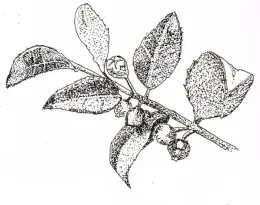
Huckleberry is a native shrub of the redwood forest understory and coastal bluffs on the California North Coast and thrives in neighborhoods at the forest edge. This article focuses on the benefits of gardening with huckleberry - a beautiful, easy to care for bush, which attracts bees and hummingbirds and produces delicious fruit - as an example of one of several native species of berry that can be grown in our Humboldt and Del Norte County coastal gardens.
Native Plants:
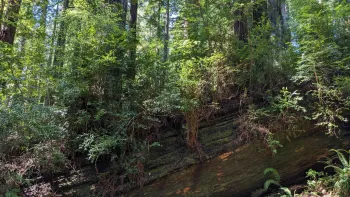
There are many benefits to growing native plants in one’s garden. Natives are ecologically adapted to local climate and soils, and are generally easy to maintain, requiring less water or fertilizer than many other plants. They provide habitat for wildlife including native pollinators, and are often resistant to garden pests and diseases. For those who hope to gain a crop from their garden, there are numerous species of native plants in our region that produce delicious berries. Some native plants that provide edible berry crops include black raspberry (Rubus ursinus), red elderberry (Sambucus racemosa), salmonberry (Rubus spectabilis), strawberry (Fragaria spp.), thimbleberry (Rubus parviflorus), red huckleberry (Vaccinium parvifolium), and California or Evergreen huckleberry (Vaccinium ovatum).
Evergreen huckleberry in the wild:
V. ovatum is one of 400 species worldwide in the large genus, Vaccinium in the Ericaceae family, which also includes cranberries and blueberries (Stuart and Sawyer 2001). Evergreen huckleberry occurs along the Pacific Coast from British Columbia to central California and grows throughout the Coast Ranges and the central Sierra Nevada and in the higher mountains of southern California. It is a very common native understory shrub of redwood and mixed Evergreen forests of Northern California (Figure 1) and of coastal headland shrub communities (Tirmenstein 1990).
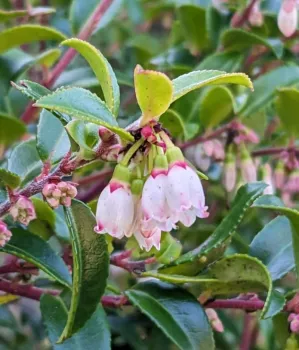
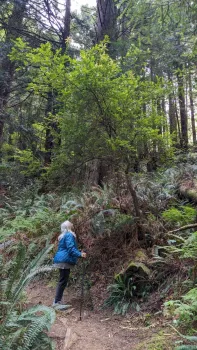
In the forest, Evergreen huckleberry may grow 2-5 meters tall (Figure 2). It has egg-shaped, leathery, shiny, Evergreen leaves between 2 to 5 cm long with fine toothed margins. Flowers are white to pinkish and bell shaped (Figure 3). The berries are black and small (around 0.5-1 cm in diameter) (Stuart and Sawyer 2001; Tirmenstein 1990). Huckleberry shrubs provide cover for a variety of wildlife species, forming dense thickets which may serve as hiding, resting, or nesting sites for many birds and mammals. Elk and deer browse them. Flowers attract long tongued bees and hummingbirds and the fruits are eaten into the winter by a wide variety of wildlife, including birds, bears, foxes, raccoons, squirrels, skunks and deer (Tirmenstein 1990.)
Native American tending of evergreen huckleberry:
North American Peoples’ use of Vaccinium species for food and medicine is well documented (e.g., Turner 2014; Trusler and Johnson 2008). Native American tribes of Northern California have long used fire to cultivate basketry materials, nuts and berries including Evergreen huckleberry in their agroforestry systems (Lake 2022). Huckleberry branch tips (meristems) are pruned to increase flower and fruit yield and ease of harvest (Frank Lake personal communication).
Evergreen Huckleberry Diseases:
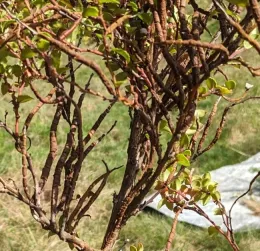
Evergreen huckleberry is a host plant for Huckleberry Witches’ Broom Rust, a disease caused by a fungus called Pucciniastrum goeppertianum. Some fungi, especially rusts, use alternate host plants to complete their life cycle. These fungi require two different hosts for distinct stages of their development and disperse between them via specialized spores. Cool moist spring weather favors rust. Symptoms on huckleberry include dense branching (witches' broom) and brown spongy swelling and loss of leaves on stems and reduced fruit production (Figure 3). The alternate hosts for the rust are any true firs, such as grand fir (Abies grandis) growing within 350 meters. So, to get rid of the rust, one would have to remove all true fir from the vicinity. Luckily, while the witches’ broom is unattractive, the affected branches and dead wood can be removed, and shrubs will live on and continue to bear fruit (Mulvey 2024; Pacific Northwest Extension 2025). A second, perhaps greater concern over time is Sudden Oak Death, a funguslike pathogen called Phytophthora ramorum. Sudden Oak Death kills a number of tree species in California and causes the Ramorum blight which infects leaves and twigs of other plants including Evergreen huckleberry (UCANR).
Uses of evergreen huckleberry:
The floral industry prizes Evergreen huckleberry foliage as a component of flower bouquets - a common sight wherever cut flowers are sold. Huckleberries
can be harvested from July into late fall and eaten fresh, frozen, cooked and preserved. They can be added to salads, pancakes and ice cream, made into syrups and jams, and baked into delicious huckleberry pie. They are full of flavor both sweet and tart and are high in vitamins A, B, and C.
Evergreen huckleberry in the home garden:
Evergreen huckleberry often persists at the forest edge and after logging in openings after timber harvest (Tirmenstein 1990), and can be a very common volunteer shrub in housing subdivisions built on land converted from redwood forest. Evergreen huckleberry can be grown in Sunset Zones 4-7, 14-17, 22-24 and thrives in acid soils (pH 4.3 to 5.2). It does not transplant well from the wild. However, plants can be propagated by hardwood cuttings or seed and transplanted 6-7 weeks after plants emerge (Tirmenstein 1990). Plants are not always available on the market, however, efforts to develop cultivars for commercial nurseries are underway (Contreras 2024) and plants may also be sourced locally through California Native Plant Society sales.
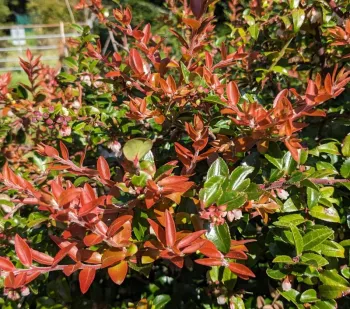
Evergreen huckleberry is a very attractive shrub that grows well in shade to partial sun and has glossy dark green leaves. It will tolerate well-drained exposed sites. New growth in spring is a showy coppery pink (UCANR 2012) (Figure 4). Plants need little maintenance and shrubs can be left to grow into their natural shape or lightly pruned as specimen plants. Alternatively, they can be trimmed into dense hedges. Evergreen huckleberry flowers from March to August (Figure 5) and fruit ripens from July through October. Flower and berry yield will be higher in sunny to semi shaded areas. Flower buds tend to be more numerous on new shoots and periodic removal of old shoots can increase flower and fruit production (Tirmenstein 1990). Birds love the berries, so netting may be needed to ensure a harvest for the gardener.
References
California Native Plant Society 2025. https://northcoastcnpsnursery.org/sale/
Contreras, Ryan. 2024. Vaccinium ovatum ‘Cascade jewel’. HortScience 59(4):503-504 https://doi.org/10.21273/HORTSCI17666-23
Hummer, K. 2013. Manna in Winter: Indigenous Americans, Huckleberries, and Blueberries. HortScience Vol. 48(4) April 2013. https://doi.org/10.21273/HORTSCI.48.4.413
Lake, Frank. 2022. First Peoples. Chapter 1 in Kauffman, M. and J. Garwood (Eds). The Klamath Mountains, A Natural History. Backcountry Press. Kneeland, CA.
Mulvey, Robin. 2024. Huckleberry Broom Rust (Pucciniastrum goeppertianum) (Kühn) Kleb. Forest Health Protection Home Page. USDA Forest Service Alaska Region. https://www.fs.usda.gov/detailfull/r10/forest-grasslandhealth/?cid=FSEPRD1003772
Pacific Northwest Extension. 2025. Huckleberry (Vaccinium spp.)-Witches' Broom Rust. Pest Management Handbooks. Oregon State University. https://pnwhandbooks.org/plantdisease/host-disease/huckleberry-vaccinium-spp-witches-broom-rust
Stuart, John and John Sawyer. 2001. Trees and Shrubs of California. California Natural History Guides. University of California Press.
Tirmenstein, D. 1990. Vaccinium ovatum. In: Fire Effects Information System, FEIS [Online]. U.S. Department of Agriculture, Forest Service, Rocky Mountain Research Station, Fire Sciences Laboratory (Producer). Available: https://www.fs.usda.gov/database/feis/plants/shrub/vacova/all.html [2025, April 20].
Trusler, S. and L.M. Johnson. 2008. "Berry Patch" As a Kind of Place: The Ethnoecology of Black Huckleberry in Northwestern Canada. Human Ecology, Aug., 2008, Vol. 36, No. 4 (Aug., 2008), pp. 553-568. https://www.jstor.org/stable/27654313
Turner, N. J. 2014. Ancient Pathways, Ancestral Knowledge. McGill-Queens University Press. ISBN 9780773543805
UCANR 2021. UC Master Gardener Program of Sonoma County. Native Shrubs for Foliage. https://ucanr.edu/site/uc-master-gardener-program-sonoma-county/native-shrubs-foliage
UCANR. Sudden Oak Death. UC Master Gardener Program of Sonoma County. https://ucanr.edu/site/uc-master-gardener-program-sonoma-county/sudden-oak-death
Personal Communication
Dr. Frank Lake, Ecologist. USDA Forest Service Pacific Southwest Research Station
Image Credits:
Text, photos, and drawings, unless otherwise noted, from the author, Yvonne Everett, UC Master Gardener of Humboldt & Del Norte Counties