
Author: Kat Kerlin, UC Davis
California has one of the highest rates of wildfire-driven deforestation in the world, and the trend has accelerated over the past three decades, according to a study from the University of California, Davis.
The study, published in the journal Frontiers in Forests and Global Change, assessed the state’s wildfire-driven deforestation rates and reforestation needs between 1991 and 2023. It found that deforestation in California’s conifer-dominated forests increased exponentially over the study period, taking place primarily on USDA Forest Service and private lands. Meanwhile, reforestation efforts are not keeping pace with the losses.
Reforestation needs were minimal in the early 1990s, rose sharply in the early 2000s and surged after 2020. During that time, California lost between 6% and 11% of its conifer forests. Multiple big-fire years caused deforestation rates to rise to between 0.25% and 0.47% per year between 2001 and 2023. That is substantially higher than the global average of 0.15% per year.
“Those rates are right up there with the world’s leaders in fire-driven forest loss, like Russia, Portugal, Greece, Bolivia and even Canada,” said senior author Hugh Safford, a forest and fire ecologist with the UC Davis Environmental Science and Policy department. “In the case of California, the rate is also accelerating rapidly. A couple more big-fire years like 2020 or 2021, and we could be looking at large-scale loss of conifer forests over wide swaths of the state.”
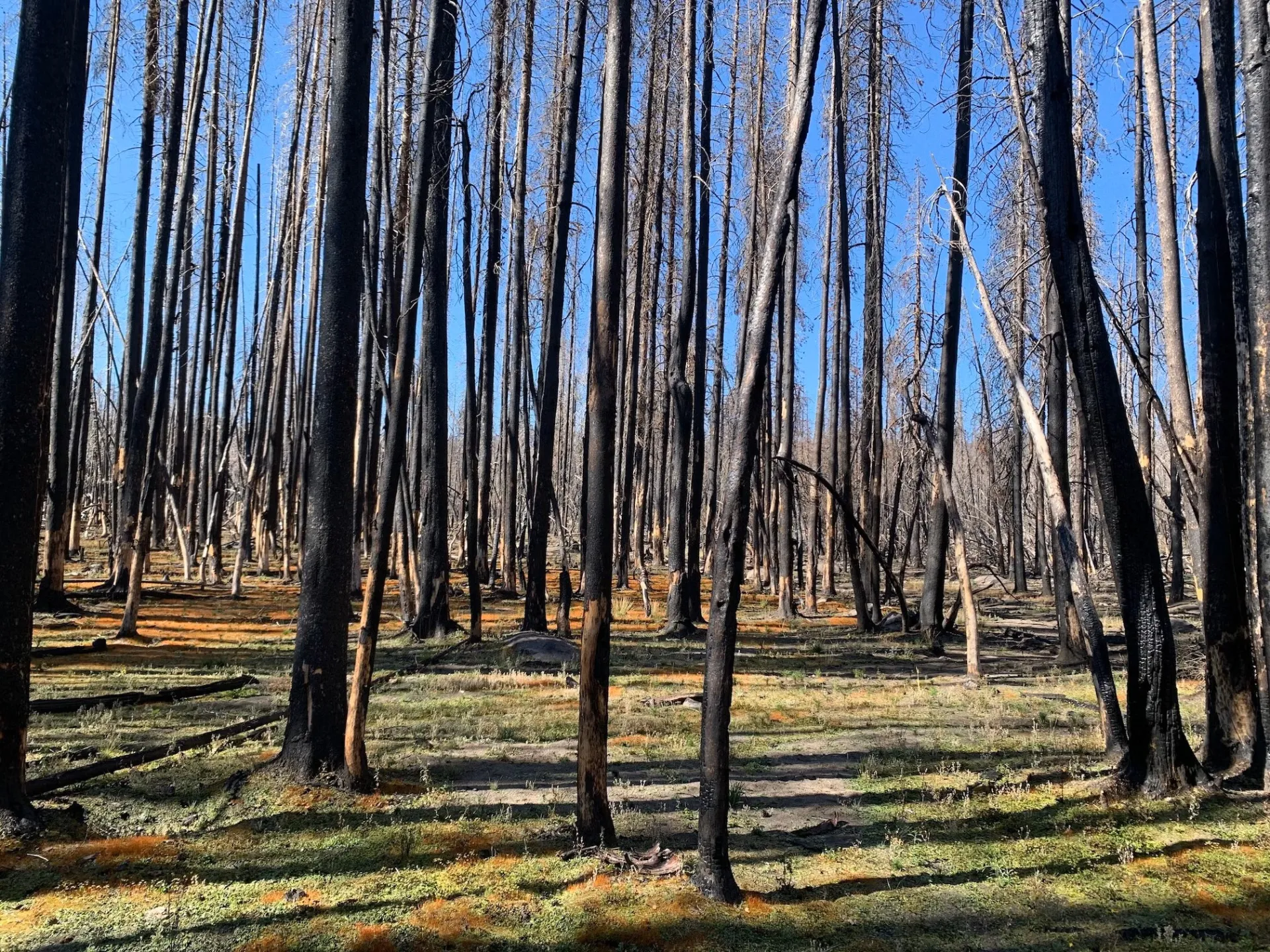
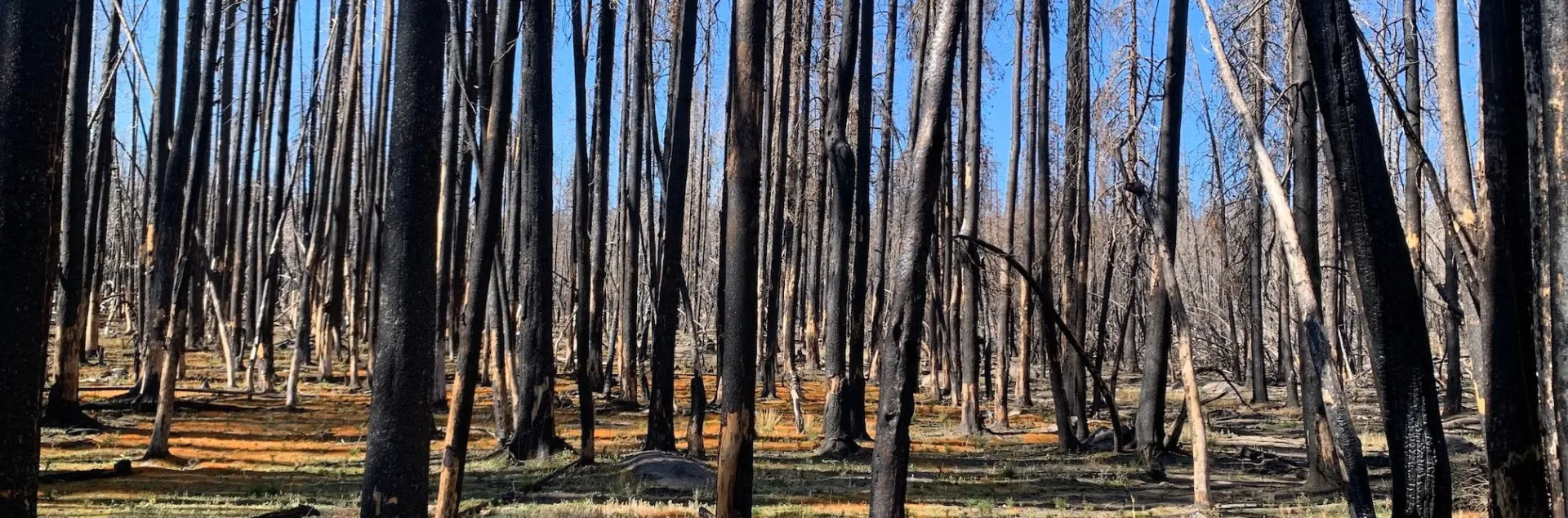
Two years after 2021's Dixie Fire in Lassen County, charred remnants cast shadows over the forest as new growth emerges. (Kat Kerlin/UC Davis)
Estimating forest loss and growth
For the study, scientists combined remotely sensed fire severity data with a tool called POSCRPT (Postfire Spatial Conifer Regeneration Prediction Tool) that was developed by UC Davis, UC Berkeley and the Forest Service. They were able to estimate how much forest was actually lost by incorporating both tree mortality and projected five-year postfire seedling densities.
Forest restoration needs were assessed under scenarios of moderate, high and acute priority. Moderate scenarios incorporated only a tree mortality measure, while the other scenarios incorporated both tree mortality and the probability that seedlings will regenerate.
The team found that on Forest Service lands only about 8% of high-priority areas and less than 3% of acute-priority areas were reforested during the entire study period. Between 2016 and 2023, only about 1% of deforested Forest Service lands were replanted. In contrast, on private industrial timberlands, more than 90% of severely burned lands were replanted.
Fire-driven reforestation needs
The state’s greatest reforestation needs are in Sierra Nevada mixed conifer forests and Northern California Douglas-fir forests, especially areas hit by the massive 2020 and 2021 wildfires: the northern Inner Coast Ranges, the northern Sierra Nevada–southern Cascades, and the southwestern Sierra Nevada.
While middle-elevation forests experienced the greatest losses, high-elevation forests showed the fastest increases in deforestation.
Those rates are right up there with the world’s leaders in fire-driven forest loss." — Hugh Safford, UC Davis
The paper noted that federal budgets and staffing for reforestation have been dropping for decades, even as drought, wildfire and pest outbreaks increase. This is in contrast to Canada, where similar trends have led to increases in budgets for reforestation science and management. Without sustained, substantial intervention, current restoration efforts will not be enough to prevent the long-term transformation of California’s forest ecosystems.
“California has much more fire-driven forest loss than people understand,” Safford said. “It’s high even by international standards. It’s happening more in high-elevation, climate-sensitive areas that protect our watersheds, and there’s almost nothing being done about it. If commensurate actions aren’t taken soon, we’re going to lose huge areas of conifer forest and the ecosystem services those forests provide.”
The study is co-authored by Joseph A. E. Stewart, a UC Davis research ecologist. It was funded by the California Department of Forestry and Fire Protection (CAL FIRE).
Media Resources
- Hugh Safford, UC Davis Environmental Science and Policy, hdsafford@ucdavis.edu
- Kat Kerlin, UC Davis News and Media Relations, 530-750-9195, kekerlin@ucdavis.edu