
Planting a New Tree
By Peggy Rice, UC Master Gardener
A tree is a big gardening investment and a long-term addition to your yard. This guide will take you through the steps of planting a new tree so you will have a long-lived, healthy tree.
Site Selection: Right Plant, Right Place
- Consider the final size of the tree — visualize it fully grown.
- Pick a sunny spot (6–8 hours of sun), protected from wind.
- Avoid lawns, or remove a 6-foot diameter circle of lawn.
- Provide well-draining soil, or plant the tree on a raised mound.
- Consider fire safety and avoid planting close to a structure.
Root Inspection and Digging the Hole
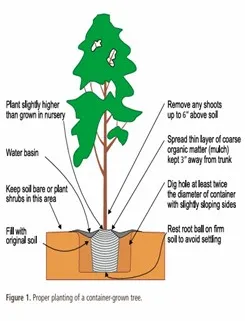
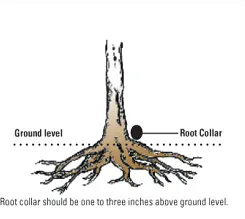
- Identify the root collar where the tree trunk slopes to merge with the roots. The level of the tree in the nursery pot may not be correct.
- Inspect the roots: clip off damaged, twisted or girdling roots, or shave off ½–1 inch of the root ball periphery.
- Return or exchange the tree if you find warty or rotting roots.
- For dormant trees, wash off the potting soil to make root inspection easier.
- For dormant trees, wash off the potting soil to make root inspection easier.
- For bare-root trees, spread the roots out and dig a hole twice as wide as the roots, but no deeper than the root ball.
- For a tree in a container, dig a hole twice as wide as the container, but no deeper than the root ball.
- Use a gopher basket to protect roots.
- Use the same soil to back-fill the hole.
Placing the Tree in the Hole: The Most Critical Step
- The crown of the tree should be above ground — it should not look like a telephone pole once planted.
- If the tree is planted too deep, it will grow slowly, be undersized and prone to disease.
- If the tree is too high, you can build up soil or build a box around it later, but planting too deep cannot be fixed.
- Make sure the soil beneath the tree is firm so the tree won’t sink later.
- Fill in the hole with original soil. Do not amend and do not fertilize.
- Settle the tree in place by watering as the hole is filled with soil. Do not stomp on the soil, as this will cause compaction.
Staking the Tree
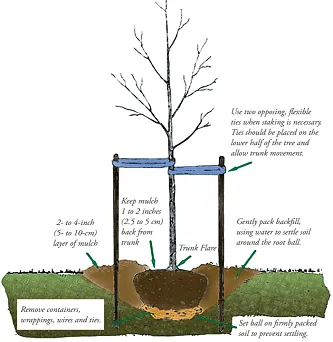
- Remove the nursery stake, which is usually tightly bound to the tree with green tape.
- Stake the tree if it cannot stand on its own or if wind is a concern. Most conifers and bare-root trees do not need staking.
- Bend the tree to determine the height of the stakes.
- Use two stakes placed parallel to the prevailing wind direction.
- Ties should have a broad surface so they don’t cut into the trunk.
- Tie loosely in loops to allow for some movement.
- Cut the stake 2–3 inches above the ties to prevent rubbing against branches.
- Remove the stakes after the first growing season.
Pruning and Mulching
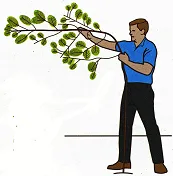
- Head cut fruit and nut trees at 20–24 inches to encourage lower branching.
- Remove suckers and growth below the graft of a fruit tree.
- Do not head cut or prune landscape or citrus trees when planting.
- Place 2–3 inches of mulch around the tree — arborist wood mulch, bark, grass clippings or leaves. Keep mulch 3–6 inches from the trunk to prevent disease.
Protect the Trunk
- You may need to protect the trunk from sun scald.
- Paint with a mix of equal parts white or light-colored indoor latex paint and water.
- Paint the lower two-thirds of the tree; leave the upper branches unpainted.
Irrigation
- Newly planted trees need regular irrigation for the first two years.
- Irrigation options include a shallow moat, drip irrigation or micro-sprinklers. Keep the root ball moist but not soggy.
- Do not allow irrigation water to reach the base of the tree trunk (crown of the tree). Water to the outer edges of the expanding roots.
- Build a shallow moat encircling the tree that slopes away from the trunk. The moat should be 8–12 inches from the trunk or at the furthest extension of the roots. Moat irrigation can be used for the first year.
- 180-degree micro-sprays directed away from the trunk can irrigate surface roots. Drip emitters should be secured near the root ball during the first year.
- Once the tree is established, irrigate halfway between the trunk and the canopy drip line and beyond. This will require moving irrigation as the tree grows. Adjust amount and timing of irrigation for the specific type of tree, soil and weather.
- Do not put emitters, a hose or a drip line within 6 inches of an established tree’s trunk. There are no feeder roots near the crown, and watering near the crown can lead to crown rot.
References
Hickman, Gary and Pavel Svihra. Planting Landscape Trees. UC ANR Publication 8046.
Irrigation: How to, How Much. UC Marin Master Gardeners. UC ANR. Irrigation: How to, How Much | UC Agriculture and Natural Resources
Kirk-Ballard, Heather. Rooting for Tree Success. LSU College of Agriculture. Rooting for tree success
Master Gardener Tree Planting. SMSF Master Gardeners. YouTube. https://www.youtube.com/watch?v=Z_VJ5joXtHc
New Tree Planting. International Society of Arboriculture (ISA), 2011. Planting a Tree
Pittenger, Dennis R. 2015. California Master Gardener Handbook, Second Edition. Oakland, CA: University of California, Agriculture and Natural Resources Communication Services. Chapters 12, 33 and 34. Publication 3382. ISBN 978-60107-857-5.
Planting Bare-Root Fruit Trees. Master Gardener Program of Sonoma County. UC ANR. Planting Bare-Root Fruit Trees | UC Agriculture and Natural Resources
Selecting, Planting, and Caring for Street Trees. UC Master Gardener Program of Alameda County. UC ANR. Selecting, Planting, and Caring for Street Trees | UC Agriculture and Natural Resources
The Science of Planting Trees. Colorado State University Extension. CMG GardenNotes #633. The Science of Planting Trees
Note: Figures 1, 2 and 4 are from the California Master Gardener Handbook; staking image from ISA; drip line image from UC ANR.