
You won't want to miss this seminar on native bees!
UC President's Postdoctoral Fellow Magda Argueta-Guzmán of UC Merced will speak on "More Than Just Flowers: Resource Use in Native Bees" at the UC Davis Department of Entomology and Nematology seminar at 12:10 p.m., Wednesday, May 13 in 122 Briggs Hall.
Her seminar also will be on Zoom. The Zoom link:
https://ucdavis.zoom.us/j/95882849672
"Bees use resources in different ways across their lives, yet studies of resource use often focus on a single interaction type, such as adult foraging," Argueta-Guzmán says in her abstract. "In this seminar, I examine how wild bees use floral and non-floral resources for different biological functions, including adult sustenance, offspring provisioning, and nest construction. By integrating behavioral observations, DNA metabarcoding, and pollen microscopy, I show that observed flower visitation can misrepresent the resources most important for offspring, and that diet breadth can depend on the function for which resources are collected, such as nest construction versus pollen provisioning."
"Through the combination of multiple methodologies, my work aims to improve our understanding of bee ecology, species niches, and the consequences of environmental change for reproductive success and ecosystem stability," she writes.
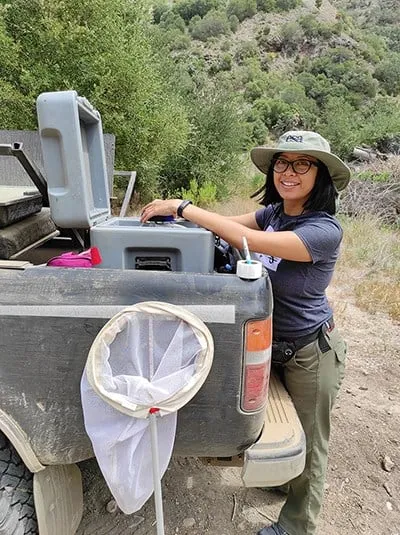
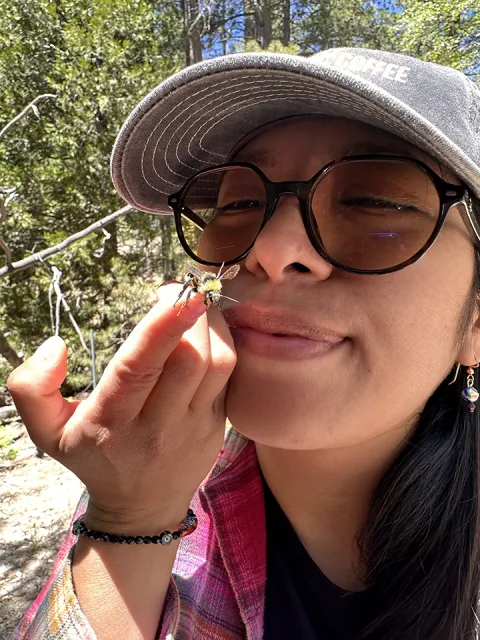
Argueta-Guzmán, with the Department of Life and Environmental Sciences, is a biologist trained in community ecology, microbiology, and entomology. On her website, she says that her research "focuses on uncovering the mechanisms that drive biodiversity through the study of multitrophic interactions. Over the past several years, I have explored how connections across different trophic levels—particularly between flowers, wild bees, and their microbiomes—shape diversity across the space. Currently, at the Gaiarsa lab, my research focuses on the impact of resource availability and climate change on flower-bee interactions, with the ultimate goal of understanding how these shifts affect population fitness and ecosystem stability. Additionally, I am deeply passionate about teaching, mentoring, and supporting others in their scientific journeys."
A native of Mexico, Argueta-Guzmán received her bachelor's degree in biology from the Universidad Autónoma Metropolitana – Xochimilco; and her master's degree in ecology from the Universidad Nacional Autónoma de México, Facultad de Ciencias; and her doctorate in entomology at UC Riverside, where she studied with major professor Quinn McFrederick. Her dissertation: "Connections Across Trophic Levels: Transmission and Variation of Bees- and Flowers-Associated Microbiomes."
Argueta-Guzmán's latest publication: "Solitary Bees Acquire and Deposit Bacteria via Flowers: Testing the Environmental Transmission Hypothesis Using Osmia lignaria, Phacelia tanacetifolia, and Apilactobacillus micheneri," published April 2025 in the journal, Ecology and Evolution.
In the abstract, she wrote: "Microbial environmental transmission among individuals plays an important role in shaping the microbiomes of many species. Despite the importance of the microbiome for host fitness, empirical investigations on environmental transmission are scarce, particularly in systems where interactions across multiple trophic levels influence symbiotic dynamics. Here, we explore microbial transmission within insect microbiomes, focusing on solitary bees. Specifically, we investigate the environmental transmission hypothesis, which posits that solitary bees acquire and deposit their associated microbiota from and to their surroundings, especially flowers. Using experimental setups, we examine the transmission dynamics of Apilactobacillus micheneri, a fructophilic and acidophilic bacterium, between the solitary bee Osmia lignaria (Megachilidae) and the plant Phacelia tanacetifolia (Boraginaceae). Our results demonstrate that bees not only acquire bacteria from flowers but also deposit these microbes onto uninoculated flowers for other bees to acquire them, supporting a bidirectional microbial exchange. We therefore find empirical support for the environmental transmission hypothesis, and we discuss the multitrophic dependencies that facilitate microbial transmission between bees and flowers."
Argueta-Guzmán wrote a piece for Entomology Today, published Jan. 19, 2022 by the Entomological Society of America, on "How to Become a Vulture and Not Die Trying: Following Tropical Bees and Their Gut Microbes."
For any Zoom technical issues, contact seminar coordinator Marshall McMunn at msmcmunn@ucdavis.edu.
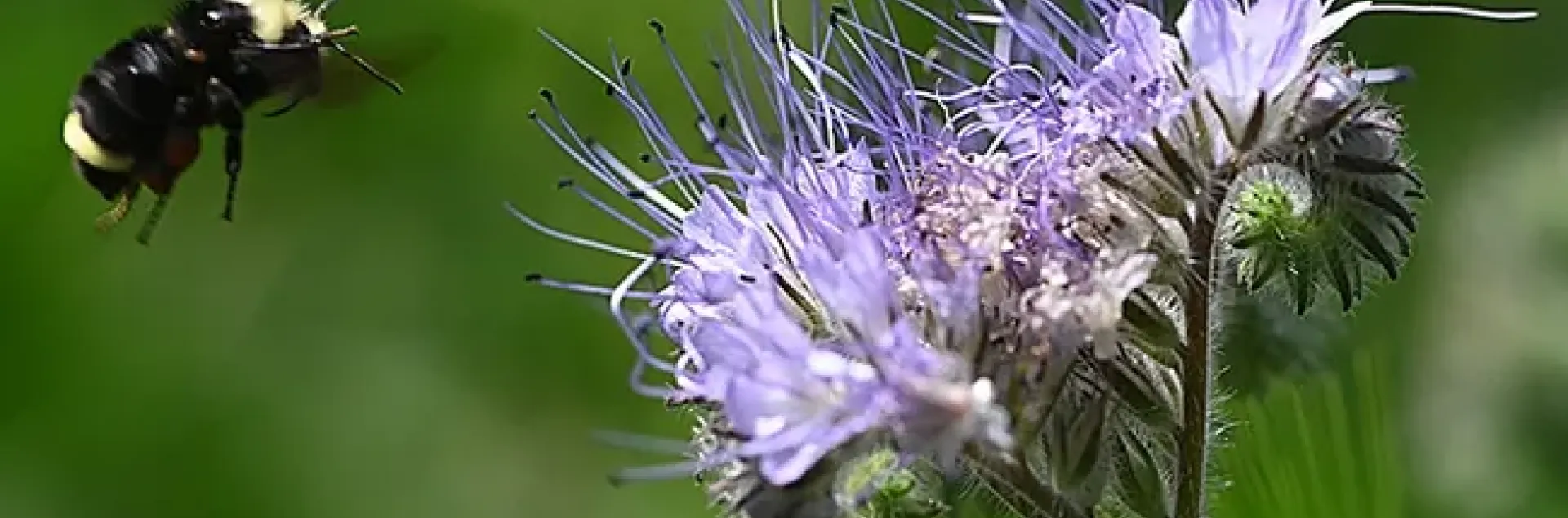
Cover image: Yellow-faced bumble bee, Bombus vosnesenskii, heading for phacelia. (Photo by Kathy Keatley Garvey)