
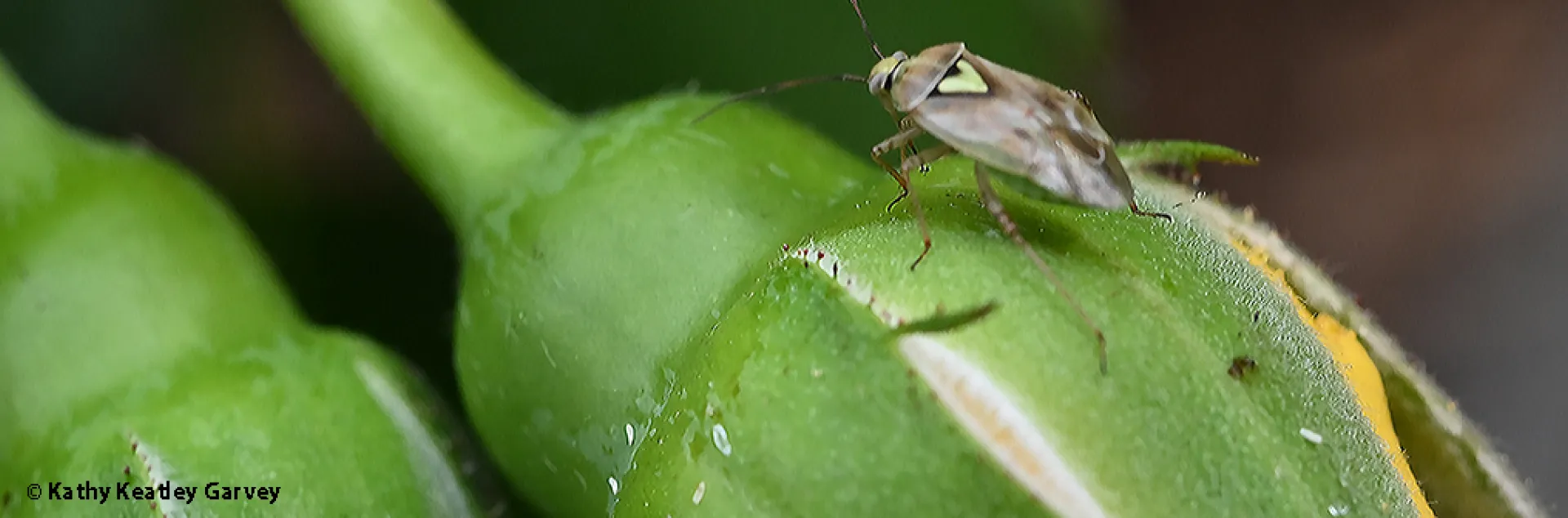
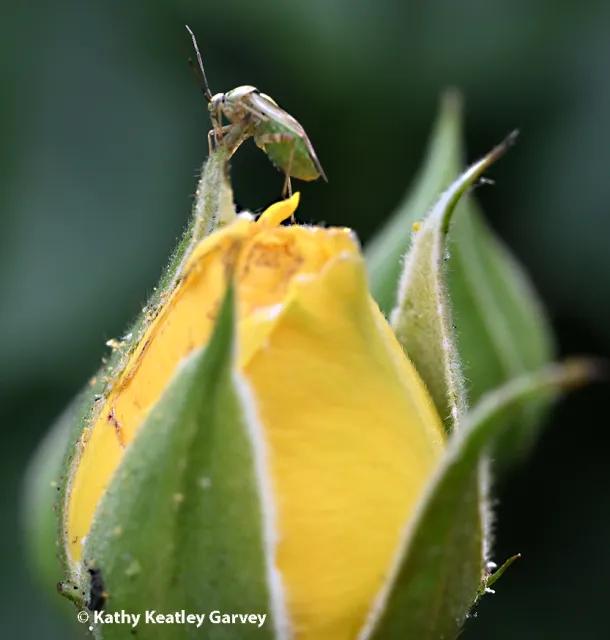
Hey, lygus bug, that bud's not for you!
Our yellow rose bushes, "Sparkle and Shine," purchased in May of 2013 at the California Center for Urban Horticulture (CCUH) Annual Rose Day at the University of California, Davis, are budding and blooming again.
The roses usuually bud and bloom in late March or early April. Lygus bugs know where to find 'em.
Lygus bugs belong to the Miridae family (commonly known as plant bugs or mirid bugs).
They suck and feed on buds, fruit and young shoots of various plants, according to the UC Statewide Integrated Pest Management Program (UC IPM) website. "At least 19 Lygus species occur in California."
Lygus bugs are quite tiny: they're the size of a small pea, or three tick marks on a standard ruler.
UC IPM shares that "Adult lygus bugs are 1/5 to 1/4 inch long. They are about one-half as wide and have a flattened upper side. Lygus species have a distinctive contrastingly colored triangle (scutellum) in the middle of the back where the wings attach. Individuals that overwintered are more dark, generally dark brown to reddish in comparison to individuals that matured from eggs laid during the current growing season."
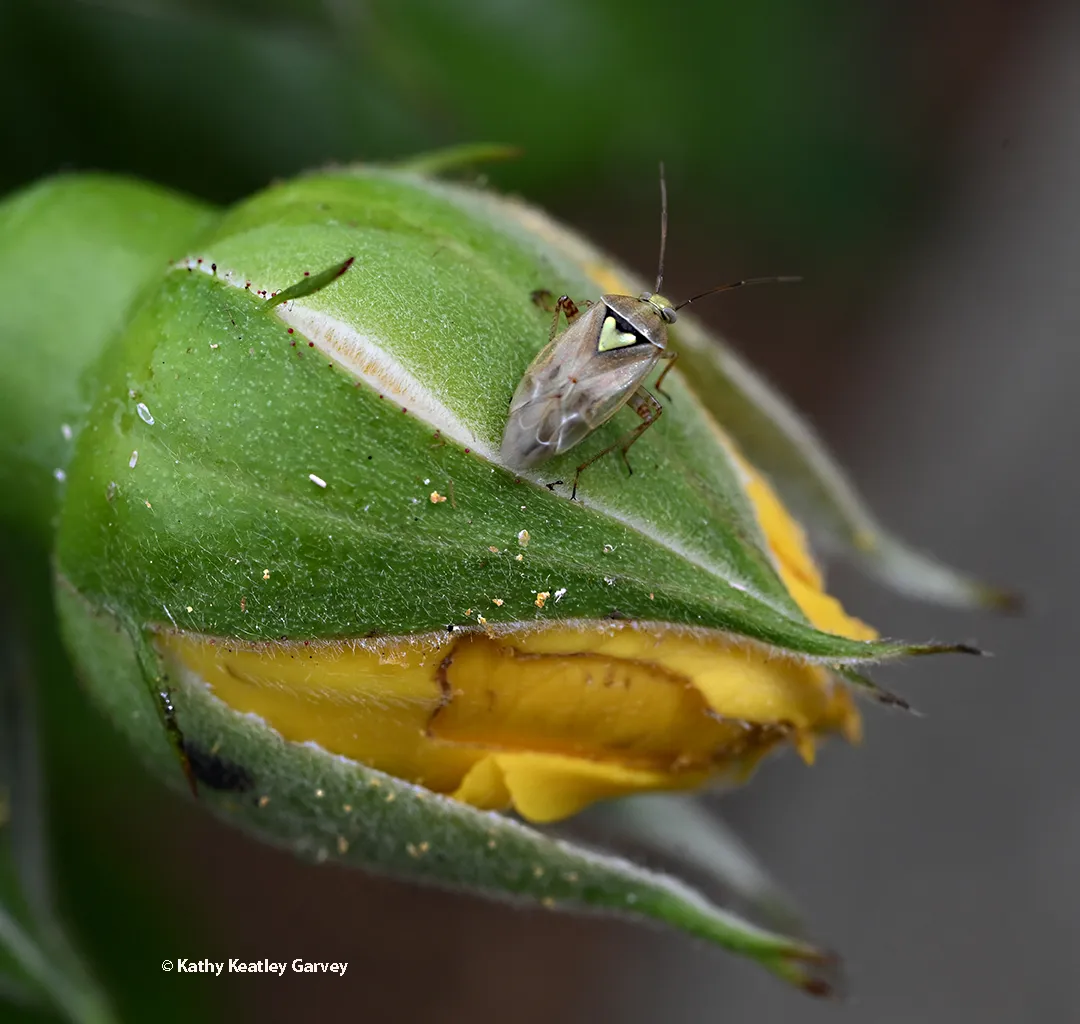
UC IPM further tells us that "Lygus bugs overwinter as adults in plant debris on the ground, in protected places of woody hosts, and in uncultivated areas outside of gardens and landscapes. In late winter as temperatures rise, the adult females begin laying eggs on a wide range of plants, especially mustards. As herbaceous plants begin to dry up in uncultivated and unirrigated areas, the adult lygus bugs migrate to irrigated plants where they mate, feed, and lay eggs. Lygus bugs can have 6 to 10 overlapping generations per year."
"Feeding damage begins in the spring when adults lay eggs and suck and feed on shoot tips," UC IPM says. "Later these shoot tips droop, wilt, and die. This can result in growth from lateral buds that appears bushy and distorted." (See more)
German entomologist Carl Wilhelm Hahn named the Lygus bug genus in 1831 in his work "Die wanzenartigen Insecten" or "The Bug-like Insects." The name Lygus may have been derived from the ancient Greek word lýgoi, which means "pliant twigs of willow" or "withes," according to Merriam-Webster. Another potential origin is the Greek word for "flat, even, or equal" (lýgus).
Bottom line: When hungry lygus bugs appear on "Sparkle and Shine" roses, the roses no longer "sparkle and shine." They droop and wilt.