

California has a designated state insect--the California dogface butterfly, Zerene eurydice--but it has no designated state bee.
Forty-eight of the 50 states in the nation have a designated state insect or a specific insect for a particular category, such as the state butterfly. Only Iowa and Michigan have no state insect.
If you Google "state insects," you'll see that Apis mellifera, the European honey bee (commonly called the Western honey bee), is the official state insect or agricultural insect for at least 17 U.S. states. These states include Arkansas, Georgia, Kansas, Kentucky (state agricultural insect), Louisiana, Maine, Mississippi, Missouri, Nebraska, New Jersey, North Carolina, Oklahoma, South Dakota, Tennessee, Utah, West Virginia, and Wisconsin.
What states have a state bee? Well, Minnesota's state bee is the rusty patched bumble bee, Bombus affinis. It's an endangered species under the U.S. Endangered Species Act. In fact, it was the first bee in the continental United States to be listed as endangered (March 21, 2017), with populations declining by nearly 90 percent over the last two decades.
It may not be too long before California has a state bee. What will it be?
News flash: The California Native Bee Society (CalNBS) is gathering input on what native bees would be good candidates.
Jess Mullins, president of CalNBS, recently wrote to UC Berkeley Professor Emeritus Gordon Frankie, co-author of California's Bees and Blooms: A Guide for Gardeners (a comprehensive guide exploring California's 1600 wild bee species) for his recommendations--and the recommendations of his colleagues.
"I'm writing to see if you have any suggestions for a California State Bee?" Mullins wrote. "We plan to prepare a list of bees and profile biological information about each species and provide support for why it should be chosen. Then, we will have people rank vote. Are there any species you think should be on that list?"
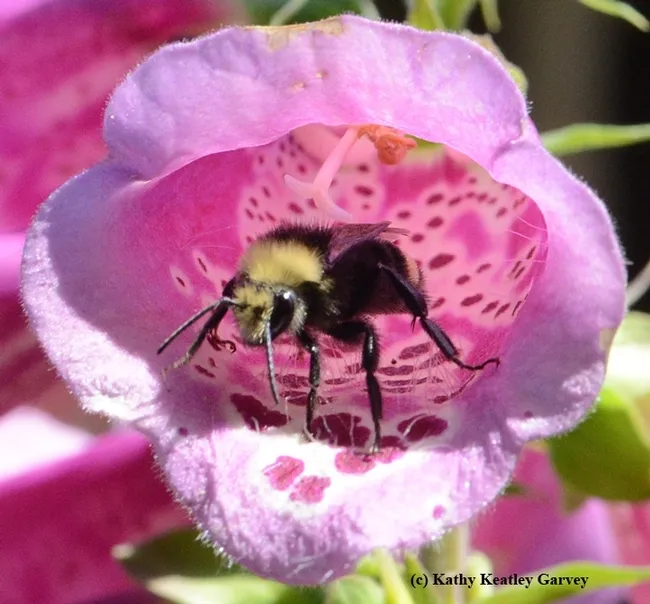
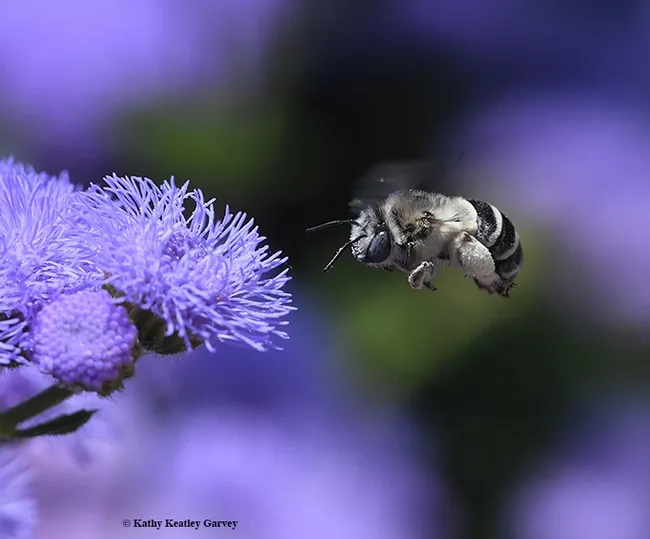
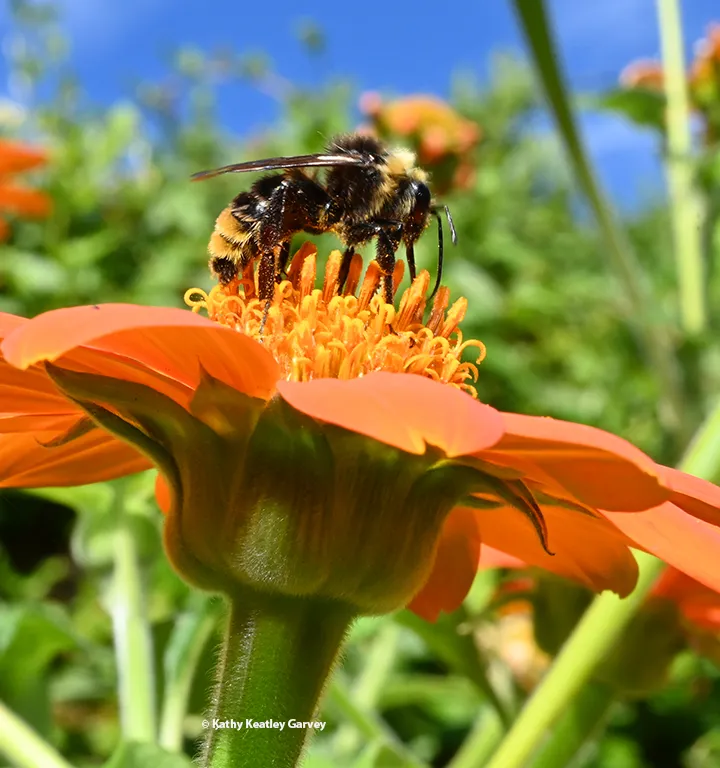
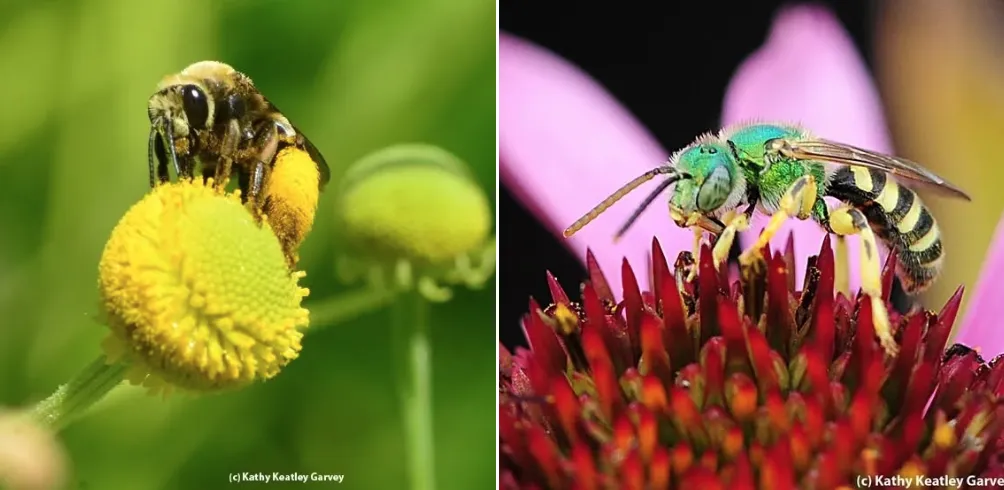
Frankie mentioned that two bees "that come to mind: Anthophora urbana and Agapostemon texanus. I also consider Bombus vosnesenskii."
Ah, so many to consider!
We asked UC Davis Distinguished Professor Emerita Lynn Kimsey, a renowned hymenopterist and the former director of the Bohart Museum of Entomology for 34 years, what she thought. "Bombus californicus would be a good pick. It's found in California obviously and is considered threatened right now. Plus a bumble bee would be a good pick because the public generally recognizes them as bees and not flies or something they don't like."
Native bee researcher Rachel Vannette, professor and vice chair of the UC Davis Department of Entomology, said she liked Frankie's suggestions. "I also like Anthophora urbana as this would be a nice opportunity to highlight a widespread solitary bee or B. vosnesenskii would also be a good choice if we want more people to be able to (more?) easily find an example of the state bee."
"The State Bee planning is still in the very early stages," Mullins says. "Our plan is to first open a nomination process to the public (nominations are open via a Google Form). After that, a committee of California bee experts will review the nominations and develop a shortlist of candidates (likely around eight species) for the public to vote on. Voting will open in mid-June. All of these dates are guestimates and will be nailed down at our next board meeting (April 1)."
You can contact Mullins at president@calnbs.org. The mission of CalNBS, as posted on its website at https://calnbs.org/ is "to protect California's native bees by fostering sustainable stewardship through research, education and conservation."
The website features recorded videos of bee scientists who have presented talks to the native bee organization. They include
- Corey Andrikopoulos, discussing "Stingless Bees of Palo Alto"
- Ian Wright, "Photographing California's Native Bees"
- Nina Sokolov, "The Artistic Musings of a Bee Disease Ecologist"
- Krystle Hickman, "Telling a Story Through Conservation Photography" and
- Felicity Muth, "Cognition in Wild Bumble Bees."
Many have UC Davis connections. Andrikopoulos worked as a researcher at UC Davis; Muth is a UC Davis faculty member; and Wright is a UC Davis alumnus. Another UC Davis connection: Hickman is currently showing her amazing macro images of native bees in a Bohart Museum of Entomology display in the hallway of the Academic Surge Building, 455 Crocker Lane, UC Davis. She is the author of the highly acclaimed ABCs of California Native Bees.
CALNBS meets at 6:30 p.m. on Zoom the second Tuesday of each month. On March 10, Leif Richardson, a conservation biologist with the Xerces Society of Invertebrate Conservation and leader of the California Bumble Bee Atlas, will be the speaker. You can register on the website.
Cover image: The California bumble bee, Bombus fervidus, formerly known as Bombus californicus, on a Gallardia in Vacaville, Calif. (Photo by Kathy Keatley Garvey)