
"Heigh ho, heigh ho, it's off to work we go..."
That's a song from Walt Disney's 1937 animated film, Snow White and the Seven Dwarfs, written by Frank Churchill (music) and Larry Morey (lyrics).
But on Thursday, April 23, employees everywhere--including those at UC Davis--will be taking their offspring to work during the annual "Take-Your-Children-to-Work" Day.
UC Davis employees and their sons and daughters, however, won't be singing "Heigh ho, Heigh ho," but they will be visiting various workplaces, including these two UC Davis Department of Entomology and Nematology sites:
- The Bohart Museum of Entomology, located in the Academic Surge Building at 455 Crocker Lane, and
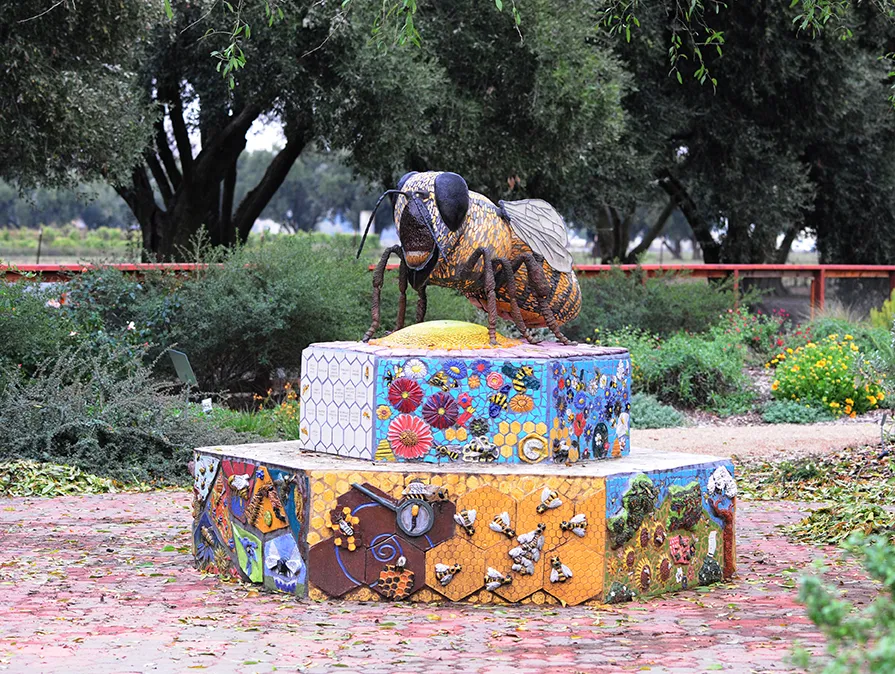
- The UC Davis Bee Haven, located on 1 Biology Road, next to the Harry H. Laidlaw Jr. Honey Bee Research Facility.
The youths attending this special day will see how the UC Davis community functions, instructs, learns and grows. They can point out "This is where my Dad works" or "This is where my Mom works."
Peaches
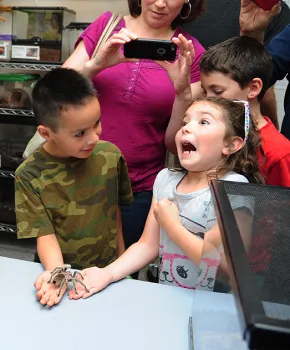
We remember 11 years ago when the UC Davis event was known as "Take Your Daughters and Sons to Work." We took an image of two youngsters with Peaches, a rose-haired tarantula, at the Bohart Museum. Joel Fuerte, then 6, and Roxanne Bell, then 7, expressed different reactions. The next year, they loved seeing her again!
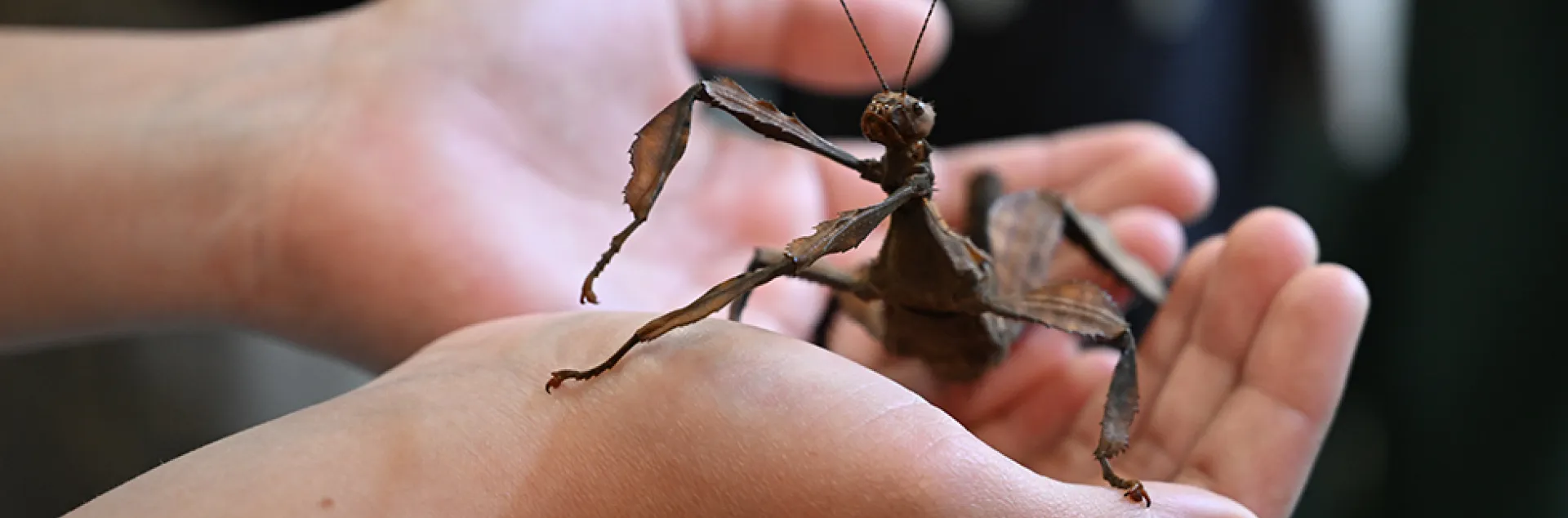
Some youths still want to hold Peaches (she's quite docile, by the way), but today the meet-and-greet sessions are reserved for Madagascar hissing cockroaches and stick insects, aka walking sticks. They, too, are loved!
But back to Peaches. A UC Davis student donated Peaches, a Grammostola rosea, then age 4, to the Bohart's live petting zoo--part of its educational program--in January of 2015. Bohart officials launched a contest to name the tarantula. Names submitted included Cuddles, Matilda, Bambi, Bobbie, Charlotte, Fluffy, Harriet, Maria, Pinkie, Rush, Tammy, Tessie, Twinkie, Lucy and Mandy, as well as Chili (Chilean rose-haired tarantula), Pepper (Chili pepper) and Gramma (Grammostola rosea). Peaches won.
We wrote about Peaches in a Bug Squad blog in February 2015: "Peaches is now part of the educational exhibit at the Bohart, where personnel will explain why a tarantula is not an insect, but a part of the spider family. It has two main parts, the prosoma (or cephalothorax) and the opisthosoma (or abdomen). A waist-like pedicle connects the two. They have small spinelike urticating hairs on their abdomen that they may release when threatened."
"Peaches' menu includes crickets and mealworms," we wrote. "Rose-haired tarantulas also dine on grasshoppers, moths, beetles and cockroaches. Larger tarantulas catch larger prey, including mice and frogs."
Earlier this year, the Bohart scientists lamented the death of Bohart tenant Coco McFluffin, a much-loved Chaco golden-knee tarantula. She had been a part of the Bohart Museum's live petting zoo for many years, at least since 2016.
Hissers and Sticks
So tomorrow, April 23 at the Bohart Museum, youths will hold Madagascar hissing cockroaches and walking sticks. They'll see the butterfly specimens in the Lepidoptera collection, curated by entomologist Jeff Smith.
And at the UC Davis Bee Haven, visitors will learn all about honey bees, native bees, and other pollinators that frequent the half-acre garden that thrives with more than 200 native plants. Education and garden coordinator Samantha "Sam" is leading the activities. (See more information here)
Both the Bohart Museum and Bee Haven are open to the public year around. The Bee Haven is open from dawn to dusk daily. The Bohart Museum hosts walk-in hours on Tuesdays and Wednesdays from 1 to 4:30 p.m. The Bohart also hosts open houses during the academic year. The next open house is Saturday, May 16 from 1 to 4 p.m. The theme: "Buzz Words: Insects in Literature." All open houses are free and family friendly.
Cover image: A child holding a stick insect at Bohart Museum of Entomology. (Photo by Kathy Keatley Garvey)