


"They really are quite tasty. I highly recommend it," Kimsey told Ng. "Like French fries, especially if you fry them."
Image
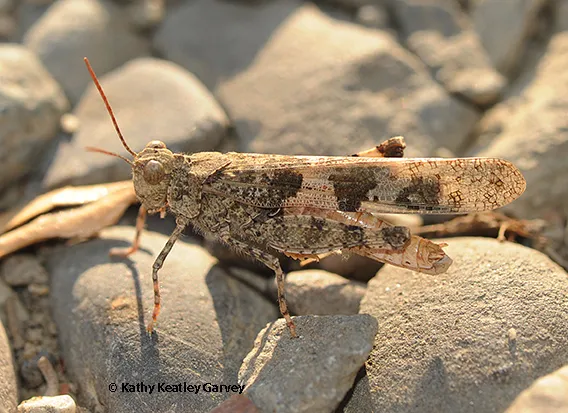
Oh, the quotes about grasshoppers!
- "War among grasshoppers delights the crow."
- "Two ants do not fail to pull one grasshopper."
- "The restless grasshopper only finds rest in the gizzard of a bird."
- "A grasshopper that sleeps about will soon be awake in a lizard's mouth."
Crows, ants, birds, lizards, who knew?
Frankly, I see more quotes about grasshoppers than I do the critters. In fact, the last grasshopper I photographed landed on rocks in our garden on Sept. 28, 2011 and was resting quite comfortably, thank you, when I approached it with a camera. It didn't hop away. Not this one, a banded-winged grasshopper in the family Acrididae, subfamily Oedipodinae.
Nary a crow around. No lizards or gizzards, either.
Curious about grasshoppers? As kids, we were told that grasshoppers produced tobacco juice. But that "spit" is actually a defense mechanism, according to UC Davis entomology alumna Solea “Sol” Wantz. As an entomology student, researcher, president of the UC Davis Entomology Club and an intern at the Bohart Museum of Entomology, she helped host an open house, "Grasshoppers, Crickets and Katydids" in March of 2024 at the Bohart Museum. “When under stress--usually when they are grabbed, especially around the thorax-- grasshoppers vomit a foul-smelling/tasting liquid to ward off whatever predator is attacking them,” she said.
Grasshoppers belong to the order Orthoptera, which also includes locusts, crickets and katydids. In the ancient Greece language, “ortho” means "straight,” and “optera” means "wings."
The UC Statewide Integrated Pest Management Program (UC IPM) informs us:
- Grasshoppers are distinguished by their hind legs with greatly enlarged femurs that are well adapted for jumping.
- Grasshoppers are sporadic pests in gardens although in some years large populations may build up in foothills and rangelands, especially after a wet spring, and then migrate into nearby gardens.
- Most grasshoppers are general feeders, but they prefer young green plants, especially lettuce, beans, corn, carrots, onions, and some annual flowers.
- Grasshoppers are among the most difficult insect pests to manage in the garden. When numbers are low, they can be handpicked and squashed. (Learn more about grasshoppers on the UC IPM site)
Grasshopper Surge
We hadn't heard much about grasshoppers until last week. Breaking news: A huge grasshopper surge is underway in Los Angeles and the gardeners are not happy.
Los Angeles journalist Fiona Ng, LAist's deputy managing editor, emailed me on March 17, looking for a news source. I suggested noted insect expert Lynn Kimsey, UC Davis Distinguished Professor Emerita of the Department of Entomology and Nematology, and the retired 34-year director of the Bohart Museum of Entomology. Kimsey is officially retired from the classroom but continues her research and her work as director of the Bohart Museum Society and as its newsletter editor.
Ng featured Kimsey and entomologist Eric Middletown, UC Cooperative Extension IPM advisor in the San Diego area (UC Agriculture and Natural Resources), in her article, "You Are Not Alone in Seeing More Grasshoppers in LA: Just Leave Them Be."
"Curious gardeners have been noticing more grasshoppers — a lot more," Ng wrote in her lede. "And inquiring minds want to know why — and what can be done about these insects with a reputation for destruction."
She then quoted Kimsey: " So what happens is the standard grasshopper that we think of can become a locust if the weather conditions are right. "In a true outbreak, they would be, you know, crossing roads by the thousands.
Both entomologists said the population will taper off soon, so please don't start spraying insecticides.
But you can eat them, Kimsey quipped. She said they make a "killer snack."