

A powerful biological tool for targeting mosquitoes?
UC Chancellor’s Postdoctoral Fellow Lyna Ngor of the UC Irvine Department of Ecology and Evolutionary Biology, will discuss "Exploring Flower-Mediated Wolbachia Transmission: A Self-Sustaining Approach to Mosquito-Borne Disease Control" at the UC Davis Department of Entomology and Nematology's seminar on Wednesday, May 6.
Ngor will speak at 12:10 p.m. in 22 Briggs Hall. Her seminar also will be on Zoom. The Zoom link: https://ucdavis.zoom.us/j/95882849672
"Mosquito-borne diseases remain one of the most persistent global public health challenges," she writes in her abstract. "The endosymbiotic bacterium Wolbachia has emerged as a powerful biological tool for suppressing mosquito-borne viruses and is currently deployed in vector control programs worldwide. However, the most widely used strain, wMel, imposes fitness costs on mosquitoes that limit its ability to spread and persist in wild populations. As a result, large and repeated releases of infected mosquitoes are required to maintain disease suppression, making this approach expensive and difficult to sustain, particularly in under-resourced communities."
"During my doctoral research, my undergraduate student and I discovered that several wild bee species naturally harbor the same Wolbachia supergroup found in mosquitoes," she continues. "Follow-up work with collaborators revealed that in some bee species, Wolbachia localizes within the salivary glands, enabling deposition of the bacterium onto floral surfaces during foraging. These findings suggest that flowers may potentally function as ecological hubs for microbial exchange between insect species that share floral resources. In my postdoctoral research, I am exploring whether these natural microbial interactions can be leveraged to create a flower-mediated, self-sustaining system for Wolbachia transmission."
Library of Wolbachia Strains
"Recent observations show that certain Wolbachia strains can persist on plant surfaces for extended periods, revealing the potential for indirect transfer between pollinators and mosquitoes. To investigate this possibility, I am building a library of Wolbachia strains from wild bees and ants to identify variants capable of stable environmental persistence and cross-species transmission. Metagenomic information will help access ants and bees associated Wolbachia functional genomic repertoire and Fluorescence in situ Hybridization will reveal Wolbachia localization in ants and bee tissue. By integrating molecular microbiology, symbiosis research, and ecological design, this work proposes a self-sustaining framework for mosquito-borne disease control, one that leverages naturally occurring microbial networks rather than relying solely on repeated releases or chemical interventions."
Lyna Ngor, born and raised in Cambodia, received her doctorate in entomology from UC Riverside in June 2025, and then joined the lab of Donovan German, Department of Ecology and Evolutionary Biology.
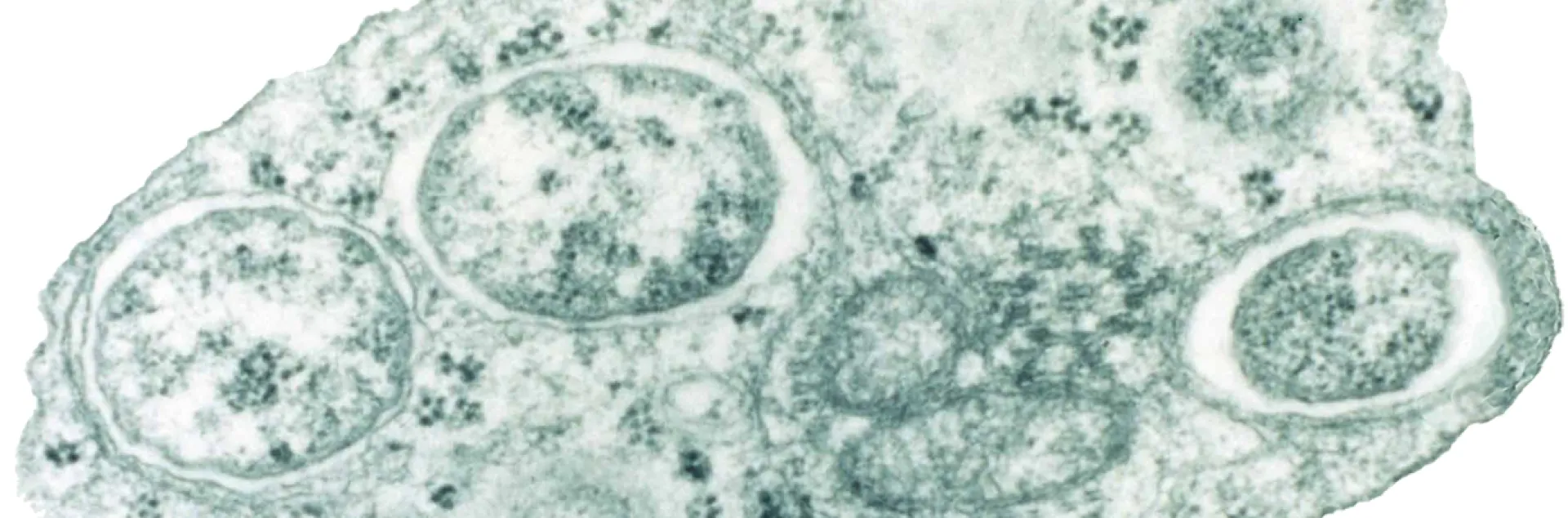
Definition: "Wolbachia is a genus of gram-negative bacteria infecting many species of arthropods and filarial nematodes. The relationship between Wolbachia and its hosts ranges from parasitism through benign symbiosis up to obligate mutualism. It is one of the most common parasitic microbes of arthropods, and is possibly the most widespread reproductive parasite bacterium in the biosphere. Its interactions with hosts are complex and highly diverse across the various species in which it is found. Some host species cannot reproduce, or even survive, absent internal Wolbachia colonies. One study concluded that more than 16% of neotropical insect species carry bacteria of this genus, and as many as 25 to 70% of all insect species are estimated to be potential hosts."--Wikipedia
Cover image: Transmission electron micrograph of Wolbachia within an insect cell. (Courtesy of Wikipedia)