Bug Squad Logo

Bug Squad

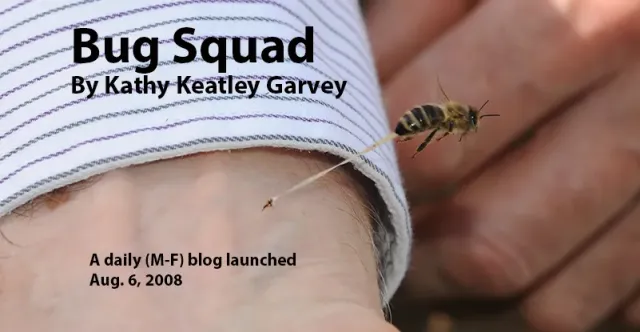
Bug Squad blog image depicts a honey bee sting in action.

Welcome to the Bug Squad blog! The Bug Squad blog was launched Aug. 6, 2008 and is a daily blog (Monday through Friday). It showcases entomologists and the work they do.  The blog focuses on scientists in the UC Davis Department of Entomology and Nematology, the Bohart Museum of Entomology, Harry H. Laidlaw Jr. Honey Bee Research Facility, the UC Davis Bee Haven, and assorted campuswide events, including UC Davis Picnic Day, UC Davis Biodiversity Museum Day, and Bohart Museum open houses. The blog spotlights insects, including bees, butterflies, dragonflies, and praying mantises, as well as arachnids such as jumping spiders and crab spiders. Author and photographer is Kathy Keatley Garvey, communications specialist, UC Davis Department of Entomology and Nematology, and a longtime journalist and community scientist with two degrees from Washington State University.  She is a member of the Entomological Society of America (ESA) and the Association for Communication Excellence (ACE). Her blog posts and images have won international awards from ACE and ESA and appeared on journal and magazine covers. She shoots primarily with a Nikon Z-8 mirrorless camera, a Nikon D500 and Nikon 800, with assorted macro lenses. 
Primary Image
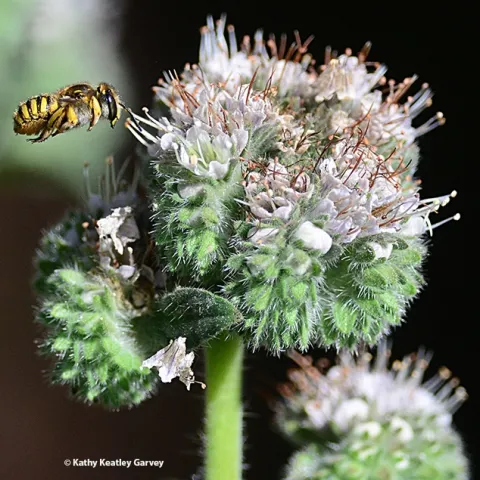
A European wool carder bee in flight. (Photo by Kathy Keatley Garvey)

European Wool Carder Bees Are on the Move

June 2, 2022
By Kathy Keatley Garvey
Seen any European wool carder bees lately? European wool carder bees (so named because the female collects or cards plant hairs for their nests) are on the move. The bees, about the size of honey bees, are mostly black and yellow.
View Article
Primary Image
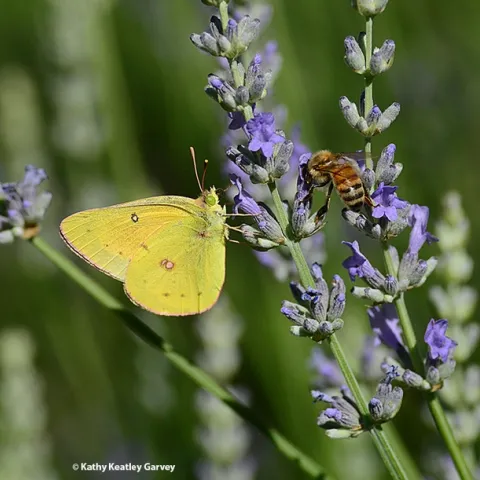
A sulphur butterfly, Colias eurytheme, and a honey bee, Apis mellifera, meet on lavender. The butterfly is a male, as identified by Art Shapiro, UC Davis distinguished professor of evolution and ecology. (Photo by Kathy Keatley Garvey)

The Bee and the Butterfly

June 1, 2022
By Kathy Keatley Garvey
The bee and the butterfly. Or, Apis mellifera and Colias eurytheme. One's a beneficial insect. That would "bee" the honey bee. The other is a yellow and white butterfly, striking in appearance, but in its larval stage, it's a major pest of alfalfa.
View Article
Primary Image
A male valley carpenter bee, Xylocopa sonorina, engaging in nectar robbing; he's sipping nectar through a hole in the base of a foxglove blossom. (Photo by Kathy Keatley Garvey)

How a 'Bear' Can Outsmart a Fox

May 30, 2022
By Kathy Keatley Garvey
There's a way for a bear to outsmart a fox. A teddy bear bee, that is. We just witnessed a male Valley carpenter bee, Xylocopa sonorina, aka "the teddy bear bee," buzz up to a patch of foxgloves, Digitalis purpurea. Then he engaged in the foraging behavior known as nectar-robbing.
View Article