Bug Squad Logo

Bug Squad

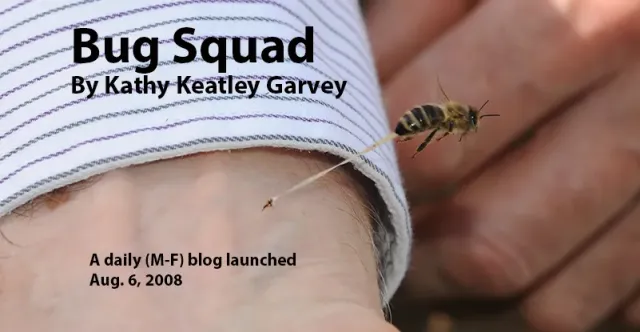
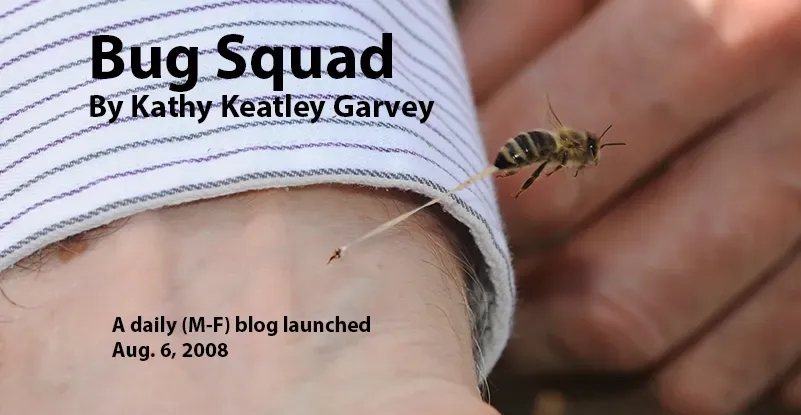
Bug Squad blog image depicts a honey bee sting in action.

Welcome to the Bug Squad blog! The Bug Squad blog was launched Aug. 6, 2008 and is a daily blog (Monday through Friday). It showcases entomologists and the work they do.  The blog focuses on scientists in the UC Davis Department of Entomology and Nematology, the Bohart Museum of Entomology, Harry H. Laidlaw Jr. Honey Bee Research Facility, the UC Davis Bee Haven, and assorted campuswide events, including UC Davis Picnic Day, UC Davis Biodiversity Museum Day, and Bohart Museum open houses. The blog spotlights insects, including bees, butterflies, dragonflies, and praying mantises, as well as arachnids such as jumping spiders and crab spiders. Author and photographer is Kathy Keatley Garvey, communications specialist, UC Davis Department of Entomology and Nematology, and a longtime journalist and community scientist with two degrees from Washington State University.  She is a member of the Entomological Society of America (ESA) and the Association for Communication Excellence (ACE). Her blog posts and images have won international awards from ACE and ESA and appeared on journal and magazine covers. She shoots primarily with a Nikon Z-8 mirrorless camera, a Nikon D500 and Nikon 800, with assorted macro lenses. 

Primary Image
This three-inch-long tobacco hornworm appears to be ready to eat more tomato leaves (or the photographer). (Photo by Kathy Keatley Garvey)

Godzilla Lives!

September 17, 2021
By Kathy Keatley Garvey
Remember Godzilla? The 1954 iconic film, Godzilla, featured what Wikipedia calls "an enormous, destructive prehistoric sea monster awakened and empowered by nuclear radiation." I have a Godzilla.
View Article
Primary Image
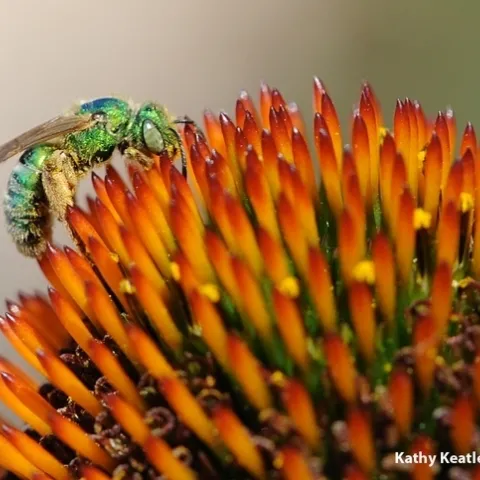
A female metallic green sweat bee, genus Agapostemon ,on a purple coneflower. (Photo by Kathy Keatley Garvey)

A Sight to See Is This Bee

September 16, 2021
By Kathy Keatley Garvey
Ever seen a green metallic sweat bee? The colors are exquisite. This is a female Agapostemon on a purple coneflower at UC Davis. They are called "sweat bees" because they are attracted to human perspiration. The genders are easy to distinguish. The males have a striped abdomen.
View Article
Primary Image
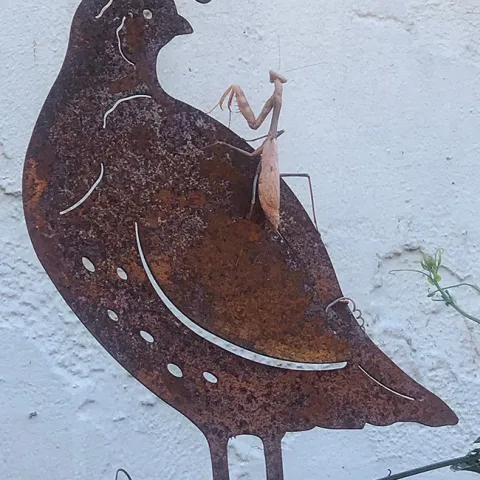
Praying mantis meets quail. (Photo by Kathy Keatley Garvey)

The Tale of a Quail and a Mantis

September 15, 2021
By Kathy Keatley Garvey
It would never happen in real life. A quail and a praying mantis together? Except when one is a decorative metal sculpture. A mantis, a carnivore, is known to eat hummingbirds (in addition to its regular diet of bees and butterflies, et al). And a quail, an omnivore, eats both plants and insects.
View Article
Primary Image
The late Robbin Thorp (1933-2019) annually searched for Franklin's bumble bee but hadn't seen it since 2006. That's his image of the bee on his computer screen. (Photo by Kathy Keatley Garvey)

How Franklin's Bumble Bee May Be Found

September 14, 2021
By Kathy Keatley Garvey
Is Franklin's bumble bee extinct or is it just elusive? Annual search parties conducted since 2006 have failed to locate the species. Now scientists may learn its status via DNA "fingerprints.
View Article
Primary Image
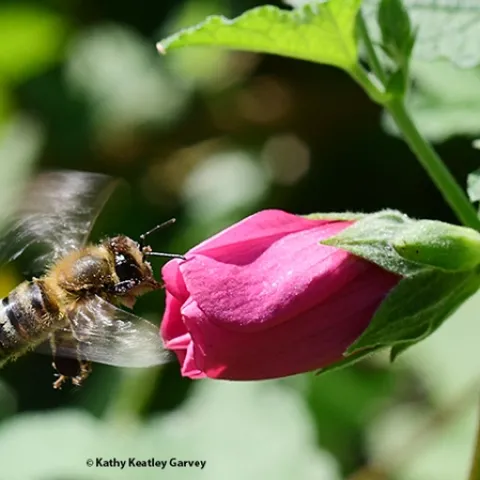
An energetic honey bee heads for a cape mallow (Anisodontea sp. "Strybing Beauty"), only to find it closed. (Photo by Kathy Keatley Garvey)

Sorry, We're Closed? Not the California Master Beekeeper Program!

September 13, 2021
By Kathy Keatley Garvey
Sorry, we're closed! What's a honey bee to do when one of her favorite flowers, cape mallow (Anisodontea sp. "Strybing Beauty") is not open for bees-ness. Well, leave it to the bee to find a way. We recently witnessed a honey bee encountering a yet-to-open flower in the early morning.
View Article