Bug Squad Logo

Bug Squad

Bug Squad blog image depicts a honey bee sting in action.

Welcome to the Bug Squad blog! The Bug Squad blog was launched Aug. 6, 2008 and is a daily blog (Monday through Friday). It showcases entomologists and the work they do.  The blog focuses on scientists in the UC Davis Department of Entomology and Nematology, the Bohart Museum of Entomology, Harry H. Laidlaw Jr. Honey Bee Research Facility, the UC Davis Bee Haven, and assorted campuswide events, including UC Davis Picnic Day, UC Davis Biodiversity Museum Day, and Bohart Museum open houses. The blog spotlights insects, including bees, butterflies, dragonflies, and praying mantises, as well as arachnids such as jumping spiders and crab spiders. Author and photographer is Kathy Keatley Garvey, communications specialist, UC Davis Department of Entomology and Nematology, and a longtime journalist and community scientist with two degrees from Washington State University.  She is a member of the Entomological Society of America (ESA) and the Association for Communication Excellence (ACE). Her blog posts and images have won international awards from ACE and ESA and appeared on journal and magazine covers. She shoots primarily with a Nikon Z-8 mirrorless camera, a Nikon D500 and Nikon 800, with assorted macro lenses. Feedspot lists it as one of the top entomology blogs on the Internet. 

Primary Image
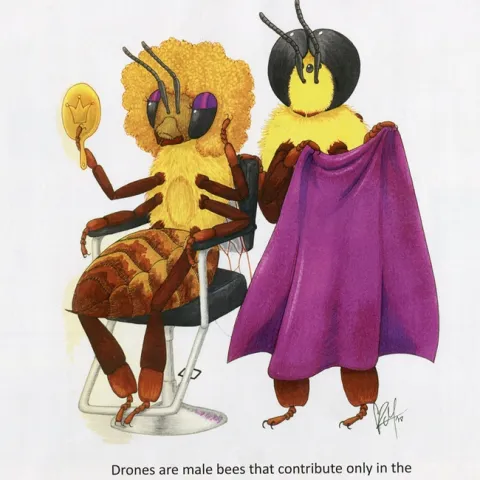
A UC Davis student wrote: "Drones are male bees that contribute only in the perm production for the queen." That inspired Karissa Merritt to create this for the newly published Bohart Museum of Entomology calendar, now available for purchase.

When Queen Bees Get Permanents: Calendar That!

December 6, 2018
By Kathy Keatley Garvey
"Drones are male bees that contribute only in the perm production for the queen." So wrote an undergraduate student in one of Lynn Kimsey's entomology classes at the University of California, Davis. The student meant "sperm." But it came out "perm.
View Article
Primary Image
The three-cornered alfalfa hopper, Spissistilus festinus. (Photo by Kathy Keatley Garvey)

About That Three-Cornered Alfalfa Hopper...

December 4, 2018
By Kathy Keatley Garvey
It's green, it's tiny, and everyone is hoping it doesn't wreak any havoc in the vineyards. "It" is the three-cornered alfalfa hopper, Spissistilus festinus, a lear-winged, wedge-shaped (thus the name "three-cornered") insect that's about a quarter of an inch long.
View Article
Primary Image
"The honey bee genome,” Robert Page Jr. explained, “is composed of about 15,000 genes, each of which operates within a complex network of genes, doing its small, or large, share of work in building the bee, keeping its internal functions operating, or helping it function and behave in its environment. (Photo by Kathy Keatley Garvey)

Shedding New Light on Honey Bee Chromosomes

December 3, 2018
By Kathy Keatley Garvey
Honey bee geneticists with long ties to UC Davis are putting together those missing pieces of the puzzle involving bee chromosomes. Newly published research by a team of Germany-based honey bee geneticists, collaborating with Robert Eugene (Rob) Page Jr.
View Article
Primary Image
Overwintering monarchs in the Berkeley Aquatic Park on Nov. 26, 2015. (Photo by Kathy Keatley Garvey)

The Sad State of the Overwintering Monarch Population in California

November 30, 2018
By Kathy Keatley Garvey
Where are all the overwintering monarchs? If you traveled to the Natural Bridges State Park in Santa Cruz this fall or to any of the other overwintering monarch sites along coastal California to see these iconic butterflies, did you see very many? Probably not.
View Article