The bees. What about the bees? How are they doing? Better, says retired Extension apiculturist Eric Mussen of the UC Davis Department of Entomology and Nematology, who today published the last edition of his newsletter, from the UC Apiaries.
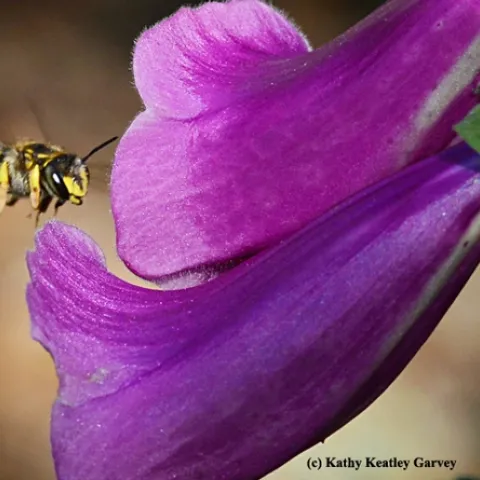
Foxgloves, meet the European wool carder bee. European wool carder bee, meet the foxgloves. It's like "old home week" when these two get together. The plant (Digitalis purpurea) and the bee (Anthidium manicatum) are both native to Europe.
We've trained puppies to "come," "sit" and "heel." We've trained an African grey parrot to say "Here, kitty, kitty, kitty! Meow!" We've trained the kitty to ignore the parrot. But how do you train a praying mantis? You don't.
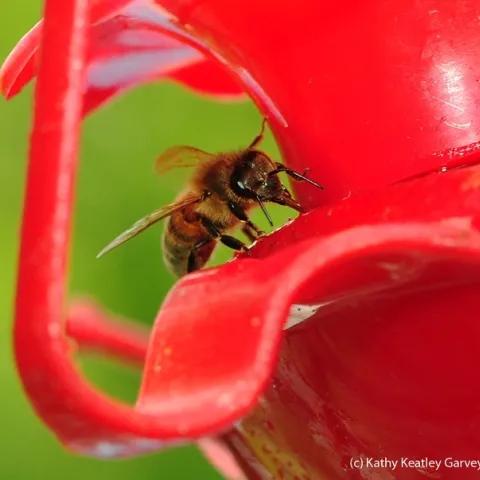
It's no secret that honey bees like the sugar/water mixture in hummingbird feeders. If there's no bee guard on the feeder or if the feeder isn't bee-proofed, bees will sip the mixture. They also will lick the spills. A sudden gust that sways or upends the feeder is "bee happy time.
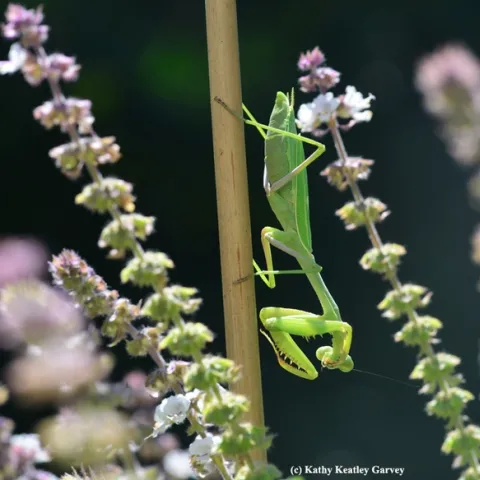
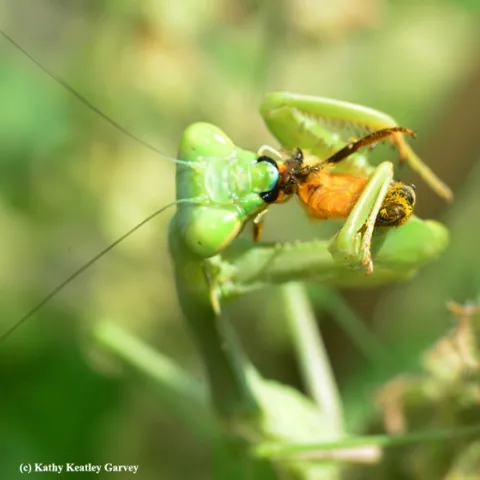
It was a good day to be a praying mantis. It was not a good day to be a honey bee. Just before noon today, we watched a green praying mantis lurking in the African blue basil, like a camouflaged soldier ready to ambush the enemy.