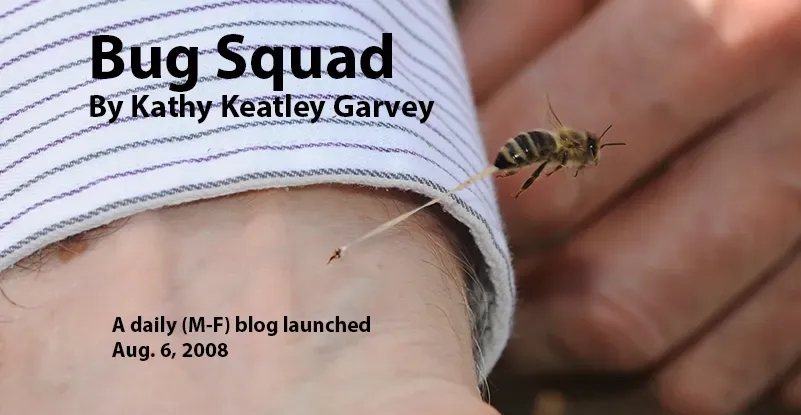
Bug Squad Logo

Bug Squad

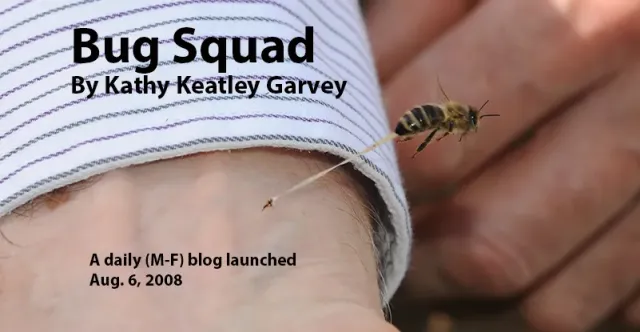
Bug Squad blog image depicts a honey bee sting in action.

Welcome to the Bug Squad blog! The Bug Squad blog was launched Aug. 6, 2008 and is a daily blog (Monday through Friday). It showcases entomologists and the work they do.  The blog focuses on scientists in the UC Davis Department of Entomology and Nematology, the Bohart Museum of Entomology, Harry H. Laidlaw Jr. Honey Bee Research Facility, the UC Davis Bee Haven, and assorted campuswide events, including UC Davis Picnic Day, UC Davis Biodiversity Museum Day, and Bohart Museum open houses. The blog spotlights insects, including bees, butterflies, dragonflies, and praying mantises, as well as arachnids such as jumping spiders and crab spiders. Author and photographer is Kathy Keatley Garvey, communications specialist, UC Davis Department of Entomology and Nematology, and a longtime journalist and community scientist with two degrees from Washington State University.  She is a member of the Entomological Society of America (ESA) and the Association for Communication Excellence (ACE). Her blog posts and images have won international awards from ACE and ESA and appeared on journal and magazine covers. She shoots primarily with a Nikon Z-8 mirrorless camera, a Nikon D500 and Nikon 800, with assorted macro lenses. 
Primary Image
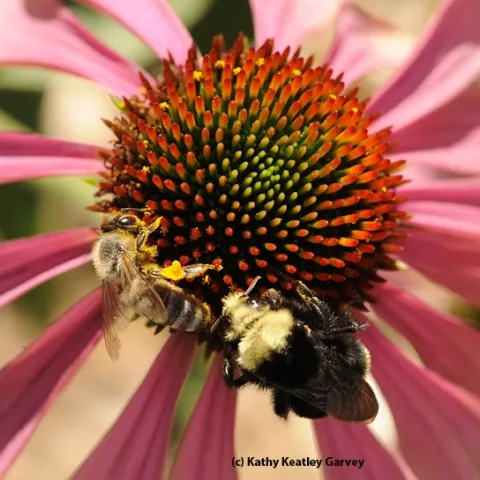
A honey bee and a yellow-faced bumble bee sharing a purple coneflower, Echinacea purpurea. (Photo by Kathy Keatley Garvey)

Do Honey Bees Impact the Native Bees?

March 14, 2014
By Kathy Keatley Garvey
The European honey bee, also known as the Western honey bee, has been in the United States for s-o-o-o long that we think it's a native. It's not. European colonists brought the honey bee (Apis mellifera) to the Jamestown colony (Virginia) in 1622.
View Article
Primary Image
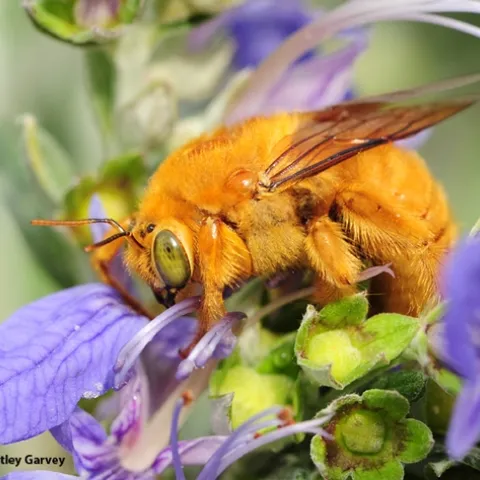
Male Valley carpenter bee, Xylocopa varipuncta, is blond with green eyes. This is on a germander bush, azure bush germander Teucrium fruitcans. (Photo by Kathy Keatley Garvey)

'Teddy Bear' Bees

March 13, 2014
By Kathy Keatley Garvey
Along about this time of year, the calls come pouring into the UC Davis Department of Entomology and Nematology and the Bohart Museum of Entomology. "I just saw a golden bumble bee.
View Article
Primary Image
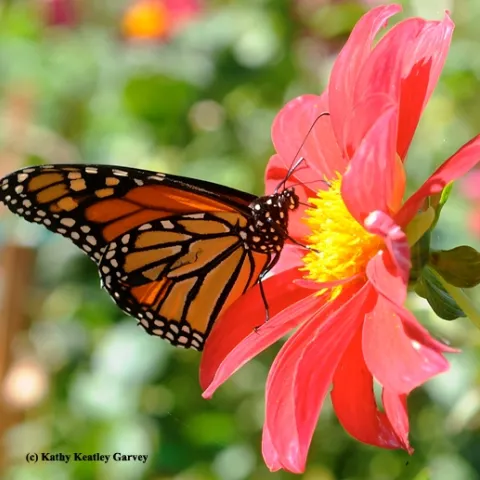
A monarch butterfly nectaring on a zinnia. (Photo by Kathy Keatley Garvey)

Monarchs 'n Milkweed

March 12, 2014
By Kathy Keatley Garvey
Monarchs and milkweed are in the news again. As well they should be. The declining monarch population, coupled with the decreasing scarcity of their host plant, the milkweed, is disturbing. The larvae of the monarch butterfly (Danaus plexippus) feed exclusively on milkweeds.
View Article
Primary Image
A honey bee heading for wild radish. (Photo by Kathy Keatley Garvey)

Going 'Rad'

March 11, 2014
By Kathy Keatley Garvey
It may not be the farmer's friend, but it's the beekeeper's friend. Wild radish (Raphanus raphanistrum), a member of the mustard family, Brassicaceae, is considered a weed, but I consider it a flowering plant for bees when I see it along roadsides and parks and lining orchards and vineyards.
View Article
Primary Image
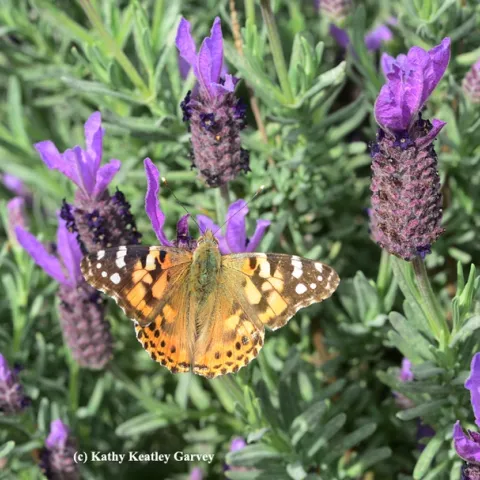
A female butterfly, a painted lady, nectaring on Spanish lavender on March 8 in the Benicia Community Garden. (Photo by Kathy Keatley Garvey)

Welcome Back, Painted Ladies

March 10, 2014
By Kathy Keatley Garvey
The painted ladies are on move. Butterflies. Scores of painted ladies (Vanessa cardui) are now migrating north from their overwintering sites near the U.S. Mexico border.
View Article