Bug Squad Logo

Bug Squad

Bug Squad blog image depicts a honey bee sting in action.

Welcome to the Bug Squad blog! The Bug Squad blog was launched Aug. 6, 2008 and is a daily blog (Monday through Friday). It showcases entomologists and the work they do.  The blog focuses on scientists in the UC Davis Department of Entomology and Nematology, the Bohart Museum of Entomology, Harry H. Laidlaw Jr. Honey Bee Research Facility, the UC Davis Bee Haven, and assorted campuswide events, including UC Davis Picnic Day, UC Davis Biodiversity Museum Day, and Bohart Museum open houses. The blog spotlights insects, including bees, butterflies, dragonflies, and praying mantises, as well as arachnids such as jumping spiders and crab spiders. Author and photographer is Kathy Keatley Garvey, communications specialist, UC Davis Department of Entomology and Nematology, and a longtime journalist and community scientist with two degrees from Washington State University.  She is a member of the Entomological Society of America (ESA) and the Association for Communication Excellence (ACE). Her blog posts and images have won international awards from ACE and ESA and appeared on journal and magazine covers. She shoots primarily with a Nikon Z-8 mirrorless camera, a Nikon D500 and Nikon 800, with assorted macro lenses. Feedspot lists it as one of the top entomology blogs on the Internet. 
Primary Image
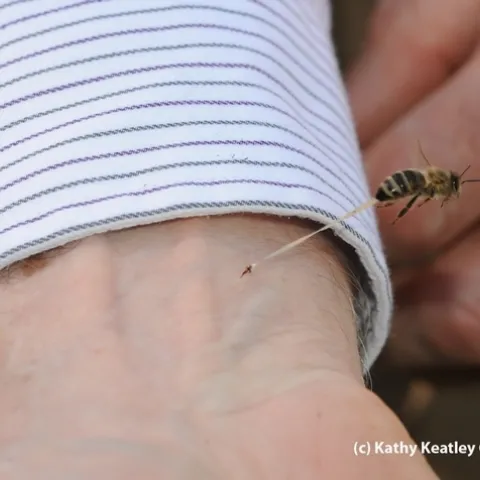
Extension apiculturist Eric Mussen getting stung on the wrist. (Photo by Kathy Keatley Garvey)

Can a Bee Unscrew the Sting?

February 24, 2014
By Kathy Keatley Garvey
When a honey bee stings you, she makes the supreme sacrifice and dies. She's usually defending her colony. In the process, she leaves behind part of her abdomen. A beekeeper simply scrapes the sting with a fingernail or a hive tool to stop the pulsating venom and continues working.
View Article
Primary Image
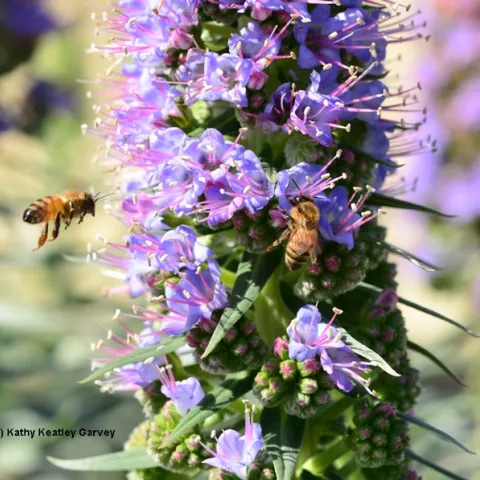
Honey bees foraging on the Pride of Madeira at Bodega Bay. (Photo by Kathy Keatley Garvey

Best of Bodega: Bees Buzzing on Echium

February 21, 2014
By Kathy Keatley Garvey
The Pride of Maderia (Echium candicans) is blooming in the tiny Sonoma coastal community of Bodega. The purplish-blue spiked flowers attract honey bees, bumble bees and syrphid flies. And visitors. And photographers. The honey bees were buzzing all over the Echium last Sunday, Feb.
View Article
Primary Image
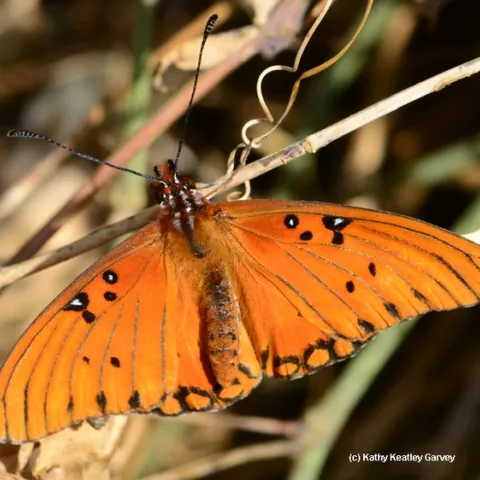
A Gulf Fritillary spotted Feb. 17 near downtown Vacaville, Solano County. (Photo by Kathy Keatley Garvey)

The Survivors

February 20, 2014
By Kathy Keatley Garvey
Just call them "The Survivors." They made it through the winter: the bitter cold with subfreezing temperatures; the 54-day drought (will it ever rain again?) and the heavy rain that caught us thinking about ark-building.
View Article
Primary Image
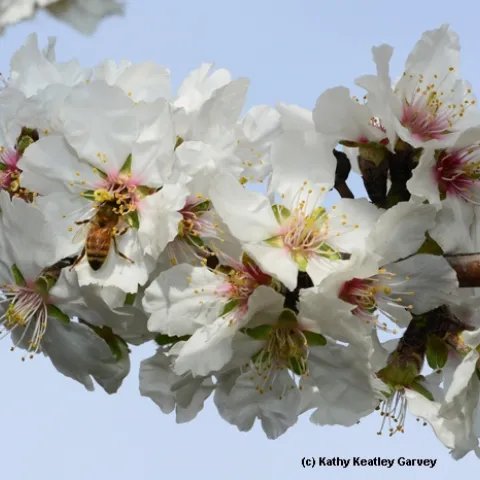
Springlike scene--a honey bee foraging in almond blossoms. (Photo by Kathy Keatley Garvey

The Almonds Are Blooming! The Almonds Are Blooming!

February 19, 2014
By Kathy Keatley Garvey
Everyone has a favorite almond tree, right? Mine--well, it's not exactly mine!--is on the grounds of the Harry H. Laidlaw Jr. Honey Bee Research Facility on Bee Biology Road, University of California, Davis. It's spectacular in bloom.
View Article
Primary Image
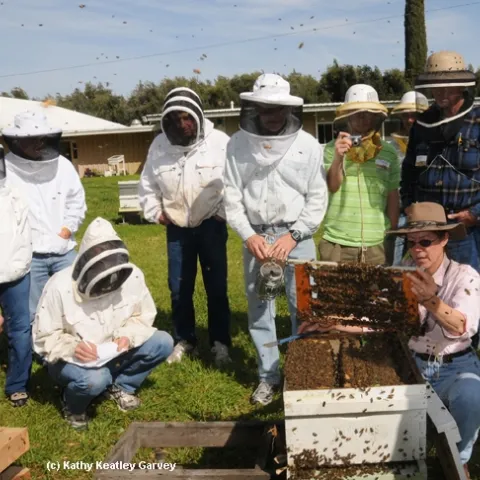
Bee breeder-geneticist Susan Cobey (kneeling at right) at one of her queen bee-rearing classes at UC Davis. (Photo by Kathy Keatley Garvey)

Susan Cobey: Queen Rearing and Instrumental Insemination

February 18, 2014
By Kathy Keatley Garvey
We know when spring approaches by the number of information requests we receive for bee breeder-geneticist Susan Cobey's popular queen bee-rearing and instrumental insemination classes. Cobey, former manager of the Harry H. Laidlaw Jr.
View Article