Bug Squad Logo

Bug Squad

Bug Squad blog image depicts a honey bee sting in action.

Welcome to the Bug Squad blog! The Bug Squad blog was launched Aug. 6, 2008 and is a daily blog (Monday through Friday). It showcases entomologists and the work they do.  The blog focuses on scientists in the UC Davis Department of Entomology and Nematology, the Bohart Museum of Entomology, Harry H. Laidlaw Jr. Honey Bee Research Facility, the UC Davis Bee Haven, and assorted campuswide events, including UC Davis Picnic Day, UC Davis Biodiversity Museum Day, and Bohart Museum open houses. The blog spotlights insects, including bees, butterflies, dragonflies, and praying mantises, as well as arachnids such as jumping spiders and crab spiders. Author and photographer is Kathy Keatley Garvey, communications specialist, UC Davis Department of Entomology and Nematology, and a longtime journalist and community scientist with two degrees from Washington State University.  She is a member of the Entomological Society of America (ESA) and the Association for Communication Excellence (ACE). Her blog posts and images have won international awards from ACE and ESA and appeared on journal and magazine covers. She shoots primarily with a Nikon Z-8 mirrorless camera, a Nikon D500 and Nikon 800, with assorted macro lenses. 
Primary Image
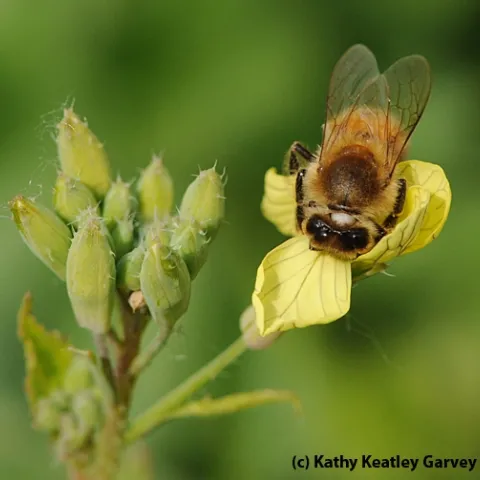
Honey bee foraging on mustard, a good cover crop for bees. (Photo by Kathy Keatley Garvey)

Bee-Helpful Cover Crops in Vineyards

August 2, 2013
By Kathy Keatley Garvey
Kathy Kellison is on a mission: to encourage winegrape growers to plant Bee-Helpful Cover Crops. This would include mustards, clover and buckwheat, plants that honey bees love. Kellison, the executive director of the Santa Rosa-based Partners for Sustainable Pollination, will speak Thursday, Aug.
View Article
Primary Image
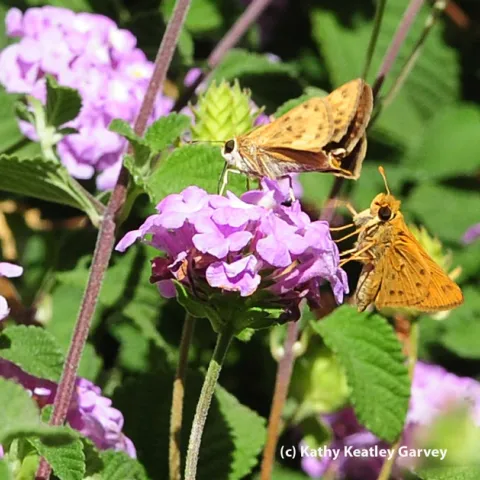
Courtship in the lantana: the female is on the left, and the male on the right. (Photo by Kathy Keatley Garvey)

Courtship in the Lantana

August 1, 2013
By Kathy Keatley Garvey
The purple trailing lantana (Lantana montevidensis) is a butterfly magnet. In our yard, it draws gulf fritillaries, Western tiger swallowtails, cabbage whites, and fiery skippers. Lately, fiery skippers (Hylephila phyleus) are the main draw.
View Article
Primary Image
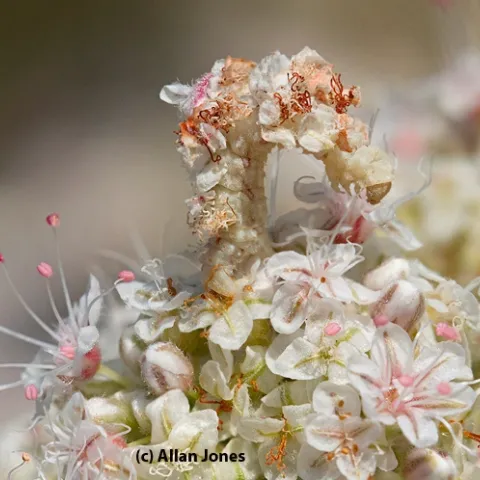
Larva of an emerald moth, Synchlora, disguised in florets. (Photo by Allan Jones)

Is There a Better Camouflage Than This?

July 31, 2013
By Kathy Keatley Garvey
Robbin Thorp saw it first. Talk about an eagle eye. Thorp, a native pollinator specialist and emeritus professor of entomology at the University of California, Davis, was monitoring the Hagen-Dazs Honey Bee Haven on Bee Biology Road, UC Davis, on July 23 when something caught his eye.
View Article
Primary Image
Gloria Gonzalez (left) of Vallejo, superintendent of McCormack Hall, Solano County Fair, and assistant Iris Mayhew of Vallejo hang a quilt by LaQuita Tummings of Vallejo. (Photo by Kathy Keatley Garvey)

Bring on the Butterflies!

July 30, 2013
By Kathy Keatley Garvey
It's a glorious summer day and butterflies are fluttering in the breeze. They are Nature's flying flowers, Nature's stained glass windows, and Nature's sunny smiles.
View Article
Primary Image
A honey bee zeroing in on a zinnia. (Photo by Kathy Keatley Garvey)

Honey Bees: Zeroing in on the Zinnias

July 29, 2013
By Kathy Keatley Garvey
Watching honey bees zero in on the zinnias: Zounds! Zinnias, known throughout the world as showy and easy-to-grow flowers, are as colorful as they are attractive to bees. Last week we watched a honey bee head toward a zinnia, grab some nectar, buzz around the blossom, and return again and again.
View Article