Bug Squad Logo

Bug Squad

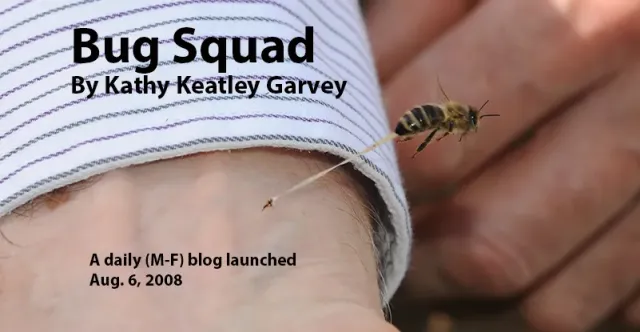
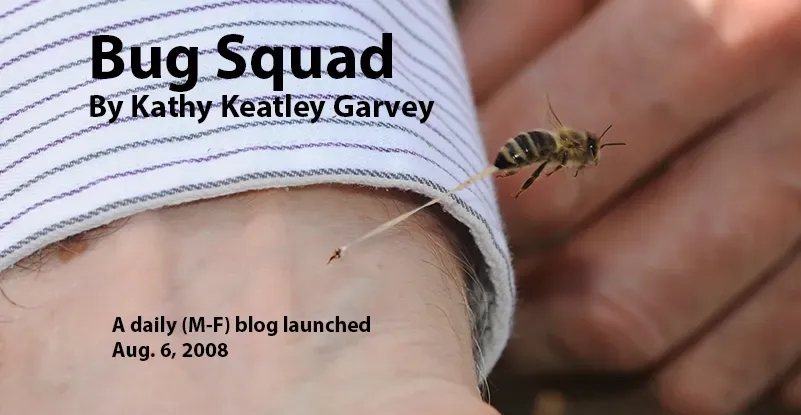
Bug Squad blog image depicts a honey bee sting in action.

Welcome to the Bug Squad blog! The Bug Squad blog was launched Aug. 6, 2008 and is a daily blog (Monday through Friday). It showcases entomologists and the work they do.  The blog focuses on scientists in the UC Davis Department of Entomology and Nematology, the Bohart Museum of Entomology, Harry H. Laidlaw Jr. Honey Bee Research Facility, the UC Davis Bee Haven, and assorted campuswide events, including UC Davis Picnic Day, UC Davis Biodiversity Museum Day, and Bohart Museum open houses. The blog spotlights insects, including bees, butterflies, dragonflies, and praying mantises, as well as arachnids such as jumping spiders and crab spiders. Author and photographer is Kathy Keatley Garvey, communications specialist, UC Davis Department of Entomology and Nematology, and a longtime journalist and community scientist with two degrees from Washington State University.  She is a member of the Entomological Society of America (ESA) and the Association for Communication Excellence (ACE). Her blog posts and images have won international awards from ACE and ESA and appeared on journal and magazine covers. She shoots primarily with a Nikon Z-8 mirrorless camera, a Nikon D500 and Nikon 800, with assorted macro lenses. Feedspot lists it as one of the top entomology blogs on the Internet. 
Primary Image
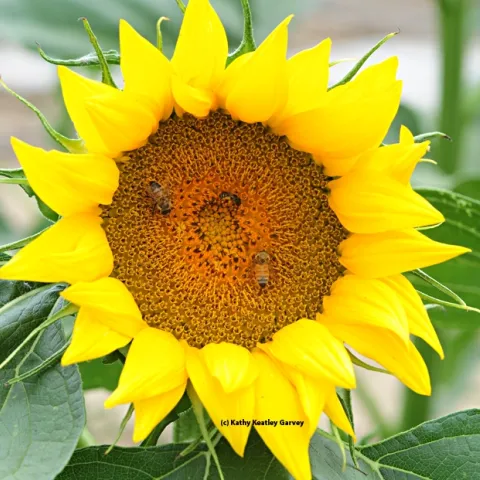
Honey bees and a sunflower bee forage on a sunflower head. (Photo by Kathy Keatley Garvey)

Sunny-Side Up

July 8, 2013
By Kathy Keatley Garvey
You can tell it's summer along Yolo County roads by the acres and acres of sunflower fields. Looking like real-life Van Gogh paintings (Van Gogh painted them in vases, Mother Nature paints them in rows), the sunflower fields are nothing short of spectacular.
View Article
Primary Image
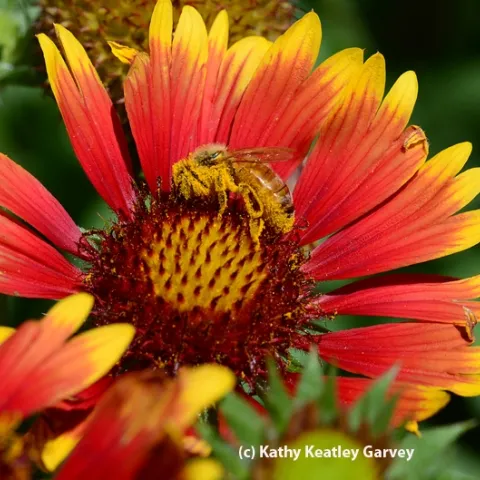
Honey bee is covered with pollen from a blanket flower, Gaillardia. (Photo by Kathy Keatley Garvey)

Pollen: Precious Gold

July 5, 2013
By Kathy Keatley Garvey
The California Gold Rush (1848-1855) has nothing on honey bees. Sometimes foraging honey bees are covered with their own kind of gold--pollen--or protein for their colonies.
View Article
Primary Image
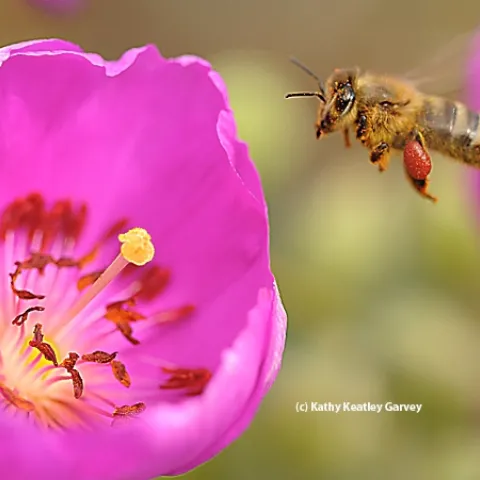
Honey bee packing red pollen from a rock purslane. (Photo by Kathy Keatley Garvey)

Hurrah for the Red, White and Blue!

July 4, 2013
By Kathy Keatley Garvey
It's the Fourth of July--a time to celebrate our nation's Independence Day. Hurrah for the red, white and blue! That also covers red, white and blue pollen collected by our honey bees. If you look closely, you'll see their "patriotic" colors.
View Article
Primary Image
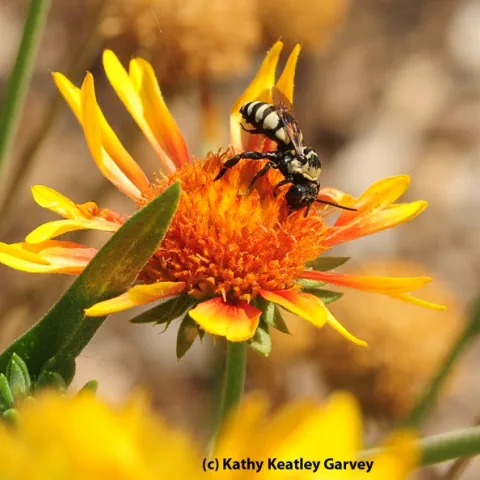
A male cuckoo bee, Triepeolus concavus, on a blanket flower (Gaillardia). (Photo by Kathy Keatley Garvey)

Why This Is Bee Is Cuckoo

July 3, 2013
By Kathy Keatley Garvey
When you visit the half-acre Hagen-Dazs Honey Bee Haven, a bee friendly garden on Bee Biology Road at the University of California, Davis, you might just see a cuckoo bee.
View Article
Primary Image
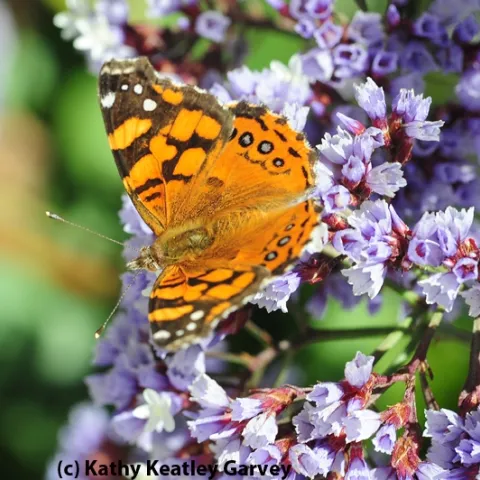
A West Coast Lady at the Berkeley Marina. (Photo by Kathy Keatley Garvey)

An Admiral at the Marina

July 2, 2013
By Kathy Keatley Garvey
There's nothing like seeing an admiral at a marina. That would be the Red Admiral butterfly, Vanessa atalanta, at the Berkeley marina. It's often very common in the urban Bay Area, says butterfly expert Art Shapiro, professor of evolution and ecology at the University of California, Davis.
View Article