Bug Squad Logo

Bug Squad

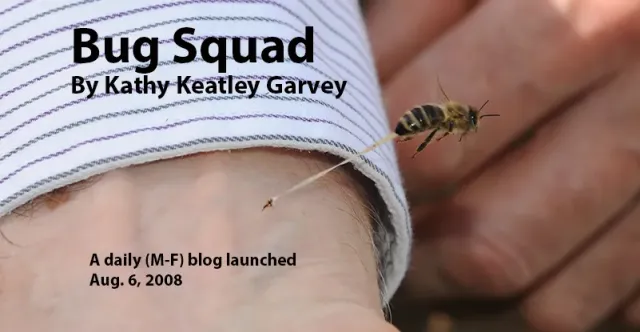
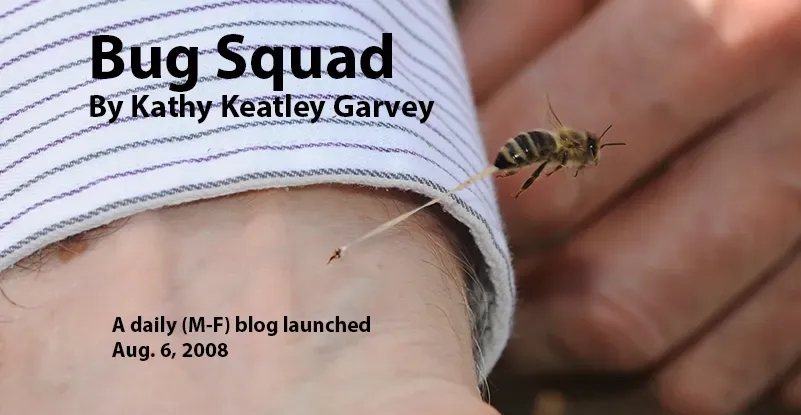
Bug Squad blog image depicts a honey bee sting in action.

Welcome to the Bug Squad blog! The Bug Squad blog was launched Aug. 6, 2008 and is a daily blog (Monday through Friday). It showcases entomologists and the work they do.  The blog focuses on scientists in the UC Davis Department of Entomology and Nematology, the Bohart Museum of Entomology, Harry H. Laidlaw Jr. Honey Bee Research Facility, the UC Davis Bee Haven, and assorted campuswide events, including UC Davis Picnic Day, UC Davis Biodiversity Museum Day, and Bohart Museum open houses. The blog spotlights insects, including bees, butterflies, dragonflies, and praying mantises, as well as arachnids such as jumping spiders and crab spiders. Author and photographer is Kathy Keatley Garvey, communications specialist, UC Davis Department of Entomology and Nematology, and a longtime journalist and community scientist with two degrees from Washington State University.  She is a member of the Entomological Society of America (ESA) and the Association for Communication Excellence (ACE). Her blog posts and images have won international awards from ACE and ESA and appeared on journal and magazine covers. She shoots primarily with a Nikon Z-8 mirrorless camera, a Nikon D500 and Nikon 800, with assorted macro lenses. 
Primary Image
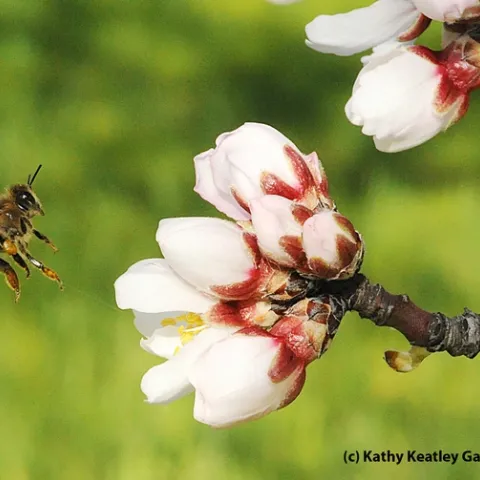
Honey bee heading toward an almond blossom. (Photo by Kathy Keatley Garvey)

Troubling Bee Shortage in Almond Orchards

February 8, 2013
By Kathy Keatley Garvey
California almond growers are worried--and rightfully so--about the honey bee shortage. Honey bee guru Eric Mussen, Extension apiculturist with the UC Davis Department of Entomology, said today that almond growers may not have enough bees to pollinate this year's crop of 800,000 acres. We need 1.
View Article
Primary Image
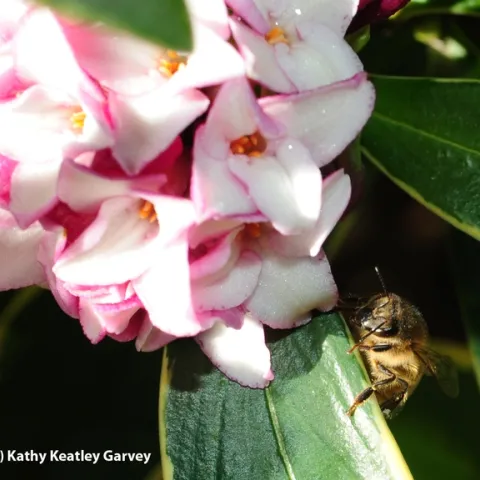
Table for one, please! A honey bee in the shadows of a daphne bloom at the Storer Garden, UC Davis. (Photo by Kathy Keatley Garvey)

Table for One, Please

February 7, 2013
By Kathy Keatley Garvey
Ah, what an intoxicating scent! If you've ever been around the winter daphne, Daphne odora, cultivar "Aureomarginata," you know that its aroma precedes it. You'll ask "What's that fragrance?" before you even see the showy pink-and-white blossoms and its green leaves edged in gold.
View Article
Primary Image
A walking stick at the Bohart Museum of Entomology. (Photo by Kathy Keatley Garvey)

Going with Your Gut

February 6, 2013
By Kathy Keatley Garvey
Of the one millions insects so far described, 120,000 are butterflies or moths, 150,000 are flies, 400,000 are beetles, and only 3000 are walking sticks. Which are my speciality. Not too much is known about walking sticks because not many people have studied them.
View Article
Primary Image
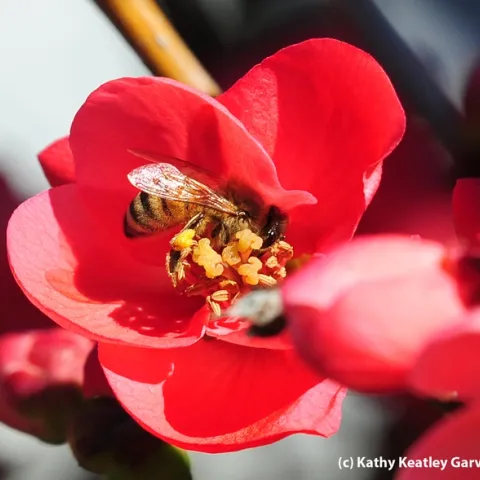
Honey bee foraging in a flowering quince. (Photo by Kathy Keatley Garvey)

A Buffet for the Bees

February 5, 2013
By Kathy Keatley Garvey
When the honey bee meets the flowering quince, the bee is "the belle of the ball." The winter ball. Suddenly the flowering quince (genus Chaenomele) transforms the bleak wintery landscape into a spring ballroom of sorts. The giddy bee is a joy to see.
View Article
Primary Image
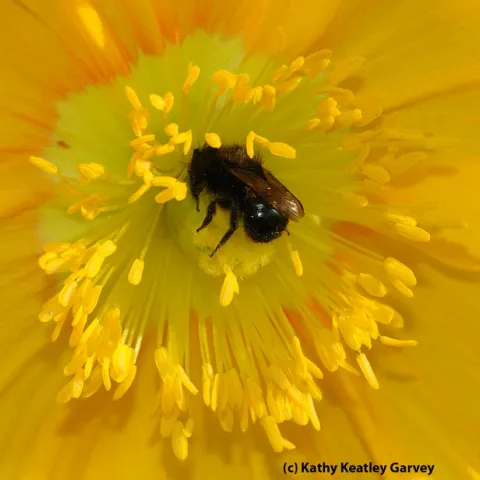
Female mason bee, genus Osmia (Family Megachilidae), as identified by native pollinator specialist/emeritus professor Robbin Thorp of UC Davis. (Photo by Kathy Keatley Garvey)

About Those Non-Social Bees...

February 4, 2013
By Kathy Keatley Garvey
About those non-social bees... A good place to learn about them is at the UC Davis Department of Entomology seminar on Wednesday, Feb. 6. James Jim Cane, a research entomologist with the U.S.
View Article