Bug Squad Logo

Bug Squad

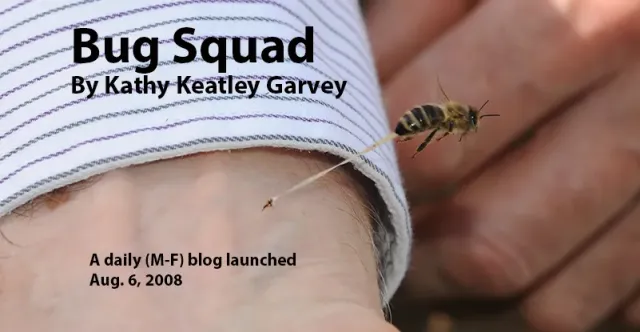
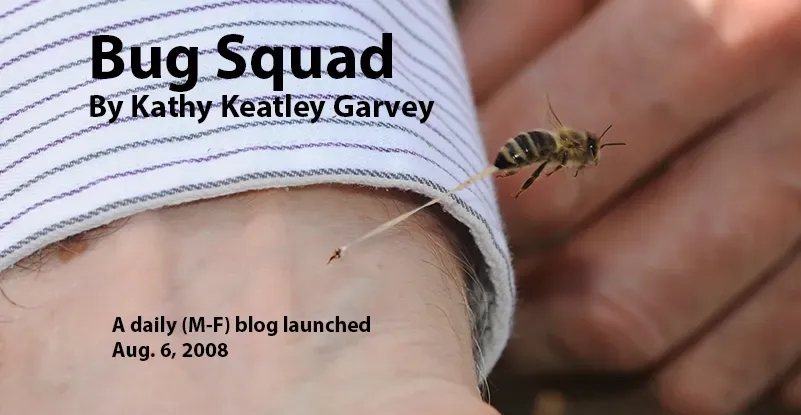
Bug Squad blog image depicts a honey bee sting in action.

Welcome to the Bug Squad blog! The Bug Squad blog was launched Aug. 6, 2008 and is a daily blog (Monday through Friday). It showcases entomologists and the work they do.  The blog focuses on scientists in the UC Davis Department of Entomology and Nematology, the Bohart Museum of Entomology, Harry H. Laidlaw Jr. Honey Bee Research Facility, the UC Davis Bee Haven, and assorted campuswide events, including UC Davis Picnic Day, UC Davis Biodiversity Museum Day, and Bohart Museum open houses. The blog spotlights insects, including bees, butterflies, dragonflies, and praying mantises, as well as arachnids such as jumping spiders and crab spiders. Author and photographer is Kathy Keatley Garvey, communications specialist, UC Davis Department of Entomology and Nematology, and a longtime journalist and community scientist with two degrees from Washington State University.  She is a member of the Entomological Society of America (ESA) and the Association for Communication Excellence (ACE). Her blog posts and images have won international awards from ACE and ESA and appeared on journal and magazine covers. She shoots primarily with a Nikon Z-8 mirrorless camera, a Nikon D500 and Nikon 800, with assorted macro lenses. Feedspot lists it as one of the top entomology blogs on the Internet. 
Primary Image
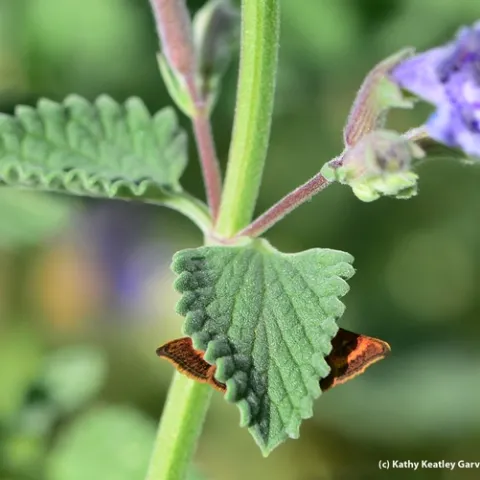
What's behind the catmint leaf (Nepeta)? (Photo by Kathy Keatley Garvey)

In Mint Condition

September 3, 2012
By Kathy Keatley Garvey
if you're growing plants in the mint family, Lamiaceae--you know, the plants with the square stalks and opposite leaves--you may see a very tiny reddish-orange visitor. It's so tiny that it's smaller than the leaf of a catmint (Nepeta). Its wing span is probably about 10 to 15 millimeters.
View Article
Primary Image
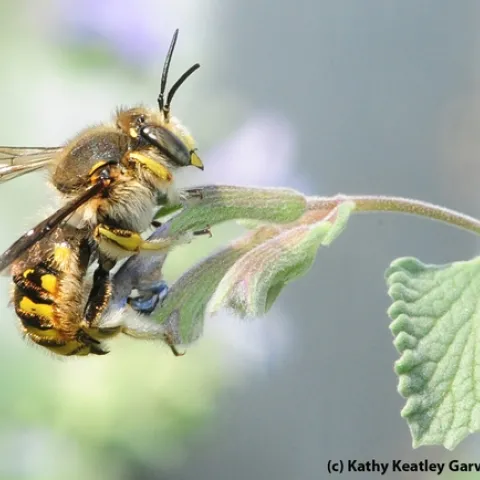
Male European wool carder bee heads for a catmint (Nepeta) leaf. (Photo by Kathy Keatley Garvey)

Up, Close and Personal

August 31, 2012
By Kathy Keatley Garvey
If you've ever glimpsed a European wool carder bee foraging in your yard, chances are that's all you saw--a glimpse. The wool carder bees (Anthidium manicatum), so named because the females collect or "card" plant fuzz for their nests, move quickly.
View Article
Primary Image
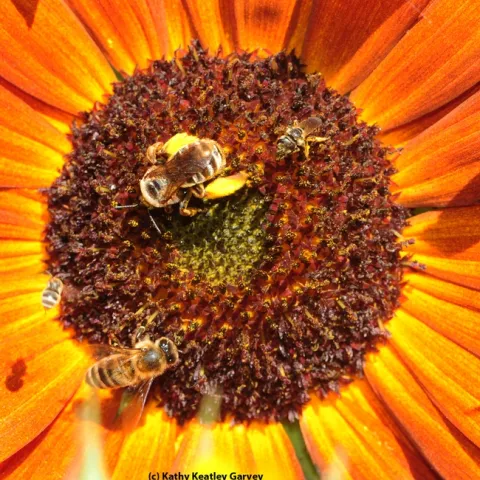
This photo shows a honey bee (bottom left), a sunflower bee, Svastra, and a sweat bee, Halictus ligatus, with another sweat bee, Halictus tripartus, coming in for a landing. (Photo by Kathy Keatley Garvey)

Sharing a Sunflower

August 30, 2012
By Kathy Keatley Garvey
You often see a single solitary bee on a sunflower. Perhaps it's a sunflower bee (Svastra) or a honey bee (Apis mellifera). But four on one? Sharing a sunflower? Yes.
View Article
Primary Image
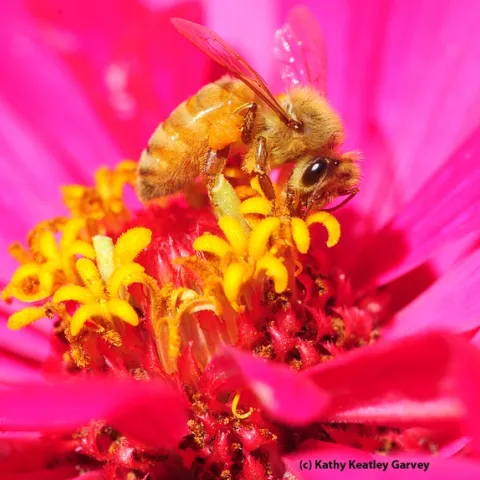
Italian honey bee forages on a zinnia. (Photo by Kathy Keatley Garvey)

Now That's Italian!

August 29, 2012
By Kathy Keatley Garvey
Now that's Italian! The Italian honey bee (below) nectaring on a zinnia at the University of California, Davis, is striking for two reasons: she's as gold as starthistle honey in the sunlight and she's a very young forager.
View Article
Primary Image
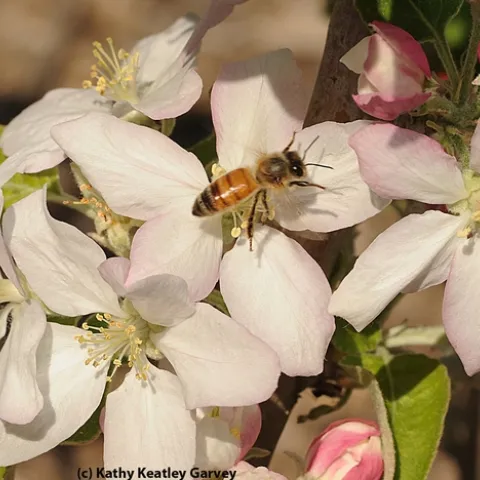
This photo of a honey bee on an almond blossom will appear on the WAS conference t-shirt. (Photo by Kathy Keatley Garvey)

A Two-Fold Bee Conference

August 28, 2012
By Kathy Keatley Garvey
Seattle will be the place to "bee" on Oct. 4-7. That's where the Western Apicultural Society (WAS) will hold its annual meeting--and this year it's in conjunction with the Washington State Beekeepers' Association.
View Article