Bug Squad Logo

Bug Squad

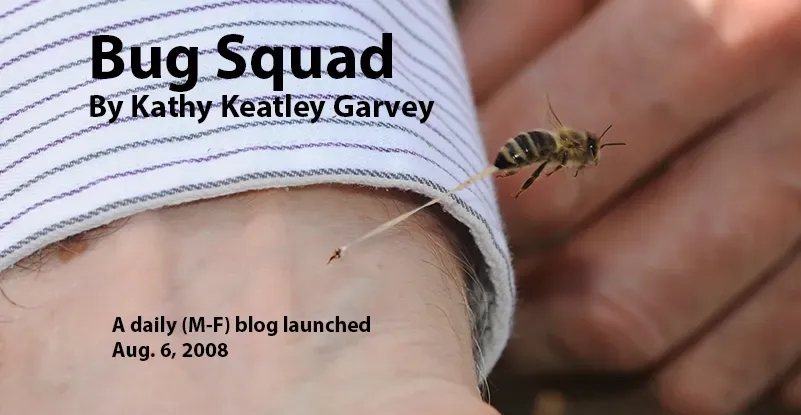
Bug Squad blog image depicts a honey bee sting in action.

Welcome to the Bug Squad blog! The Bug Squad blog was launched Aug. 6, 2008 and is a daily blog (Monday through Friday). It showcases entomologists and the work they do.  The blog focuses on scientists in the UC Davis Department of Entomology and Nematology, the Bohart Museum of Entomology, Harry H. Laidlaw Jr. Honey Bee Research Facility, the UC Davis Bee Haven, and assorted campuswide events, including UC Davis Picnic Day, UC Davis Biodiversity Museum Day, and Bohart Museum open houses. The blog spotlights insects, including bees, butterflies, dragonflies, and praying mantises, as well as arachnids such as jumping spiders and crab spiders. Author and photographer is Kathy Keatley Garvey, communications specialist, UC Davis Department of Entomology and Nematology, and a longtime journalist and community scientist with two degrees from Washington State University.  She is a member of the Entomological Society of America (ESA) and the Association for Communication Excellence (ACE). Her blog posts and images have won international awards from ACE and ESA and appeared on journal and magazine covers. She shoots primarily with a Nikon Z-8 mirrorless camera, a Nikon D500 and Nikon 800, with assorted macro lenses. 
Primary Image
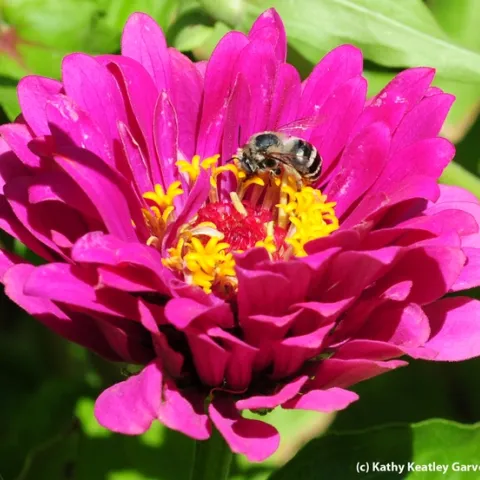
Female digger bee, Anthophora urbana, on zinnia. (Photo by Kathy Keatley Garvey),

Diggin' the Digger Bee

August 24, 2012
By Kathy Keatley Garvey
Diggin' the digger bee... We spotted this female digger bee, Anthophora urbana, zooming in on some zinnias at UC Davis. She buzzed loudly, virtually owning the zinnia patch. Smaller sweat bees scattered.
View Article
Primary Image
Male mountain or foothill carpenter bee, Xylocopa tabaniformis orpifex, on salvia. (Photo by Kathy Keatley Garvey)

Meet a Carpenter Bee

August 23, 2012
By Kathy Keatley Garvey
Meet a carpenter bee. This one (below) is a male carpenter bee, Xylocopa tabaniformis orpifex, as identified by native pollinator specialist Robbin Thorp, emeritus professor of entomology at the University of California, Davis. It's also called a "mountain" or "foothill" carpenter bee.
View Article
Primary Image
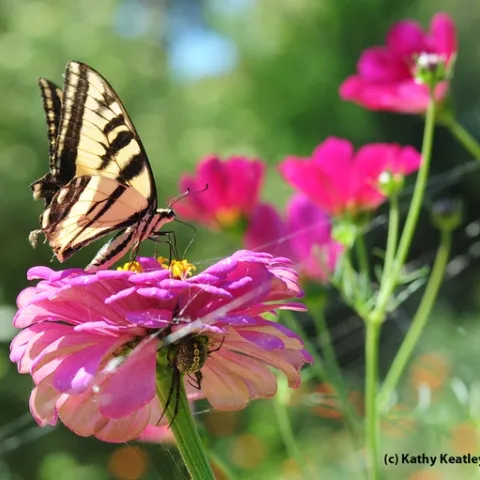
Western tiger swallowtail, Papilio rutulus, nectars on a zinnia, unaware of the danger lurking below. (Photo by Kathy Keatley Garvey)

Tiger by the Tail? Not This Time!

August 22, 2012
By Kathy Keatley Garvey
Don't look now, but a garden spider almost grabbed a tiger by the tail. The tiger? That would be the Western tiger swallowtail, Papilio rutulus. The ragged wings of the butterfly (below) show signs of a close encounter with a predator--maybe another spider, a praying mantis or a bird.
View Article
Primary Image
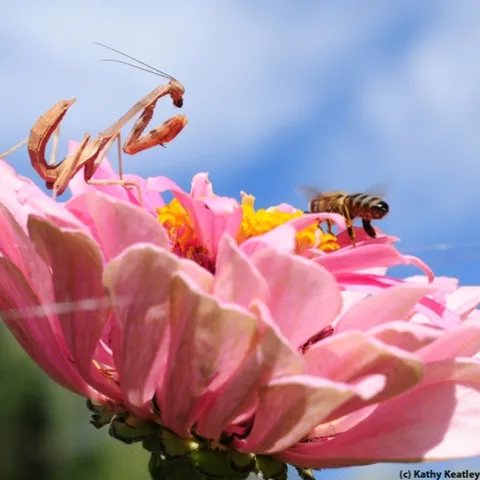
Unsuspecting honey bee lands on a zinnia occupied by a praying mantis lying in wait. (Photo by Kathy Keatley Garvey)

It Was Not to Bee

August 21, 2012
By Kathy Keatley Garvey
The drama unfolds slowly. The crafty praying mantis that's perched atop a zinnia raises its spiked, grasping forelegs and silently waits for unsuspecting prey. A sweat bee cruises by. Then a second one. Then a third. They do not land and the praying mantis does not move.
View Article
Primary Image
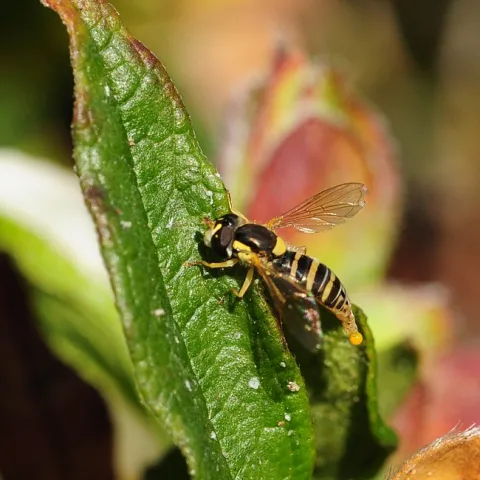
Syrphid fly (female Sphaerophoria), as identified by senior insect biosystematist Martin Hauser of the CDFA. (Photo by Kathy Keatley Gavrey)

The Girl and the Bubble

August 20, 2012
By Kathy Keatley Garvey
Ah, the little intricacies of life... We were walking along a stretch of the coastal town of Bodega Bay when we spotted something we'd never seen before: a bubble on a syrphid fly. Syrphid flies, also known as hover flies or flower flies, are pollinators, just like honey bees.
View Article