Bug Squad Logo

Bug Squad

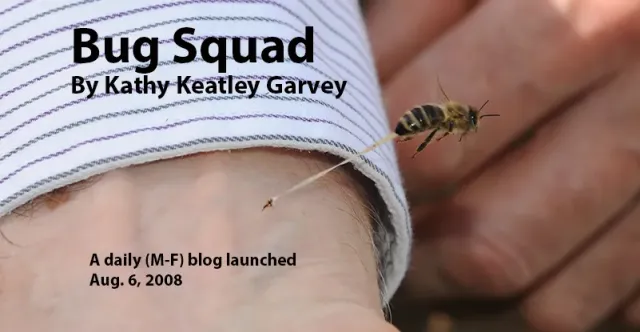
Bug Squad blog image depicts a honey bee sting in action.

Welcome to the Bug Squad blog! The Bug Squad blog was launched Aug. 6, 2008 and is a daily blog (Monday through Friday). It showcases entomologists and the work they do.  The blog focuses on scientists in the UC Davis Department of Entomology and Nematology, the Bohart Museum of Entomology, Harry H. Laidlaw Jr. Honey Bee Research Facility, the UC Davis Bee Haven, and assorted campuswide events, including UC Davis Picnic Day, UC Davis Biodiversity Museum Day, and Bohart Museum open houses. The blog spotlights insects, including bees, butterflies, dragonflies, and praying mantises, as well as arachnids such as jumping spiders and crab spiders. Author and photographer is Kathy Keatley Garvey, communications specialist, UC Davis Department of Entomology and Nematology, and a longtime journalist and community scientist with two degrees from Washington State University.  She is a member of the Entomological Society of America (ESA) and the Association for Communication Excellence (ACE). Her blog posts and images have won international awards from ACE and ESA and appeared on journal and magazine covers. She shoots primarily with a Nikon Z-8 mirrorless camera, a Nikon D500 and Nikon 800, with assorted macro lenses. Feedspot lists it as one of the top entomology blogs on the Internet. 

Primary Image
Female leafcutting bee, Megachile fidelis, foraging on a Mexican sunflower. (Photo by Kathy Keatley Garvey)

Piling on the Pollen

July 26, 2012
By Kathy Keatley Garvey
It's a native bee. It's a pollinator. And it's a leafcutter. This morning we admired this female leafcutter bee, Megachile fidelis, as identified by native pollinator specialist Robbin Thorp, emeritus professor of entomology at the University of California, Davis.
View Article
Primary Image
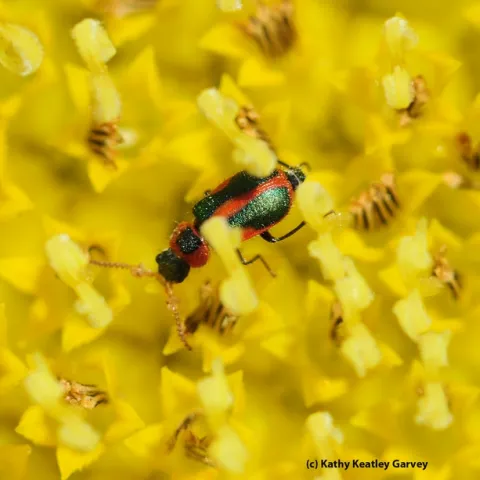
Melyrid beetle on a sunflower. (Photo by Kathy Keatley Garvey)

What's in the Sunflowers?

July 25, 2012
By Kathy Keatley Garvey
So you're walking through a sunflower field and you're seeing lots of honey bees foraging on the flowers. But wait, look over there. Are those beetles? They are. Melyrid or blister beetles (Melyridae family) and spotted cucumber beetles (family Chrysomelidae) are frequently found on sunflowers.
View Article
Primary Image
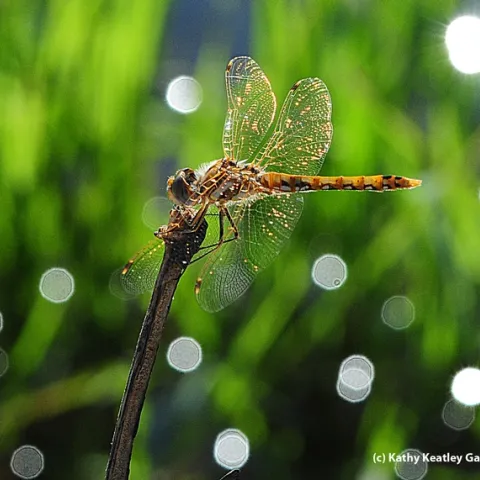
Variegated meadowhawk, Sympetrum corruptum, glows in the early morning. (Photo by Kathy Keatley Garvey)

Ode to the Meadowhawk

July 24, 2012
By Kathy Keatley Garvey
If you're around creeks, ponds and irrigation ditches, watch for the dragonflies. We spotted scores of variegated meadowhawks (Sympetrum corruptum) last Sunday along an irrigation ditch bordering a sunflower field in Winters, Calif.
View Article
Primary Image
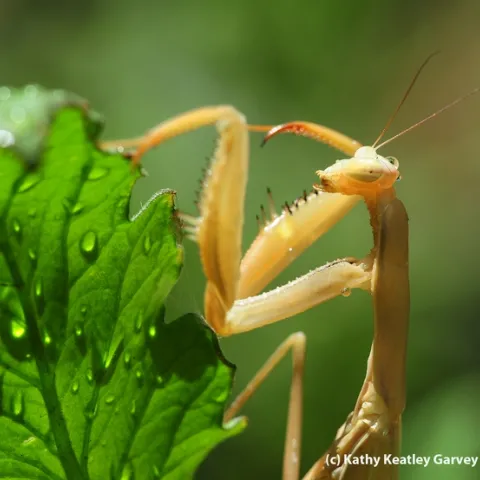
Praying mantis on a watered tomato plant. (Photo by Kathy Keatley Garvey)

How to Flush Out a Praying Mantis

July 23, 2012
By Kathy Keatley Garvey
So you want to capture an image of a praying mantis. You have to find one first. Sometimes it's a case of hide 'n seek--it hides, you seek. Mantises, or mantids, are camouflaged.
View Article
Primary Image
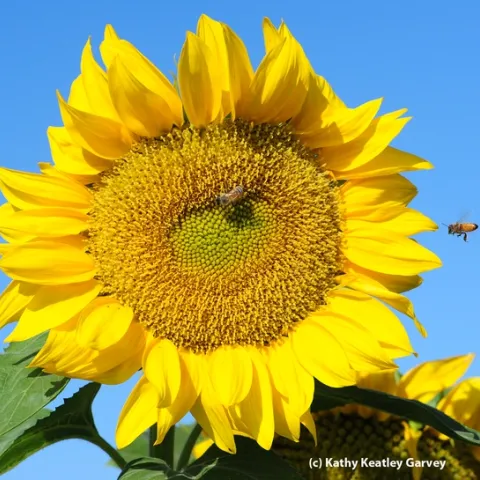
Honey bee heads for a sunflower in a field off Pedrick Road, Dixon. (Photo by Kathy Keatley Garvey)

Here Come the Sun(Flowers)

July 20, 2012
By Kathy Keatley Garvey
You can't drive by a sunflower field without smiling. Their golden heads turned toward the sun, their fringed petals aglow, sunflowers set an amicable scene in a world sometimes darkened by strife and sorrow. Take, for example, the sunflower fields along Pedrick Road in Dixon, Calif.
View Article