Bug Squad Logo

Bug Squad

Bug Squad blog image depicts a honey bee sting in action.

Welcome to the Bug Squad blog! The Bug Squad blog was launched Aug. 6, 2008 and is a daily blog (Monday through Friday). It showcases entomologists and the work they do.  The blog focuses on scientists in the UC Davis Department of Entomology and Nematology, the Bohart Museum of Entomology, Harry H. Laidlaw Jr. Honey Bee Research Facility, the UC Davis Bee Haven, and assorted campuswide events, including UC Davis Picnic Day, UC Davis Biodiversity Museum Day, and Bohart Museum open houses. The blog spotlights insects, including bees, butterflies, dragonflies, and praying mantises, as well as arachnids such as jumping spiders and crab spiders. Author and photographer is Kathy Keatley Garvey, communications specialist, UC Davis Department of Entomology and Nematology, and a longtime journalist and community scientist with two degrees from Washington State University.  She is a member of the Entomological Society of America (ESA) and the Association for Communication Excellence (ACE). Her blog posts and images have won international awards from ACE and ESA and appeared on journal and magazine covers. She shoots primarily with a Nikon Z-8 mirrorless camera, a Nikon D500 and Nikon 800, with assorted macro lenses. 
Primary Image
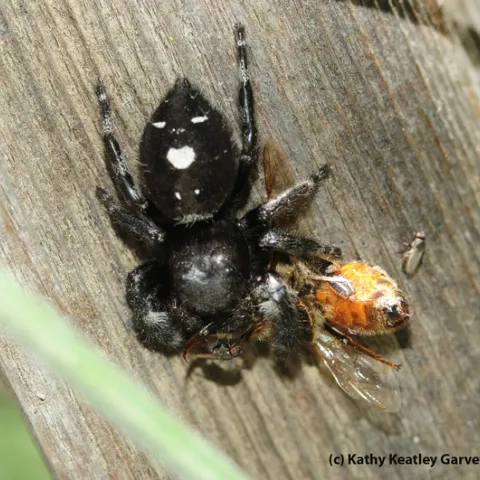
Jumping spider eating a honey bee. (Photo by Kathy Keatley Garvey)

The Predator

July 6, 2012
By Kathy Keatley Garvey
I know. Jumping spiders have to eat, but do they have to snag the bees? Last weekend as we were checking the lavender patch in our yard, we noticed something partially hidden--and moving--on a post. It was a jumping spider eating a honey bee.
View Article
Primary Image
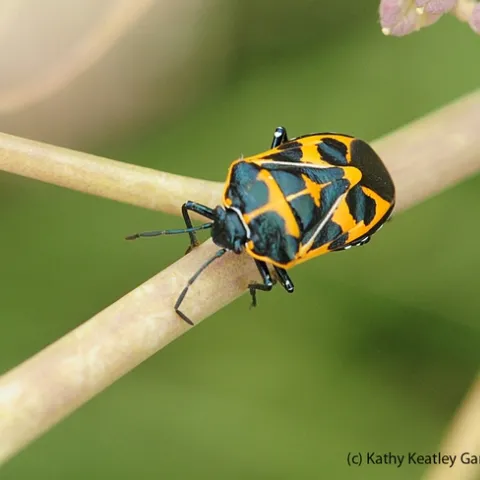
Harlequin bug, Murgantia histronica, on weeds at the Benicia Marina. (Photo by Kathy Keatley Garvey)

This Bug Is Not Welcome

July 5, 2012
By Kathy Keatley Garvey
It boasts striking colors, but you don't want this bug anywhere near your garden. It sucks. Literally. This is a harlequin bug, Murgantia histronica, as identified by Lynn Kimsey, director of the Bohart Museum of Entomology and professor of entomology at the University of California, Davis.
View Article
Primary Image
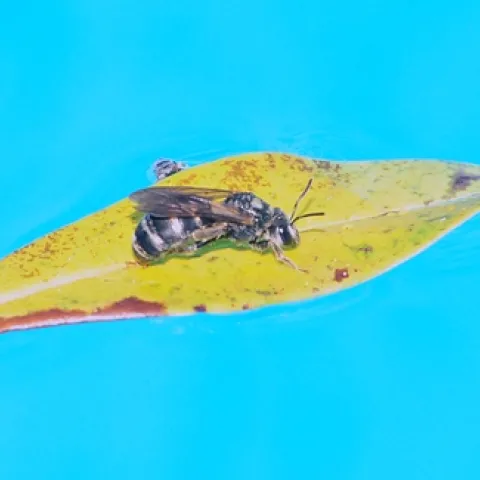
Summertime...and the living is easy...A female sweat bee, genus Halictus, floats on a leaf in a swimming pool. (Photo by Kathy Keatley Garvey)

Summertime...and the Livin' Is Easy

July 4, 2012
By Kathy Keatley Garvey
Today's the Fourth of July and folks are splashing in their pools. So, what happens when a bee falls in? Sometimes they get lucky--if there's a human around to rescue them. And sometimes their luck extends to a floating leaf. This tiny female sweat bee, genus Halictus (probably H.
View Article
Primary Image
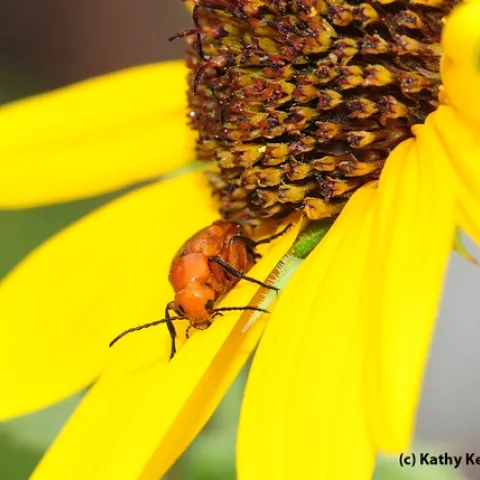
Meloid blister beetle, which produces a toxin known as cantharidin, peers at the camera. (Photo by Kathy Keatley Garvey)

Caution: Toxic!

July 3, 2012
By Kathy Keatley Garvey
It was a reddish-orange beetle, moving a little but not a lot. We spotted it on a sunflower bordering the Avant Garden in Benicia.
View Article
Primary Image
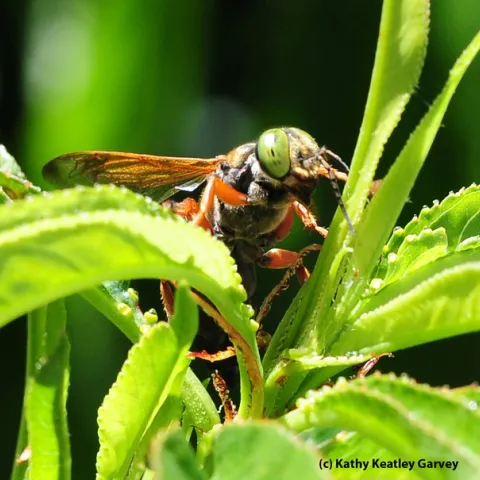
Green-eyed wasp, genus Tachytes, in a nectarine tree. This one is a female, as identified by Lynn Kimsey, director of the Bohart Museum of Entomology. (Photo by Kathy Keatley Garvey)

Green-Eyed Gal

July 2, 2012
By Kathy Keatley Garvey
We saw her touch down in our nectarine tree last weekend. Big green compound eyes glowed at us. She moved up and down a branch, foraging for food, and then took off. A wasp. The carnivore cousin of the vegetarian honey bee. They belong to the same order, Hymenoptera.
View Article