Bug Squad Logo

Bug Squad

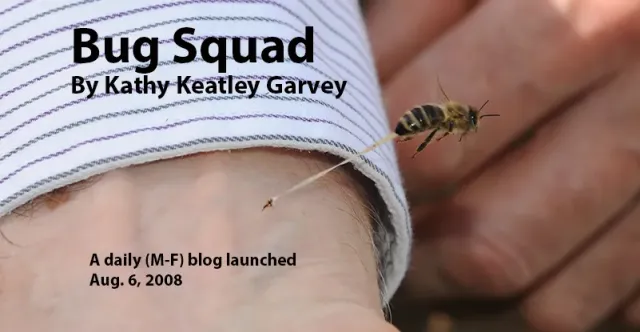
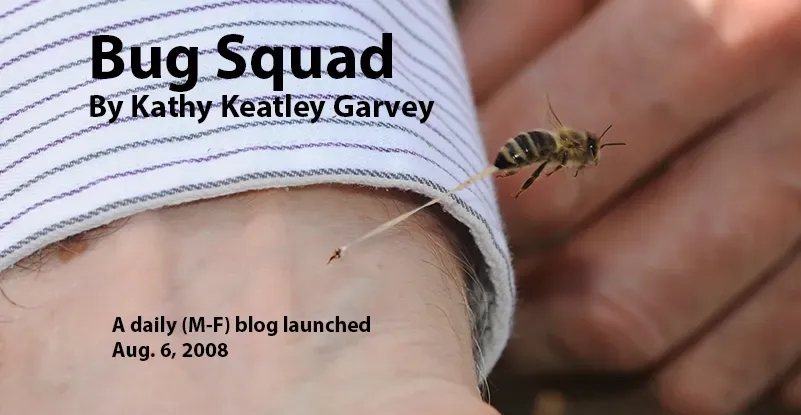
Bug Squad blog image depicts a honey bee sting in action.

Welcome to the Bug Squad blog! The Bug Squad blog was launched Aug. 6, 2008 and is a daily blog (Monday through Friday). It showcases entomologists and the work they do.  The blog focuses on scientists in the UC Davis Department of Entomology and Nematology, the Bohart Museum of Entomology, Harry H. Laidlaw Jr. Honey Bee Research Facility, the UC Davis Bee Haven, and assorted campuswide events, including UC Davis Picnic Day, UC Davis Biodiversity Museum Day, and Bohart Museum open houses. The blog spotlights insects, including bees, butterflies, dragonflies, and praying mantises, as well as arachnids such as jumping spiders and crab spiders. Author and photographer is Kathy Keatley Garvey, communications specialist, UC Davis Department of Entomology and Nematology, and a longtime journalist and community scientist with two degrees from Washington State University.  She is a member of the Entomological Society of America (ESA) and the Association for Communication Excellence (ACE). Her blog posts and images have won international awards from ACE and ESA and appeared on journal and magazine covers. She shoots primarily with a Nikon Z-8 mirrorless camera, a Nikon D500 and Nikon 800, with assorted macro lenses. Feedspot lists it as one of the top entomology blogs on the Internet. 
Primary Image
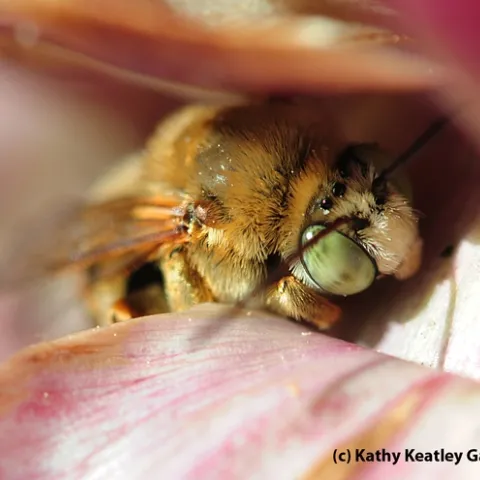
Long-horned sunflower bee tucked in a flowering artichoke. (Photo by Kathy Keatley Garvey)

Green-Eyed Bee

June 25, 2012
By Kathy Keatley Garvey
So you're poking around in your garden and you see a bee on a flowering artichoke that you've never seen foraging there before. On sunflowers, yes. On artichokes, no. A closer look--and huge green eyes stare back at you. Definitely not a honey bee (Apis mellifera), although its size is comparable.
View Article
Primary Image
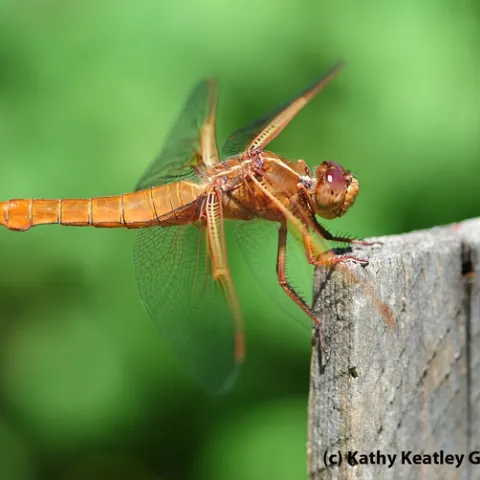
Flame skimmer perched on a tomato plant-stake. (Photo by Kathy Keatley Garvey)

An Old Flame (Skimmer)

June 22, 2012
By Kathy Keatley Garvey
Gotta love those flame skimmers. It's a joy to watch these firecracker-red dragonflies (Libellula saturata) make their presence known. They dart over our fish pond, snatch an insect, and then perch on a tomato-plant stake to eat it. Last year another generation did the same thing.
View Article
Primary Image
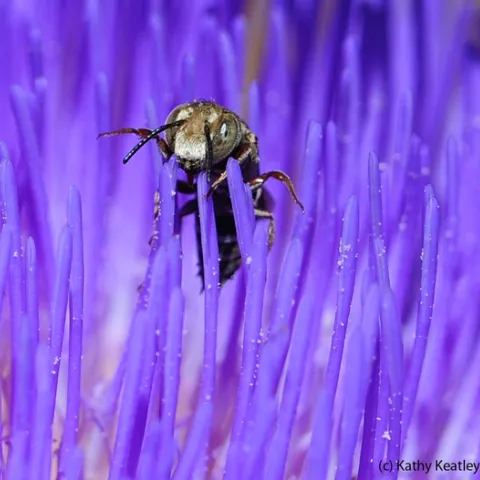
Male cuckoo leafcutting bee (genus Coelioxys) emerges from the purple strands of an artichoke blossom. (Photo by Kathy Keatley Garvey)

Purple Paradise

June 21, 2012
By Kathy Keatley Garvey
If you want to attract insects to your garden, plant an artichoke and let it flower. You'll get honey bees, syrphid flies, butterflies, carpenter bees and leafcutter bees. (And well, a few predators, such as spiders and wasps.) Today we saw leafcutter bees (Megachile spp.
View Article
Primary Image
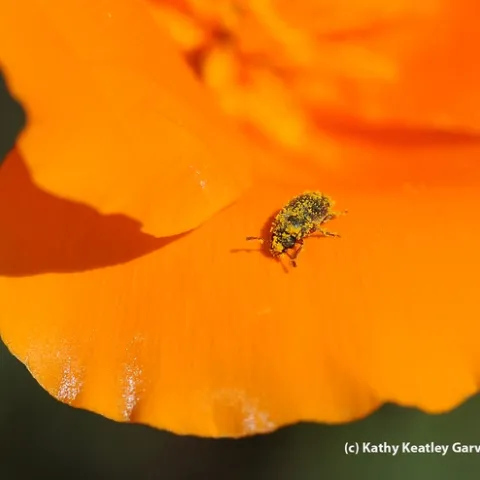
Melyrid beetle (Endeodes insularis) on a poppy petal. (Photo y Kathy Keatley Garvey)

Not Your Usual Pollinator

June 20, 2012
By Kathy Keatley Garvey
Since this is National Pollinator Week, you're probably out celebrating the bees--maybe doing hand stands, cartwheels and pirouettes. But have you ever thought about beetles as pollinators? They are. We spotted this little critter on a California golden poppy at the Sonoma Mission in Sonoma, Calif.
View Article
Primary Image
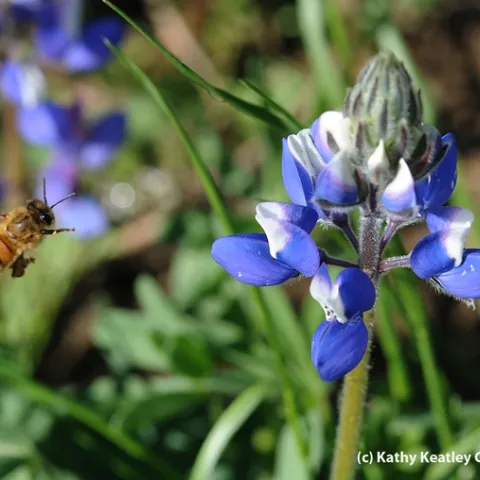
Honey bee heading for blue lupine. (Photo by Kathy Keatley Garvey)

Wild Blue Yonder

June 19, 2012
By Kathy Keatley Garvey
Sometimes you see honey bees "making a beeline." Such was the case when this honey bee (below) encountered a native wildflower, blue lupine (Lupinus). Lupines are known more as pollen plants than nectar plants, according to Frank Pellett's book, American Honey Plants, a Dadant publication.
View Article