Bug Squad Logo

Bug Squad

Bug Squad blog image depicts a honey bee sting in action.

Welcome to the Bug Squad blog! The Bug Squad blog was launched Aug. 6, 2008 and is a daily blog (Monday through Friday). It showcases entomologists and the work they do.  The blog focuses on scientists in the UC Davis Department of Entomology and Nematology, the Bohart Museum of Entomology, Harry H. Laidlaw Jr. Honey Bee Research Facility, the UC Davis Bee Haven, and assorted campuswide events, including UC Davis Picnic Day, UC Davis Biodiversity Museum Day, and Bohart Museum open houses. The blog spotlights insects, including bees, butterflies, dragonflies, and praying mantises, as well as arachnids such as jumping spiders and crab spiders. Author and photographer is Kathy Keatley Garvey, communications specialist, UC Davis Department of Entomology and Nematology, and a longtime journalist and community scientist with two degrees from Washington State University.  She is a member of the Entomological Society of America (ESA) and the Association for Communication Excellence (ACE). Her blog posts and images have won international awards from ACE and ESA and appeared on journal and magazine covers. She shoots primarily with a Nikon Z-8 mirrorless camera, a Nikon D500 and Nikon 800, with assorted macro lenses. Feedspot lists it as one of the top entomology blogs on the Internet. 
Primary Image
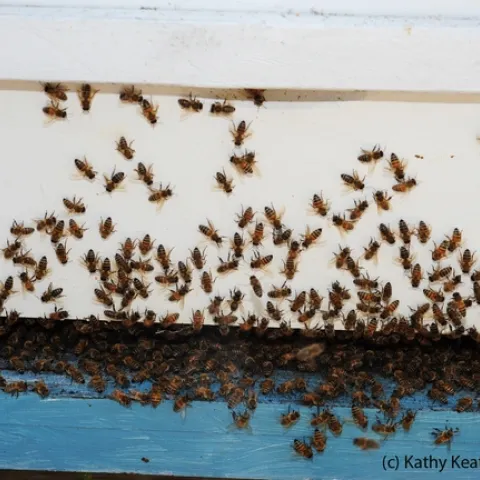
Honey bees engaging in washboarding behavior with "rocking" or up-and-down movements. (Photo by Kathy Keatley Garvey)

Rub-a-Dub-Dub

May 28, 2012
By Kathy Keatley Garvey
Ever seen honey bees engaging in washboarding? It's a behavior so named because they look as if they're scrubbing clothes on a washboard or scrubbing their home. It occurs near the entrance of the hive and only with worker bees. They go back and forth, back and forth, a kind of rocking movement.
View Article
Primary Image
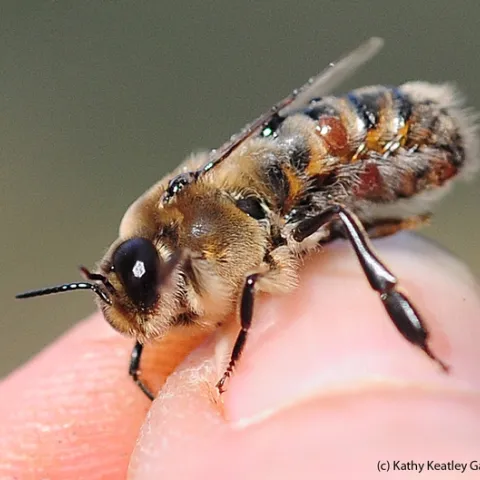
The lifespan of this mite-infested drone will be short. The brownish-orange "bumps" are varroa mites. (Photo by Kathy Keatley Garvey)

What We Need: A Better Bee

May 25, 2012
By Kathy Keatley Garvey
Varroa mites, those pesky little parasites that suck the blood out of honey bees and spread multiple viruses, are now found throughout the world, except in Australia.
View Article
Primary Image
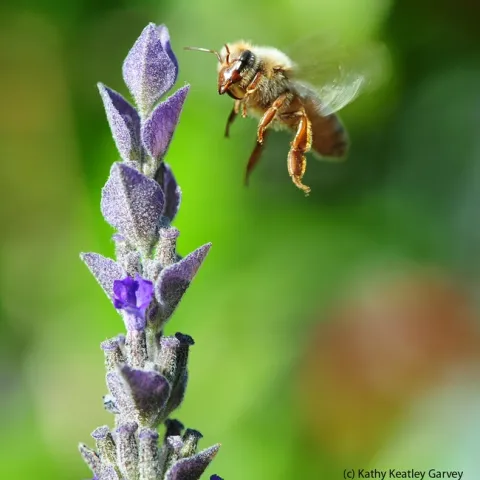
Honey bee in flight, heading toward a lavender blossom. Note the varroa mite on her head. (Photo by Kathy Keatley Garvey)

The Lavender Blossom Special

May 24, 2012
By Kathy Keatley Garvey
If you want to take photos of honey bees in flight, do so early in the morning. They don't move as fast and the lighting is to die for. This morning we stepped out in our yard, steaming coffee in hand, and watched the honey bees foraging among the lavender blossoms.
View Article
Primary Image
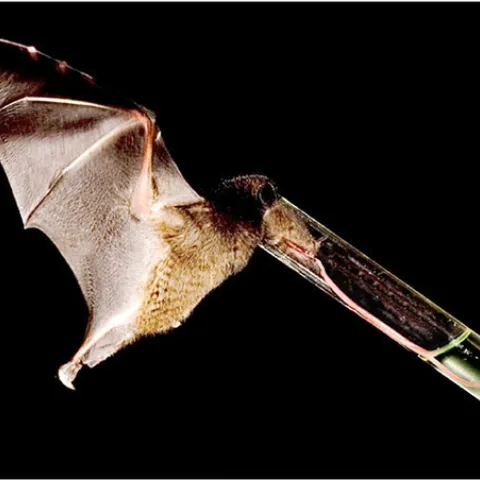
Nectar-feeding bat with a record-long tongue sips sugar-water from a tube. (Photo by Murray Cooper; photo courtesy of Nathan Muchhala)

Now That's a Pollinator!

May 23, 2012
By Kathy Keatley Garvey
Remember the news published several years ago about a scientist who discovered a two-inch-long bat with a tongue longer than its body, so long that it had to tuck it into its rib cage?
View Article
Primary Image
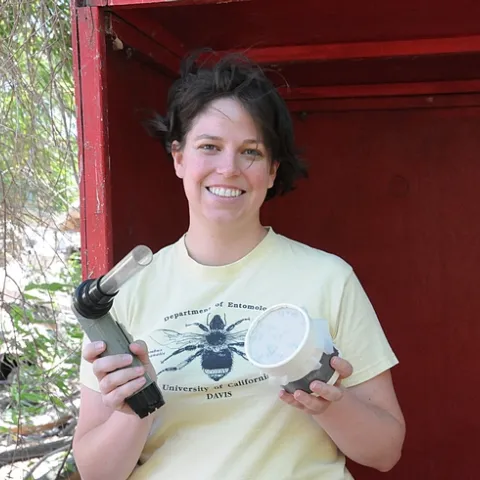
Tara Thiemann is researching bloodfeeding patterns of Culex mosquitoes. (Photo by Kathy Keatley Garvey)

The Hostest with the Mostest

May 22, 2012
By Kathy Keatley Garvey
You're sitting in your back yard or at a park and a mosquito bites you. You're the host whether you like it or not. You just hope that this isn't an infected mosquito that can transmit West Nile virus (WNV).
View Article