Bug Squad Logo

Bug Squad

Bug Squad blog image depicts a honey bee sting in action.

Welcome to the Bug Squad blog! The Bug Squad blog was launched Aug. 6, 2008 and is a daily blog (Monday through Friday). It showcases entomologists and the work they do.  The blog focuses on scientists in the UC Davis Department of Entomology and Nematology, the Bohart Museum of Entomology, Harry H. Laidlaw Jr. Honey Bee Research Facility, the UC Davis Bee Haven, and assorted campuswide events, including UC Davis Picnic Day, UC Davis Biodiversity Museum Day, and Bohart Museum open houses. The blog spotlights insects, including bees, butterflies, dragonflies, and praying mantises, as well as arachnids such as jumping spiders and crab spiders. Author and photographer is Kathy Keatley Garvey, communications specialist, UC Davis Department of Entomology and Nematology, and a longtime journalist and community scientist with two degrees from Washington State University.  She is a member of the Entomological Society of America (ESA) and the Association for Communication Excellence (ACE). Her blog posts and images have won international awards from ACE and ESA and appeared on journal and magazine covers. She shoots primarily with a Nikon Z-8 mirrorless camera, a Nikon D500 and Nikon 800, with assorted macro lenses. Feedspot lists it as one of the top entomology blogs on the Internet. 
Primary Image
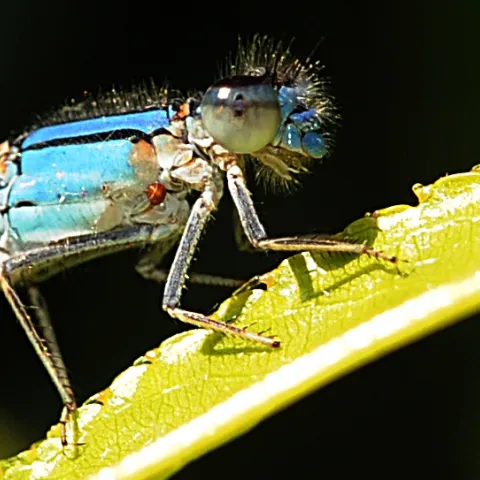
Blue damselfy resting on nectarine leaf. (Photo by Kathy Keatley Garvey)

Up Close and Personal

August 10, 2011
By Kathy Keatley Garvey
Up close and personal, those blue damselflies (suborder Zygoptera, order Odonata) look prehistoric. Fact is, they were here before the dinosaurs. These needlelike insects add an iridescent presence as they fly awkwardy over our fish pond, catching prey.
View Article
Primary Image
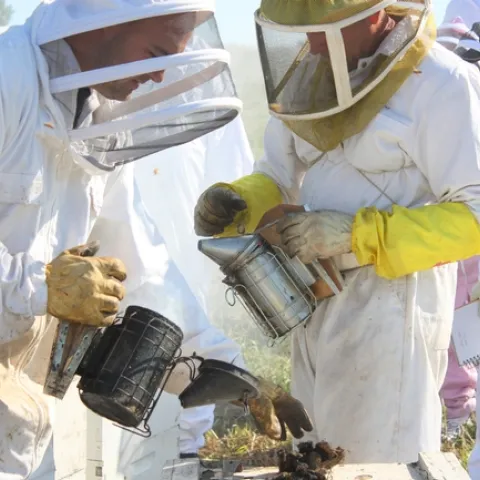
Beekeeper John Miller (right, with yellow gloves and smoker) tending his hives. Copyrighted photo, 2010, by Melody Owen, used with permission.

The Beekeeper's Lament

August 9, 2011
By Kathy Keatley Garvey
The Beekeeper's Lament: How One Man and Half a Billion Honey Bees Help Feed America should be required reading for anyone interested in honey bees, crop pollination and migratory beekeepers. Award-winning journalist Hannah Nordhaus tells the story of migratory beekeeper John Miller of Gackle, N.D.
View Article
Primary Image
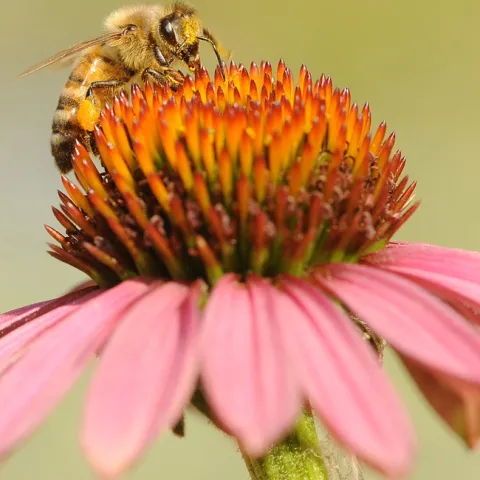
Honey bee on purple coneflower. (Photo by Kathy Keatley Garvey)

Nothin' Like a Cone

August 8, 2011
By Kathy Keatley Garvey
There's nothing quite like a cone--no, not an ice cream cone. A purple coneflower. The purple coneflower (Echinacea purpurea, family Asteraceae), looks like royalty in the Hagen-Dazs Honey Bee Haven at the University of California, Davis.
View Article
Primary Image
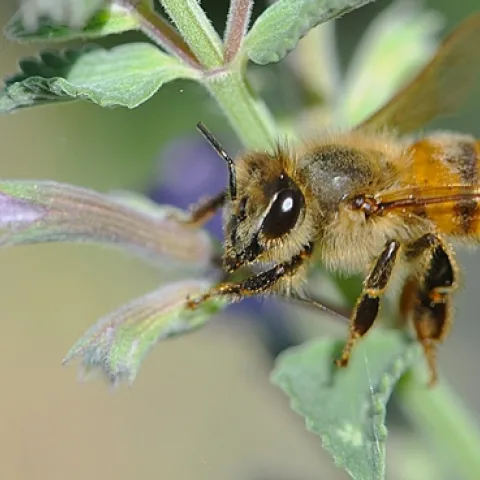
Honey bee working the catmint (Nepeta). (Photo by Kathy Keatley Garvey)

Cooperative Bee

August 5, 2011
By Kathy Keatley Garvey
If you want to attract honey bees in your garden, you can't go wrong by planting catmint (genus Nepeta). Honey bees like the mints. So do cabbage white butterflies, wool carder bees, carpenter bees and hover flies, among other insects. Nepeta is easy to grow.
View Article
Primary Image
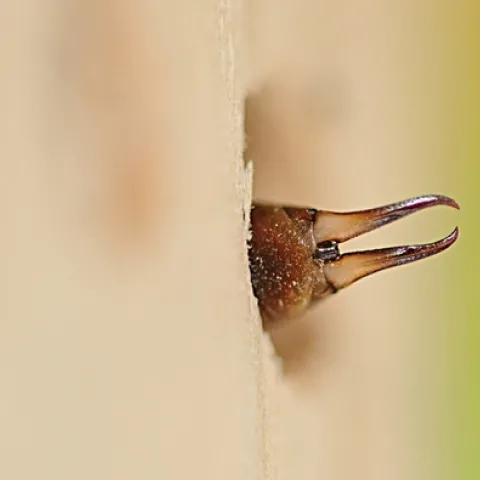
Earwig inside a blue orchard bee condo, which has larger holes than one for leafcutting bees. (Photo by Kathy Keatley Garvey)

Home Invasion!

August 4, 2011
By Kathy Keatley Garvey
When you install bee condos--those wooden blocks with holes drilled in them to attract nesting native bees--sometimes you get the unexpected. Like earwigs! Home invasion! Home invasion! We installed two bee condos, each about the size of a brick, in our yard.
View Article